Friends’ Stories and 60th Birthday Wishes trom 2004
Karen Roper (Introduction and the Engagement)
Aaron Roper
Virginia Roper
Steve Allaback
Don Avriett
Don Beavon
Fred Beavon
Mitch Blanton
Bob Bolton
Kal Brauner
Brad Bromling
Norm (John) Burke
Maurine Butterworth
Amy Carlson
John Childrey
Marshall Eaton
Stefan Feller
Bette Felton
Steve Fry
Don Goodman
Warren Guntheroth
Ray and Diane Hazen
Ted Hegg
Jeff Howbert
Charlie Janeway
Ken Jones
Dick Kegel
Dallas Kloke
John Lixvar
Ian Mackay
Ann Marshall
Joe Medlicott
Mick Newhouse
Rose Lochmann
Mark Owen
Bob Packard
Jim Pinter-Lucke
Austin Post
Don Potter
Howard Putter
Tom Rainey
Jim Richards
Dusty, Toby and Christina Steere
Grady and Nigel Steere
Monte and Ellen Steere
Tex Steere
David Stonington
Jani Stonington
Mike Torok
Diane Zehnder
Sue Zook
Introduction by Karen Roper
Written January 2004
John Roper was conceived in the North Cascades, the place where his obsession began. He grew up in Newhalem, Washington, the heart of what is now the North Cascades National Park, and graduated from Concrete High School in 1961.
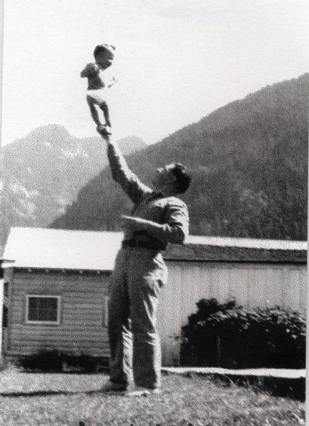
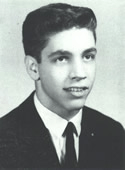
In 1944, Newhalem was a bustling hydroelectric energy town, home of Seattle City Light’s Gorge Dam and Powerhouse Project on the Skagit River in Whatcom County. It was also home of Jack Roper, who came to supervise first Ross, then Gorge and Diablo powerhouses at various times, and Virginia Roper, the City Light camp nurse. The nearest hospital was a small facility in Sedro Woolley, nearly 55 miles away. With their first born on the way, Jack and Virginia traveled to Seattle for John’s birth on January 14, 1944.
John grew up in the shadow of the mountains, listening to their siren’s call. So much virgin land; so much rock and ice and snow: Could his be the first human foot to walk there?
He began hiking summits when he was 9 years old in 1953, doing venerable Little Si, on his first “camp away from home” with the Seattle Boy’s Club, out of Camp Wascowitz near North Bend. Then came Sauk Mountain in 1956, then a first “kids only” trip up Newhalem Creek in 1958 (age 14), and a serious adventure into the wilderness to Azure Lake in 1962 (age 18) with cousin Monte Steere, a prize destination still rarely done even now in 2004, 42 years later.
On June 15, 1963 , at the age of 19, John climbed his first honest wilderness North Cascades summit, Trappers Peak, a 5964-foot mass of trees and stone and snow, overlooking his hometown of Newhalem. It was a challenging and beautiful adventure where the views were spectacular. He was hooked.
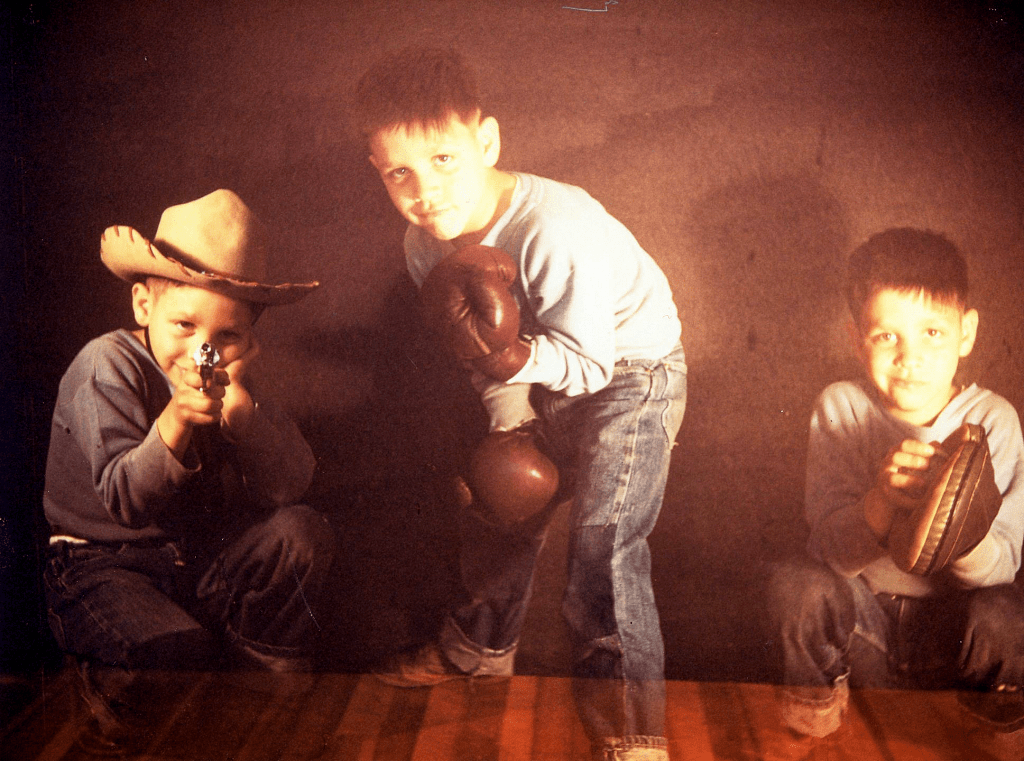
Driven by the need to explore the pristine territory that surrounded his home, John began a lifelong quest for unclimbed peaks, overlooked challenging beauties and beasts. He determined to know and understand every facet of his mistress, studying the maps, elevations, and geography, geology, climbing history, nomenclature, Native American history, indigenous species, rivers, every part of her.
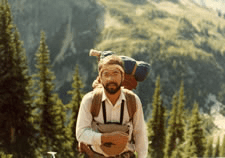
As his knowledge has grown, so have his horizons and his goals. He devises and revises his goals, and considers others’ various lists and ways of classifying this territory and state, targeting all peaks within selected boundaries, distinct peaks determined by accepted rules of separation, named geographic features within specific river drainages, county high points, and whether or not it “looks” like a worthy summit. There’s always another goal, a new challenge.
Climb on, JR.
THE ENGAGEMENT
John has his version of climbing Grassy Point. I have mine. Though it occurred many years ago, some parts of the trip are etched in my memory forever; some I’d just as soon forget.
On August 26, 1988, John and I got to bed late, with me in limbo wondering where our 3-year relationship was headed. I wasn’t in on John’s plan.
The morning of August 27 dawned breath-takingly beautiful, destined to be a scorcher, at least we assume that it did, since by the time we drug ourselves out of bed it was well on its way. John was on a quest to pick off every named peak (as well as those that weren’t named) in the Skagit drainage. I was just along for the hike.
With our late start, it was already warming up as we walked across the Suiattle River on a wide bridge near road’s end. A pale lavender-blue butterfly that perched on my shoulder seemed a good omen for things to come. I hoped so. I don’t like hiking in the heat, the trail promised few spots of shade or water, and we weren’t carrying enough fluid with us. It took me years to learn that, if I wanted to hike with John, I needed to bring at least twice the water he recommended.
The trail stays flat for a long while – maybe a mile or two – then begins to switchback its way up for some few thousand feet. As we began to climb, I paused to put on shorts and a halter, which, contrary to popular climbers’ beliefs, substantially reduces my susceptibility to sunstroke. Unfortunately, shorts and halter provide no protection from the swarms of deer flies that accompanied us, and the nasty little bugs love me. We only walked a few feet before I knew I wouldn’t survive. In my pack I carried only loose, cotton pants – suitable protection for my lower half – and a polypro turtleneck and sweater – impossible in the heat. I put on the pants and concentrated on murdering as many of the creatures that plagued me as I could. Each slap took out 7 or more. It wasn’t enough, but it helped, if only through the psychology of revenge.
We slogged through the heat and flies for what seemed like miles and miles, me in abject misery thinking it would never end. John tried to be encouraging – but, as everyone knows, he has an optimistic view of the truth. He kept saying we were nearly there. How can “nearly” last so long?
Eventually, we could see the slope flattening out. Bright-colored fabric hanging in the trees above became a beacon signaling a plateau. The fabric appeared larger and larger as we neared, and we began to wonder what it could be. Oh . . . parachutes. Then smoke. Gaining the ridge, we saw spot fires . . .and fire fighters, one of whom apologized for “ruining our wilderness experience.” I was ready to turn back, but John shrugged it off and pushed on. He had a plan, after all. Watching the huge bucket of water flown in by helicopter emptied over errant flames was fascinating.
Beyond the ridge, in full view of the glacier, the temperature dropped and the flies thinned. John had a particular campsite in mind where we headed. Unfortunately, it was taken. We selected another site in the smoky breeze, and made camp. I relaxed. I had survived. I thought the worst was over. I was wrong.
John lit his camp stove and started dinner. Dinner with John in the mountains is never gourmet, but it does the job . . .at least usually. This time, about half way through boiling our mixture of Top Ramen flavored with split-pea soup the gasket on his stove blew, shooting flames in the air. Dinner was crunchy and barely edible. We’d planned oatmeal for breakfast, so we added water to it then let it soak over night. I went to bed, ready for this day to be over.
But John had plans. Unfortunately, the moon took its time in cooperating. Finally, close to midnight, the full moon lit the icy cirque above us. John dragged me out of my sleeping bag, insisting I take in this spectacular sight. I wasn’t interested. He insisted. Finally, though somewhat cranky and tired, I stepped back into my boots, crawled from the tent, and admired the view. He proposed. I transferred my gaze to him, said “yes,” then went back to bed. I may have been surprised and cranky, but I wasn’t about to let him off the hook after three years together. And it was a pretty romantic setting.
The next day looked better. The smoke had dissipated, the day seemed cooler, the flies were nowhere in sight. We packed up, after gulping down our soggy, cold oatmeal, and headed toward Grassy Point. A short time later, John mentioned he had an ancillary goal – Is anyone who knows him surprised? – that he’d neglected to mention earlier. I could either come with him, or hang out in the meadow. I chose the meadow, and laid back watching and listening to the marmots at play. Two hours or so later, he returned successful and ready to go on.
The final goal was in sight . . .or so I thought. We went up. The sun moved high. We went down. It was getting hot. We went up. The flies were back. We went down. I was volubly complaining. We went up. . . I don’t remember how many ups and downs we made. John had sworn it was just another thousand feet of elevation. He didn’t mention we’d have to repeat it several times. I was not a happy camper. I was sick of this whole trip. Finally we reached the point. I didn’t care.
Then, he gave me a choice. We could either go down (and up, and down, and up, and down, and up, and down. . .) the way we came, or we could drop off the side – “Here, look at the map.” – and head straight for the Suiattle River . It seemed like a no brainer. No truer words were ever spoken. I must have had no brain to accept that alternative.
Down, down, down we dropped nearly 4,500 feet down an evergreen- and tree needle-covered cliff, my soft trail boots sliding all the way. (John’s much heftier climbing boots dug in.) Luckily there were so many trees to slam into that I never got out of control. Unfortunately, the trees were hard and rough, and my bruising and jarring were significant.
I was tired. I was cranky. I was unhappy. I was whining. I needed a break.
My husband-to-be was nowhere to be seen, but a barely audible response to my “hoot” came through. He – reluctantly – agreed to wait for me. I found him 20 minutes later resting on a log. I dropped down next to him and immediately jumped back up screaming. He looked totally disgusted. “What?!!” was his sympathetic query.
“I got stung,” I yelled.
He rolled his eyes in disbelief.
A minute later he saw the swelling on my arm and had the grace to admit it did, in fact, look like a yellow jacket sting. (“Thanks for your confirmation, honey.”)
After another 5 minutes he looked at me expectantly. “Are you ready?” he demanded.
The argument doesn’t bear repeating. At least that gained me another few minutes of immobility. But, all good things must end.
We continued on down the slope, with him again leaving me far behind, and finally came to a wide swath of devil’s club, indicating the river’s presence. Devil’s club was nothing at this point, and we gamely batted our way through to our first look at the river.
Oh. My. God. How did that little creek become such a raging torrent? And, how are we ever going to cross it?
The Suiattle, fed by melting glaciers in the August heat, had easily risen 2 to 3 feet. It roared passed us without sympathy. Not a single log or gravel bar (or even a rope swing, for God’s sake) offered any encouragement. To our left, downstream, the way we needed to go, our way was blocked by a 200-foot cliff. Upstream, devil’s club grew as far as our eyes could see. Since I was too exhausted to even look at the cliff, we chose the devil’s club and prayed for a well-placed log. Half a mile later, there was none, and the day was getting late.
John, the king of chivalry, made this offer: “I have to go out tonight. People will worry if we don’t come out and I have a full slate of patients tomorrow. I’ll help you set up the tent and leave you our food (about a tablespoon of stale peanuts and a cube of sun-baked cheese), then I’ll go on out, call my folks and let them know we’re okay, and go to work tomorrow. By then it will be too late to come back that day, but I have the next day off and then I can come back to get you.”
Leave me two nights in the woods without so much as a trashy novel? Not a chance.
I followed him up the cliff, the whole time listening to his arguments in favor of his plan. On the other side we could see a gravel bar, but still no log. His arguments grew more forceful.
It was a brush bash between us and the bridge, about 3 miles downstream. We were rapidly losing light, I was tired, and he knew I’d never make it.
Lips compressed, teeth grinding, I continued to walk. As he argued and I walked, we came upon a 100-foot log, extending all the way across the river. It wasn’t a perfect log. It could have been more substantial. It might not have had such loose bark. And it really would have been better if the water weren’t splashing up on it so much. But, it was a log, and I fully intended to cross it.
John can walk across anything. He went first. I’ve always suspected that if I hadn’t followed he would have kept going. But, he encouraged me to sit on my bottom and scoot across, or crawl on my knees, and he’d come back for my pack. I flashed him one look of loathing and started walking.
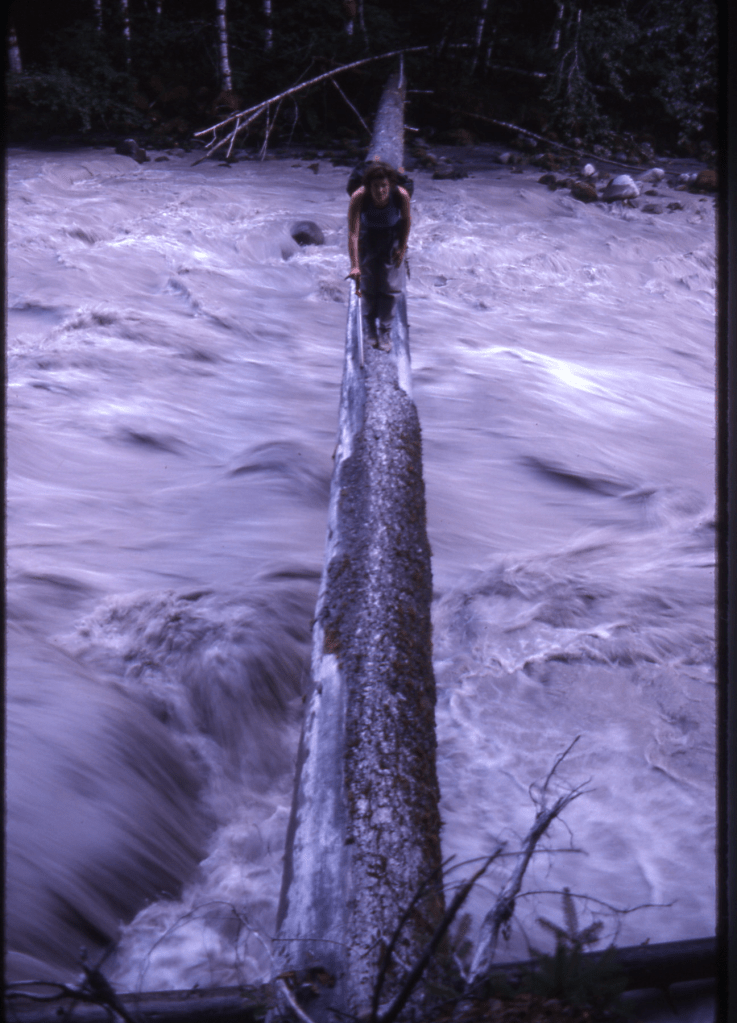
Anger is a wonderful thing. I had no doubt. I had no fear. Anger filled every part of my being and I walked solidly across the log above raging waters. In the middle of the crossing, I looked up and stated, “I’m still going to marry you, but I will NEVER hike with you again.” He snapped my picture. That photo – now framed on our wall – won a first-place award from the Boeing Alpine Society. I completed the crossing and made it to the trail on the other side as darkness fell.
We made it to the car in another hour and headed for home.
Yes, I still married him, and, believe it or not, I’m not sorry.
Occasionally, I still hike with him, but only with plenty of witnesses. (I may love him, but I’m not a masochist.)
After now more than 40 years, I do love you, John. Truly.
Karen
Aaron Roper
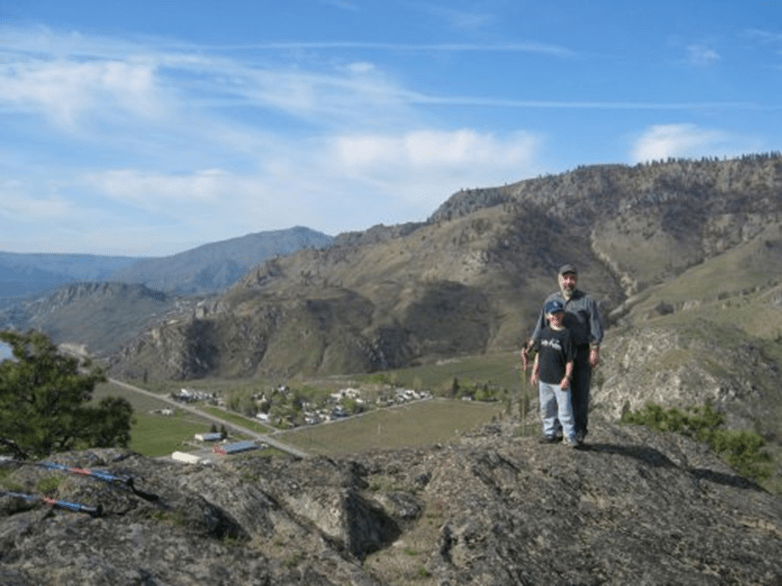
My father, John Roper, took me on my first climb when I was three weeks old. It was a nearby hill called Cougar Mountain. I have been on many climbs with him since. For example I now go with my father on all of my grandfather, Jack Roper’s “last mountains.” I also now do an annual climbing trip to eastern Washington with my father and his friends Jeff Howbert and Austin Post. My father climbed his first mountain when he was a year younger than I am now. In the same time it took him to climb one mountain, I climbed at least two hundred.
Aaron Roper Age 10
Stardate 2004.01.14
Virginia Roper
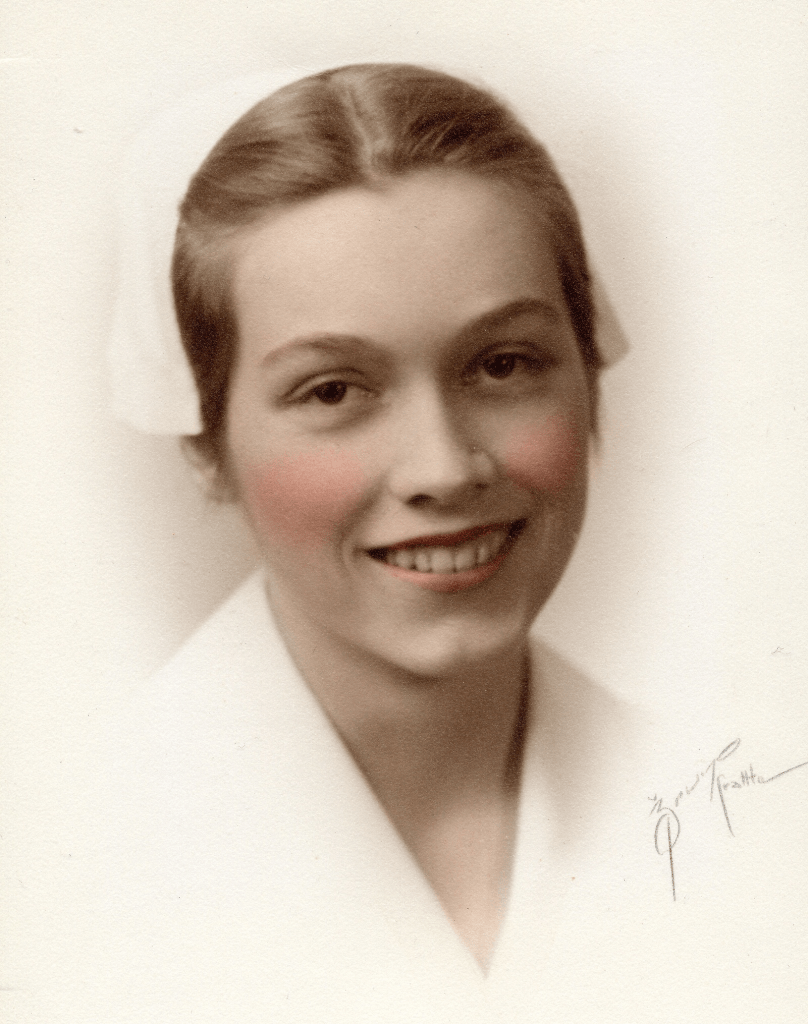
John Walter Roper was born January 14, 1944 in Maynard Hospital in Seattle – a much-wanted and loved baby. We had just received word on Dec. 24, 1943 that my brother Walter “Bud” had been killed at Tarawa in November. John filled a big void in everyone’s life.
Your childhood years were all spent in and near Newhalem (Diablo, 1 year) at the Seattle City Light Project. Your Dad, Jack started as an operation helper and advanced to many years as Power House Supervisor, spending time at Ross (which he put on line), Diablo (and cleaned it up into a show place), and Gorge, where he spent most of his years.
I, Virginia, your Mom, spent a full and happy life as a nurse on the project, school nurse, substitute teacher, PTA president, Sunday school teacher and superintendent, home nursing trainer during WW II.
In 1949, your sister Virginia Maurine joined the family, another cutie. She followed you around like a puppy, but 5-1/2 years’ age difference made for a no-rivalry sibling.
From the beginning I knew I’d never be able to climb mountains with John, but I could participate: Blueberry pancakes at 2, 3 or 4 a.m. (whatever the schedule) were put out to give the climbers their first burst of energy. Thousands, I must have made. On the return trip, I offered a soak in the tub or a hot shower. Mickey Newhouse says I saved his life by saying, “Go take a hot soak.” After the climbers had relieved some of their aches and pains, dinner was ready and a bed available if they chose to stay.
Many of John’s hiking buddies have been friends of ours for a long time.
Thank you, John, for sharing your love of the mountains.
Mom
(Virginia Roper)
Bill Affolter
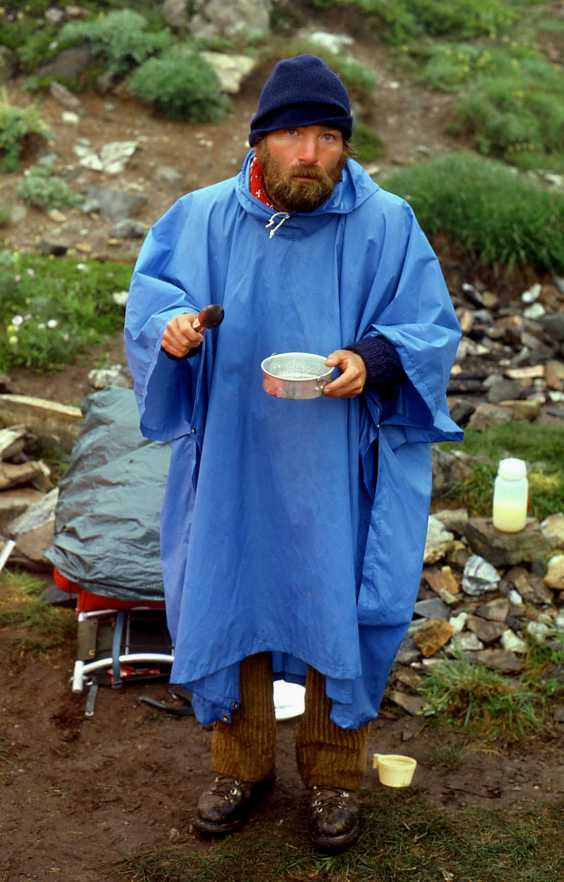
Lost? Or Possibly Misplaced in the North Cascades
So here’s a John story. It must have been the summer of ’74 when John asked if I’d be interested in doing the Ptarmigan Traverse–a classic route in the North Cascades–like where else? I fancied myself a budding mountain man and knew I’d be in good hands with John as leader so I jumped at the chance.
John, myself, John’s then wife Terri, and an east coast buddy of John’s, Alex Medlicott were the team.
We started by traversing a steep snowfield east of Cascade Pass. I thought it was steep anyway though I don’t think John was particularly impressed with it. We then came to the White Ledge. This was a narrow ledge that offered possible death if one slipped off it. We didn’t slip. Then, just as my sphincters were beginning to relax, we came to the Red Ledge. This was a narrow part of the trail that offered certain death if we slipped so I think we actually roped up for that one. At least I did. I was starting to rethink this trip when the fog hit as we were crossing a snowfield directly across from Mt. Furious or Mt Nasty or Mt.Terrible or one of those. I do remember it was a dark jagged forbidding–maybe that’s it Mt Forbidden, anyway I remember hearing frequent avalanches the next few days from its slopes. I say the next few days because the fog never lifted for 4 days and we simply sat and waited, not sure what was above us or below us, though we were more worried about what was above us since we were camped in the middle of a modestly steep snowfield. Anyway I remember we spent many hours trying to talk ourselves into the fact that the sky was getting lighter by a lumen or two when of course nothing at all was happening. Waiting paid off though and it finally cleared although we were now way behind schedule. We were with the Legend of the North Cascades though, so we knew we could stretch the limits and continue on.
It was a great next 2 or 3 days and be bagged a couple of peaks and had a couple of great campsites and eventually were poised for a long but very doable last day’s hike out.
We got up early and started up a long glacier-snowfield to whatever the last pass was. I’ll bet John remembers the name (and the elevation, and the peak to the north south east and west and the drainage, etc., etc.) When we got to the top however our leader was perplexed because we were 200 feet too high or low whatever to be at the right place. This was worrisome, but what was stranger still was the fact that our compass was off by a few degrees. This, through the retropectoscope might have given us pause, but John was not about to be second guessed by a couple of crude instruments. Press on! he ordered and of course we did, over the pass and down an increasingly steep and treacherous slope. The fog was so thick we couldn’t see above or below but we had faith and on we went. At some point Terri started to become hypothermic so we knew we needed to get down so we finally glissaded the last few hundred feet into the unknown, not unlike Shackelton’s loyal crew on South Georgia.
We finally found ourselves on a wide glacier ringed by high peaks and not apparently where we thought we would be. We anxious looked to John for guidance. John meanwhile had pulled out the maps and was with an air of should I say, mild concern, trying to figure out where the hell we were.
After consulting his errant compass and altimeter and turning the maps this way and that he announced that we were probably, I stress the probably, on the Spire Glacier. He also noted that we would have to stay the night, a foregone conclusion at this point and try to make it out over that pass, he pointed to a pass or what could be a pass at the top of the glacier. When we asked if he were sure it was passable he grunted something that no one heard or maybe wanted to hear.
That night since we had run out of food we each ate one of our boots. Or was that another trip–anyway it didn’t matter, we had put all our hopes on John’s navigational skills even though our faith was slightly shaken by the day’s events.
It should be no surprise to hear that when we came to the “pass” with some trepidation the following day (maybe that was the name of that peak – Mt. Trepidation), we emerged on the other side exactly were John had predicted. We practically skipped the next fifteen miles to the trailhead and waiting car, where we quickly tore up and ate the leather seats.-or was that another trip.
So that’s it. Now I’m not saying John got lost on that trip–that’s close to heresy I know, but maybe he got like confused or something. Anyway it was a rare and memorable trip and I wouldn’t have missed it for anything and if it weren’t for the Red Ledge I might even do it again.
Bill Affolter
Mark Allaback
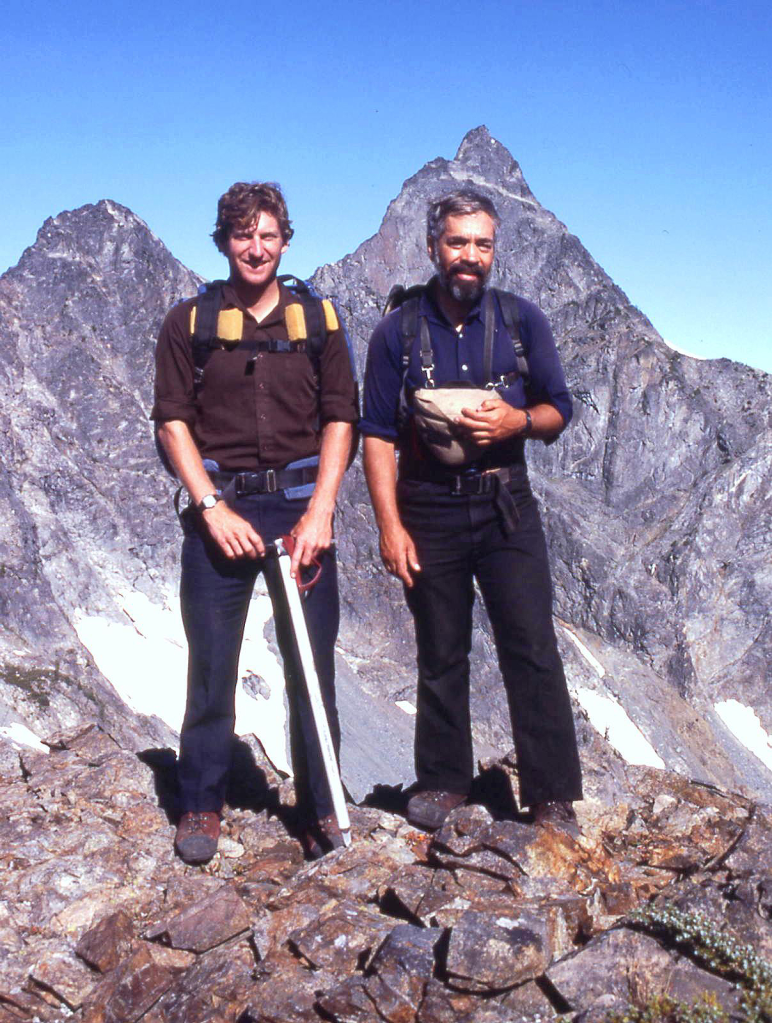
I suspect that most people only have a few good teachers during their lifetime. It is even rarer for a teacher to become a friend. John Roper is a special friend, indeed. Where do I start? Although we rarely spent more than a week or so together each year, it was always memorable because it was always an adventure. The man has been an integral part of my life for at least 20 years, spanning three decades. And who knows what the future may bring along with Aaron? There are at least a few new routes left in the mighty Cascades.
I first met Roper when I was 15 (going on 16) in 1977. He had heard that Alex Medlicott, my Dad and I had been visiting the Diobsud Lakes for a few years and offered to tag along and then take us beyond. Whenever anyone stepped off the trail in the Cascades, he seemed to know it. Although born in Seattle, I mostly grew up on the beach in California and I had never climbed a mountain before. I was skinny and small: grew 3 inches after high school. But I was also tough and athletic and sports were always part of life. The idea of visiting the remote Cascade Mountains certainly seemed like an adventure. It started easy enough, trail to Watson Lakes, then cross-country along a route I’d done twice previously. It was always a long day that ended by dropping into the Diobsud basin. We whacked fish, probably just before dark, since I would soon learn that Roper wasn’t the type to lay around all day fishing.
We left the Diobsuds to climb Bacon, a peak near Berdeen Lake and one of the Hagans. Roper led, Dad stayed in the rear to keep Medlicott and me in place. At first, cross-country travel in the Cascades was anything but easy. Not long after leaving the lowest Diobsud Lake, my Dad and I were trying to keep within shouting distance of Roper while side-hilling through wet, 7-foot high brush. This wasn’t the dreaded vine-maple under-story we would encounter so often in other areas, but a near wetland on a steep slope where every piece of vegetation either scratched or was otherwise worthless to grab for support. It was comical. My Dad and I wallowed in our heavy Levi’s, falling constantly, filthy and soaked with sweat, simply unable to follow Roper’s smooth lines. I had a bulky frame pack that kept catching the brush and knocking me down. Just when we caught sight of Roper he would disappear. It was damn frustrating but we kept our complaints to ourselves. My pack frame hooked on a branch at one point and I did half a summersault and landed on my back head facing downhill; Dad picked me up and managed to break the agony by cracking some joke. When we finally broke free of the brush into a heather meadow, Roper was already hundreds of feet away ascending a huge snowfield. Other than a few dirty patches between Watson Lake and the Diobsuds, Dad and I had never really walked on snow. In fact, we tried to avoid it.
But Roper charged on. And I realized that by following his footsteps in snow there was no reason why I should fall if he didn’t. Indeed, by watching him closely, even imitating his body language, I ought to avoid any slips he makes and reap a significant benefit from following. It seemed to work. He probably slowed for me, but I caught him on that snowfield, and once I became his shadow and fell into his pace, everything was easier. And to be free of the brush! In later years, I would shadow Roper in all types of terrain and I truly was fortunate to receive a crash course in cross-country travel.
That night was my first up high in the Cascades and I do believe I was hooked: so little human disturbance, such difficult terrain; I felt so lucky to be out there. But the body was getting a bit beat up. And Roper’s pace was relentless. It was years before his ceaseless efforts, dawn to dusk, became normal to me such that hanging around a lake or sleeping late seemed silly. The next morning Roper gave us our first lesson on glacier travel and we walked up Bacon, my first peak.
We had another amazing high camp above the bugs and brush near Berdeen and Green Lakes, even a bit of fishing, then I do believe we bagged a first, or maybe a second, ascent of a peak over the lakes. Roper let me go first, photos were taken, ice axes raised. Roper gave the experience a sense of adventure and carefully recorded our history. A summit register was left behind, the first of many. Roper said that if the pleasure is just a little better than the pain, it is worth doing, worth climbing. He suggested that I collect a bit of rock, something that represents the specific peak we climbed. No two pieces of rock are exactly the same, right? The weather was perfect and so was the vista. Roper started naming every peak in all directions, pointing out possible unclimbed summits for future trips, the ridges he had run and others that he would surely visit. Early on, I noted that he was clearly doing what he loved.
Later in the trip my Dad and I got hung up descending off an arm of one of the Hagans. Even Roper hesitated above a high angle snow chute but he said nothing before literally jumping into a steep glissade that really amazed me. Again he looked smooth, in control. We had played around with the technique a bit but not in any real steep areas. I hesitated, turned to Dad and he said just sit down. I think Roper shouted after he saw me make the mistake but I lost it down that chute, out of control, then quickly safe into a soft run-out. Although it was probably only 75 feet or so, the helpless, frantic feeling of a fall was nothing I had ever felt before. And there was that ice axe to worry about. But Roper had selected the spot carefully, knowing that whatever happened would likely turn out okay. He quietly but firmly told me never to sit down while glissading. (“Yeah, yeah, but Dad told me.”). Unfortunately, I would take 2 or 3 more out of control falls on snow and ice over the next 20 years.
That first trip with Roper seemed to have a little of everything including a brutal last day descending below timberline. Roper seemed to think that there was a trail somewhere, but maybe it was a running joke, since we spent a terrible last day beating brush. The previous night’s rain didn’t help. There was no trail. There was thick brush, steep slopes and endless windfalls. Near the end of the day we made it to a river crossing, one of the big drainage basins near Mt. Baker, and I had to really fight the current to make the crossing. Maybe it was easier for the adults but I doubt I weighed more than 130 lbs.
Roper invited us back every year, a true compliment for a couple of guys from the beach in California. We were happy to go wherever John wanted. He seemed to save many unclimbed areas for us. They may not have been interesting to most climbers since they were mostly scrambles but I felt honored to be walking where others had not. Hell, I could climb the other peaks whenever. I knew Roper was doing something special, one step at a time. And each year he carefully exposed me to more technical climbs such that by the 1990s I was doing a bit of leading. Although I had some natural ability, I did not live and breathe climbing: I was a beach person, a surfer, baseball and basketball player. This wouldn’t be much of a problem until the climbing got serious.
It wasn’t long before my Dad’s knees failed him but I kept returning each summer in August or September. There were times when I had absolutely no money after the plane ticket, but Roper made it easy by taking care of everything once I arrived. We often went straight from the airport to the mountains. He had all the food figured out, including extra cheese and pita bread for me. There was always extra gear if I needed to borrow anything.
Roper’s ability to keep going, all day every day, dawn to dusk, was something I had never experienced. It seemed normal for him, so it had to become normal for me or I wasn’t going to make it; I wasn’t going to be asked back. I learned to see little routes through walls of brush. I learned to look down a ridge and not get intimidated at the formidable terrain ahead. For a few years on bad days in endless snowfields riddled from exhaustion, I counted steps, which was not a sane way to be. I overcame the false summit conundrum. Roper really tested me a few times early on, especially up along the Canadian border near Mad Eagle Peak and Bear Mountain in 1979, a trip that was also tough on my Dad. I remember reaching a flat spot high on a ridge maybe an hour and a half before dark after a grueling day, which included our first ascent of Mad Eagle. Dad seemed to collapse and I felt wasted. But Roper asked me to grab my fishing pole and ice axe since we needed to check out a lake just out of sight on the opposite side of the ridge [Depot Lake]. The good news was that we were able to glissade much of the descent and a snowfield led all the way down to the lake. But I remember my legs shaking badly from exhaustion and holding the glissade position was difficult. The bad news was that the ascent back to camp was between 2100 and 2500 feet and it was almost pitch dark when we got back. I was too tired to speak. We didn’t catch any fish but Roper thought he saw one. Later on that trip I remember being so tired late in a day that I wished my leg would break just so we could stop.
In 1986 that unfortunate wish came true. Roper thought I was ready to enter the Southern Pickets with the hotshot climbers. He was mostly right, I was strong and tough, but still not comfortable on high angle snow. I have since realized that steep snow requires significant skill, which is only acquired through experience: innate coordination and nerve can take one only so far. There are all types of snow and the conditions can change quickly. Anyway, the Koala, Rhino and I crossed a snow bridge to reach rock, and the route led back into a snow chute with a bad runout into an abyss between rock and ice. I started punching steps up steep snow and felt strong, but was undoubtedly moving too fast; we were not roped. It happened so quickly: I reached up with both hands overhead to plunge my axe, then went over backwards, headfirst. Did I lift a foot at the same time? Regardless, I was out of control and heading into a bergschrund less than 100 feet below. I knew I had to hit rock on one side of the chute to have a chance to slow down or stop so I kicked my feet desperately to fall at an angle. Thankfully, I suppose, I hit rock and stuck, slammed my helmeted head and bent my ankle inward so severely that the fibula broke on the outside just below the knee. Roper packed my ankle in ice, left me on a nearby ledge and finished the ascent with the Koala. I fell asleep, woke up by rock-fall in a whiteout. The weather went bad but the Koala and Roper orchestrated a fairly advanced rescue to get me back on snow and then out via helicopter late the next day. It was very humbling to be taken care of by so many people.
We ran a lot of ridges and bagged a lot of peaks together. There are lots of stories to tell; lessons were learned. Roper helped me grow up. I really do miss the sport and the Cascade Mountains. But it takes time and dedication and it helps greatly to live in proximity to the peaks. I am grateful to John Roper for teaching me how to be a mountaineer and bringing me into his world. His accomplishments speak for themselves. Happy 60th Birthday my good friend John, I sure miss you!
Mark Allaback
Aptos, California
2 January 2004
Steve Allaback
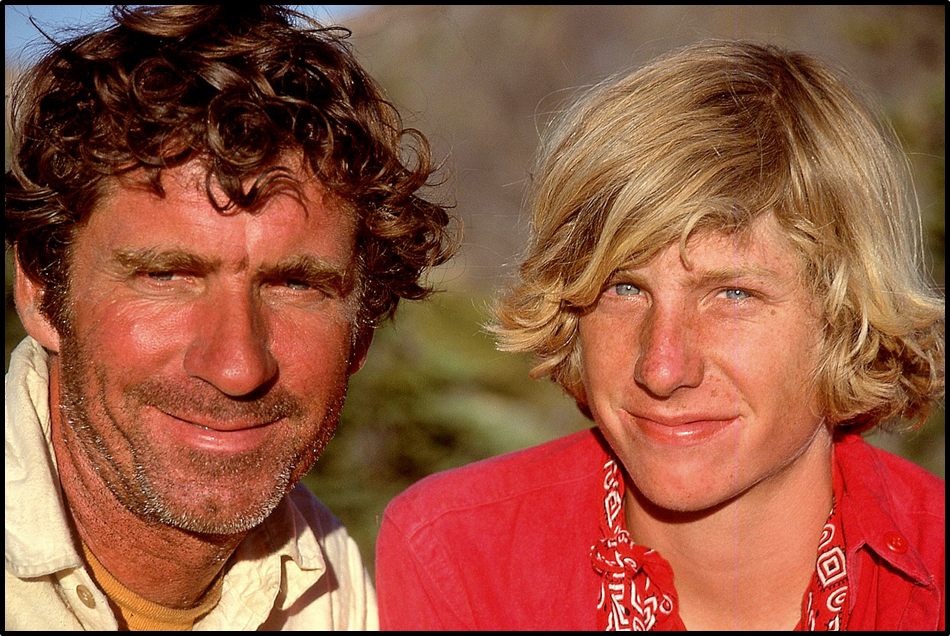
It’s Never Bad in the Mountains
They had met us at the airport and now we were all together again. Rogers and I in the front seat of his Fiat, Melly and my son Mark in the back. By sunset we were passing through Everett. At Newhalem we would spend the night with Rogers’ parents and there Rogers would lay out his plan. Everett, smelling as usual like paper bags, is where one receives his first long look at the ominously serrated peaks of the North Cascades. The others exclaimed, and so did I.
“Beautiful,” I said, “just beautiful”—but I did not feel their beauty. Something closer to despair or loss was what I felt, though it wasn’t quite either of those. Whatever it was, it included fear, plain old-fashioned fear.
We had spent four hundred dollars we couldn’t afford to fly from California to Washington State to put ourselves through this ordeal once again. Why? Hadn’t last year been bad enough? Not all bad, no. And when I turned around to smile at Mark—“How about that view?”—I was reminded that these trips were one thing we did together, more or less together, which was strong and solid. For him it would evolve into a bank account of fond memories: mountain peaks, snuggling into sleeping bags, breaking out snacks, catching monster cutthroat, seeing goats, whistling back at marmots, being places where no one had ever been. But as I studied the shadowy snow-flecked peaks I also foresaw how in a few days one of those flecks of confetti—or one like them, several ranges farther back—would turn into a vast glacier up which we would make our way, and I would be worried, worried about slipping, losing my ice ax, losing the rope, pulling others with me, sliding, sliding, falling into the blue-black depths of a crevasse, disappearing.
“That’s Bacon Peak, that’s Mount Despair, and the nubbin is Green, then Hagen One and Hagen Two.” Rogers was showing off for Mark. “That’s near where we were last year, remember?” I could hear the excitement in his voice. He loved the prospect of what was before us. He loved it. He was born to it.
“Will it be as bad as last year?” asked Melly happily. He too seemed full of anticipation. At fifty-one he was old enough to know better. Last year, plenty of times, he was as frightened as I was. Had he forgotten?
“Bad?” said Rogers. “Bad? It’s never bad in the mountains.”
Melly laughed.
“Last year was a dog trot,” said Rogers , looking over at me. “Right, Peter?”
And I smiled back as if I agreed. For several years now Rogers had reserved his difficult, history-making trips for Melly, Mark, and me, his out-of-state friends—or acquaintances, rather. ( Rogers was not exactly a friend, but Melly was, and I met Rogers through him.) If he took Washington State climbers with him, his routes would no longer be secret. He had set himself the task of climbing everything in the North Cascades, and he loved the idea of subsequent climbers years hence finding his cairns on the most remote interior peaks.
“Right, Peter?” he asked again.
“Right.” I had come to a stop once last year on the side of a precipice. Clinging there, stone-still, the terror had been tangible: a flock of tiny gray birds landing on my shoulders and thighs, perching on my back and stomach, pecking at me, draining me of myself. I alone was all that mattered in the world. I even forgot about Mark, my son, my responsibility.
* * *
“A dog trot?” said Mr. Mellichamp. “You call that Bataan death march a dog trot?”
Rogers said he did. I wanted to ask what Bataan meant. Rogers was really teasing Mr. Mellichamp, putting him on. “Only a warm-up,” said Rogers , and then he predicted three first ascents for us this year. When he talked like that I knew we could do anything. It was fun to be with him and Mr. Mellichamp again. Even my dad was excited.
“And we’ll try the north side of Prophet too. It’s never been done.”
“Oh, no,” said Mr. Mellichamp, holding his forehead.
“Sounds good,” said Dad.
“It should be a classic,” said Rogers.
“Great,” said Dad.
* * *
I didn’t think Peter felt so great about it, though. Peter was like a man with a tumor saying, “Go ahead, Doctor, and operate,” hoping for the best. But last year he had never complained, none of them did. I don’t want complainers with me. I want cheerfulness. I see enough complainers. So I was glad to be doing it again with these willing amateurs. They took directions well, they didn’t hassle you about routes and techniques, and they lived too far away to give away my routes. Besides, Mark was someone you could teach. I couldn’t teach anything to Melly and Peter—they were too old and anyway were teachers themselves. Melly was an unbelievably happy man, and talk about cheerful, Christ, he’d smile if he were falling to his death. Knock on wood. Peter worried all the time but tried not to show it. He was a nice enough guy but not good for Mark. I really liked Mark. He wasn’t scared yet and was smart and plucky. Even if I only saw him once a year for a week or so, I could still help him. I could save him from his father.
* * *
When Rogers filled out the wilderness permit at the ranger station and under destination and route put “Southern Pickets via Little Beaver Valley,” the old man in charge laughed. “You mean fifty miles in the opposite direction, don’t you, Harry?”
“I believe in telling the truth, Matt,” said Rogers.
“You wouldn’t give your true route to your own mother. One of these days you won’t come out, Harry.”
“One of these days, Matt.”
The ranger shook his head. Then he and Rogers went on to discuss mountaineers they knew, recent expeditions, first ascents. All the while this weathered old man fawned over Rogers as if he were a movie star and not a Seattle physician. The same thing had happened that morning when we left Newhalem: Rogers honked at a man watering his lawn and at another washing his car and they both waved back with an enthusiasm meant for a celebrity. And when we filled up with gas at Ross Lake Dam the teenage attendant nervously asked, “Aren’t you Harry Rogers?” Mark took it all in. He kept giving Rogers furtive worshiping glances of the kind he used to give me when he was nine or ten. That didn’t bother me—a father can’t and shouldn’t be his son’s hero forever, and I had had my day—but what did annoy me was Rogers’ assumption that Mark never regarded me in that way at all. Rogers, twice divorced (you could see why: he was married to the mountains), manly as hell, did things a sixteen-year-old boy would admire. And yet, childless himself, he really knew little about sixteen-year-old boys. I could see he had some sort of plan for Mark this trip.
* * *
I had paid the widow who runs Ross Lake Resort twenty bucks to boat fifteen miles up the lake and drop us off. From here three days of bushwhacking would get us to the north side of Prophet ridge and a group of unclimbed peaks. No one I knew—and I knew them all—had ever taken this route before. No one.
After Mrs. Secord left us, we stood on the shore. I, Harry Rogers, owned it all. At first I saw each thing as separate: each peak, each trout gliding in the lake, each shade of green streaking the mountainsides. In a few minutes, once we were underway, it would all blend together and I could take it for granted as I led these interlopers up the mountain behind me. Then I could concentrate on simply Being here, and being in control of these mountains and these people—and whenever I wanted I could break the place into separate parts again and give an anatomy lesson: look at the Monkey flowers, look at the Devil’s Club, look at that ridge, that peak, that bird. I could name everything. So what if I was vain about my own powers out here? So what? What harm? Here I knew what to do.
* * *
We waited for Rogers to lead the way. He was a great guy. He was whistling as he rearranged stuff in his pack. I don’t mean he was fussy like Mr. Mellichamp, who had a place for everything and everything in its place. Rogers just dumped all his gear into this giant faded red pack. It was the biggest pack I’ve ever seen and it was custom-made and had a single giant compartment that opened down the middle. “Like opening a fat man’s gut,” he always said. He’d pull something out, hold it up, and look dumb. “Anyone recognize this? An inner organ? A spleen perhaps?” And it would be a piton or a can opener or something like that. Weird. Rogers laughed at us for having Keltys with ten zippers and pouches everywhere, but I didn’t care.
He got out his topo map and altimeter and checked them both. When he saw me watching, he came over and showed me our route. The destination for tonight was a pothole lake without a name where he guessed there might be fish, but he didn’t know for sure. He had never been there before, he said.
Dad had already put on his pack and was leaning on his ice ax, watching us. Mr. Mellichamp was beside him.
* * *
“Peter, that boy is a prince, a winner,” said Melly. “They don’t make them like that anymore.”
“Well—“ Except for a breeze blowing through the pines and the sound of our voices, we seemed surrounded by a huge silence which made me want to whisper. It was like nothing else I knew and it always surprised me. “Go away,” it said to me. “This is the raw surface of the planet. No place for you.” I forced myself to attend to Melly. He was a lovely man who truly cared about people.
“You’ve done a tremendous job with him.”
“Thanks.”
“Never complains. Has a lot of grit. Remember last year? That little guy kept on Harry’s heels the whole trip.”
“Except for the first day.”
“He’s a natural,” said Melly. “Not so little anymore either.”
Mark unslung his new camera and took a picture of Melly and me and one of Rogers.
“Hey, that’s new, isn’t it, Mark?” asked Melly, stepping over to Mark’s side. “That’s slick. Let’s see it. Last year you had an Instamatic, didn’t you?”
Mark nodded, surprised and pleased that Melly remembered. Rogers joined them. Both Melly and he were camera buffs and owned expensive Nikons with elaborate lenses. On last year’s trip Mark got the idea of saving up for a fancy camera of his own, which he did, except that the camera was one of those Best Buys and wasn’t so good after all. I warned him, but he wouldn’t listen.
* * *
I had a super job as a busboy—2.85 an hour plus tips—and so I paid two hundred dollars for it. The shutter sometimes stuck. It had a five-year warranty, which I thought excellent. But Dad pointed out that it was a discontinued model, and I’d probably have trouble making them back up the warranty.
“That’s a well-built little machine,” said Rogers.
“I’ll say,” said Mr. Mellichamp.
I snapped off another picture, but on the next the shutter stuck again. I pretended nothing was wrong, closed the case, and put the camera in my pack. I really felt dumb.
“Everything okay, Mark?” asked Dad. “Camera all right?”
“Sure,” I said.
“Sure?”
“Yep.”
He had told me to return it to the camera shop and have it fixed before we made this trip, but I hated to go into the place because they treated me like a kid. Until they saw your money, it was hard to get waited on.
“Everything all right, Mark?” asked Dad again.
“I told you. Everything’s fine.”
* * *
If I had a son like Mark, I’d know when to watch him, when not, when to hang on, when to let go.
“Let’s head out, men,” I said, hoisting up my pack. “Let’s make history.”
“History it is,” said Melly, raising his ice ax in a toast.
“Let’s go,” I heard Peter say. “We’re off like a herd of turtles.”
After fifty yards or so I turned around. They were already a distance behind me. For some reason Mark was hanging back, in between Melly and Peter, and I knew he didn’t want to be there.
“Come up here with me, Mark,” I said. “Let the Geritol-for-lunch-bunch guard our flank.”
So Mark joined me and we began to move.
* * *
The first day last year was bad. I had started out fast, right behind Rogers , but by noon I couldn’t keep up. A couple of times I told my dad I had to slow down, that I had a headache. All he said was “Hang in there” or “Well, Mark, I told you to do a little running before this trip.” He didn’t slow down. It wasn’t any fun. For a while just thinking of going on for six more days, up, down, the brush hitting me in the face, getting all scarred up, sweating like mad—made me hate Rogers and everyone. But later that night—I guess it was at dinner—everything was different and Rogers kept saying how great I was, and after that the trip was great too.
This year I knew already I’d have a good first day, except for maybe a blister or two. Already I was moving good, staying with Rogers, no problem. My arms and legs knew right where to go. I had a knack for it. My dad was a good athlete himself, but out in the woods (the real woods, I mean, like these, miles from nowhere, miles from trails) he was not really that confident. He was like those tourists who always have to test the water before going in. But he can run a marathon. I can’t do a mile without getting a cramp or wanting to throw up.
* * *
The underbrush was thick and tangled and often I could not see my feet, but Rogers hastened through it as a nimble messenger might move through a crowd of people, shoving branches asides, skipping around exposed roots and boulders, never missing a step. Mark, behind him, did the same. Soon they were out of sight, whistling and shouting now and then to let us know where they were.
I had forgotten the minute-by-minute misery of it all. It would take three days of overland bushwhacking even to reach the peaks which we intended to climb: heavy packs, lifting and lowering ourselves hundreds of times, stumbling and sliding, often crawling. Jagged, wet, and clogged with vegetation, the Cascades made the Sierra seem like a golf course. We would lose weight, our arms and legs would become crisscrossed with cuts and nicks from thorns and rocks and branches, our muscles would ache. Then, once we reached the peaks, we had to go up, and that’s what I truly dreaded. And Rogers always made a race out of it. He took it so seriously.
* * *
It was good for them, good for me, to keep a fast pace, especially the first day. You got the kinks out quickly and after a few miles you had committed yourself absolutely to the trip. No turning back, for anything. I liked that feeling. I liked not knowing exactly what was in store but knowing that whatever it was we—or I rather—would have to handle it. Sure, I could slow down and travel at Melly and Peter’s pace, but we’d never get anywhere then. Also the whole spirit of the trip would be ruined. This was no Rocky Mountain trail stroll, this was something else. I was leading these people into the unknown interior of a true wilderness. You had to push and cause pain but look at what they got: this was once-in-a-lifetime stuff. They’d surpass themselves. They’d do things no one did. I had to drive them. I admit it: I loved it.
* * *
Halfway up the slope Rogers and I stopped at a clearing for a water break. I yelled. Down the slope and off to our left came a whistle.
“See them?” said Rogers.
“Not yet.”
“Maybe we shouldn’t get so far ahead,” said Rogers. “This isn’t a race. Or is it?” He looked at me.
“Oh, I don’t think they mind. They like to be together and talk. They’re old friends.” He looked at me again, so I thought about what I had said. Well, it was true. My dad and Melly used to teach together. I knew Rogers didn’t like my dad as much as he liked Melly, but they got along okay. I wasn’t trying to say that my dad and Rogers weren’t friends.
“They’re old, certainly,” smiled Rogers.
“They’re not old,” I said. “Anyway, here they come.” The top of Mr. Mellichamp’s bright red pack was poking up through the brush. Dad was right behind him. As they came into the clearing, they were sort of gray-faced and soaking wet with sweat and walking like it hurt.
“Transfusion time,” said Rogers . “Get out the oxygen.”
“My dad could probably go faster.”
“Just kidding, Mark. The first few hours are always the toughest. Those two’ll do just fine.”
“I know that.”
Dad was peeking out from behind Mr. Mellichamp and up at me. He smiled, but I was pretty sure he was hurting.
“You all right, Mark?” he asked.
“I’m fine, Dad.”
“Boots all right?”
“Yep.”
That was another thing he had warned me against. I had spent eighty dollars on new boots without having a chance to break them in before the trip.
“You sure?”
* * *
Mark nodded but I would have bet a thousand dollars he had hot spots on his feet already. And if he developed a case of blisters, it would cause problems for us all. God, I wished he would learn.
“We’ve plenty of moleskin,” I said.
“I’m fine, Dad.”
“If you take care of them now, you’ll save yourself a lot of grief later.” I looked at Rogers , hoping he would help me out, but all he did was hand me his water bottle as if to say, “Take care of yourself first.”
* * *
Peter drank like it was going out of style. He had forgotten to fill his own water bottle, but I decided not to tease him about it. He was having a hard enough time.
“Thanks, Harry,” he said. He handed back my bottle. It was almost empty. “I don’t know how you two do it.”
“We’re younger and tougher,” I said. “Mark and I.” But Peter didn’t laugh. He tried to, but he didn’t.
“I forgot how hard it is,” Peter said. He wiped sweat from his forehead and neck with a shiny blue bandanna he must have bought new for this trip. “It’s almost as bad as a marathon.”
“Nothing is bad in the mountains,” I said. “Nothing.” It’s not that you can’t run into bad situations—I’d been on a trip where we lost a man and another where a guy broke his back and both legs—but you can’t have people talking themselves into bad situations either.
“Right,” said Peter. Now he smiled. “You’re absolutely right.” He turned to check on Mark—he couldn’t leave the poor kid alone—but before he could say anything Mark handed him a square of chocolate.
“Here you go, Dad,” he said. “New life.”
* * *
After we ate the chocolate Melly handed around some pepperoni sticks and we took a few more swigs of water. I reapplied Cutters to my arms and neck and offered it to Mark, but he said he didn’t need any. He did, though. Mosquitoes were everywhere.
“Just a little?” I said.
“To hell with the bugs,” interrupted Rogers, looking at me. “Let’s be on our way.”
He started off very slowly, pretending to be an aged man, hunched over, leaning on an imaginary cane, making creaking sounds and wheezing like an asthmatic. All at once he straightened up and actually started to run, that huge pack bouncing against his back, his thick boots pounding, his arms pumping. He ran and ran and ran. He ran out of sight. We heard him crashing forward. He reappeared a hundred yards up the slope, scampering along an enormous fallen tree trunk. He stopped and stood there, legs apart, beating his chest, shouting, “The woods, the woods, the woods,” like he was insane.
II
Rogers and I sat on the boulders in the sun next to a stream. We had been out for three days now, and I knew I could do anything. We were going to climb the north side of Prophet this afternoon, and I could hardly wait. We were having a snack. Before us was a small valley, full of snow, which we had just crossed. Beyond this valley was a high ridge and a steep snowfield we had come down an hour earlier. We watched as Dad and Mr. Mellichamp came in sight at the top of that ridge above the snowfield. Rogers shouted. They looked our way and when they saw us Mr. Mellichamp waved his old felt Kentucky mountaineer’s hat.
“Glissade it,” yelled Rogers . But they couldn’t hear. He cupped his hands and yelled again. “Try…a…glissade.” His voice kept echoing and echoing.
“It’s too steep for Mr. Mellichamp’s bad knee,” I said.
“Your dad could try it.”
“He’ll want to stay with Mr. Mellichamp.”
“One step at a time, is that it? Well, that’s the safe way. But you and I had one hell of an elevator ride, right, Mark?” He reached over and jiggled my shoulder.
He was right. It had seemed straight down, super fast—but I stayed on my feet. It took only a few seconds. After we had slid to a stop in the snow-filled valley, my arms and legs shook like jell. “Nice going,” Rogers said, and we had marched on across to where we were now.
“They had better stay clear of the shade,” said Rogers .
“They know that,” I said.
“Hope so.”
* * *
I knew I would fall. I could feel it coming. Ever since Rogers had yelled “Glissade” or whatever, I knew we were being watched, and I was nervous. Even though we had been doing everything right—kicking in with the heels of our boots, plunging our ice axes into the snow and holding on as we made each step, moving slowly and diagonally across the steep slope—we made one stupid mistake. About a fourth of the way down we got a yard or two into a shady section, where the snow was frozen, and when we started to turn around, my right foot crossing over my left, both feet slipped, my sunglasses flew off, and just like that I was sliding down the hill on my back. For the briefest instant, relieved, unburdened, I decided to relax and simply let the snowfield swallow me up.
* * *
For a minute my dad hung there, and then he started to slide. Gross!
“Turn over,” whispered Rogers. “Self-arrest.”
Almost like he had heard Rogers, he flip-flopped over to his stomach, spread his legs, arched his back, and tried to slam the pick of the ice ax into the snow. That was what Rogers had taught us. But he kept sliding. It was too steep, and his pack too heavy.
* * *
I could not slow myself down. I could not set the ax. The snow was scraping me like gravel. I was helpless, foolish. I prayed that when I hit no bones would break. Far back up the slope Melly leaned over to pick up my sunglasses.
* * *
“That’s going to hurt,” said Rogers. “A lot.”
But I didn’t believe him. From where we were Dad looked like a cartoon character, slipping super fast down a mountain, pounding away with his ice ax, but I knew he’d be all right. I was pretty sure, at least. He dropped maybe a hundred yards and came to a stop in the soft snow where the steep slope met the valley at almost the exact spot where Rogers and I had ended our glissade.
“Lord,” said Rogers, laughing quietly.
“He’s not hurt,” I said. My dad jumped up and looked toward Mr. Mellichamp. He didn’t even check to see if he was injured.
“He should be wearing a long sleeve shirt.”
“Why? He always wears a T-shirt on these trips,” I said. “He likes T-shirts.”
“That,” said Rogers, “was some kind of slide. He’d better have leather for skin.”
“He may have let himself go on purpose. For the fun of it.”
Rogers looked at me. “Maybe,” he said. “Here.” He tossed me an open package of dried apricots. “Finish them off.”
* * *
I did not wait for Melly. I had to keep walking, partly to see if I could, partly to ease the pain. My face felt as if it had been scalded with boiling water. I did not want to look at my elbows. So I started across the snowy valley to where Mark and Rogers were perched picturesquely on some boulders. Maybe they had been talking or eating and hadn’t seen what happened.
* * *
Blood ran down his forearms. He also had raw places on his cheeks, his forehead, and on the tip of his nose. He looked like a clown. He smiled at me and shook his head.
“Did you see that?” he asked.
“You all right?” I said.
“No problem. Actually, it was kind of fun. I was talking to Melly and we got over in that icy spot and when I turned around, zap, there I was on my back. But I did get over on my stomach. For some reason I couldn’t self-arrest. Not enough strength, I guess. The old ax just wouldn’t hold. For a minute I thought I’d be coasting down the Cascades forever.” He laughed and glanced at Mark. “I bet I looked bad from here. But you have to admit, it’s an efficient descent. No wasted energy.” He held up his arms, examined them, shrugged. “Good thing that snow is cold. Otherwise these babies might hurt.”
They did hurt, that was obvious.
* * *
Right below his elbows were two bright red circles, the size of half dollars. They were awful—raw and oozing. I wondered why Rogers didn’t get up and look at them, and I think my dad did too.
“Don’t those hurt, Dad?” I asked.
“I’ve got some stuff, if they do,” said Rogers.
“No, no,” he said. He sat down and slowly unwrapped a piece of cheddar cheese. He kept talking about the great country we had passed through that morning, about how great it was to think of climbing Prophet that afternoon.
* * *
When Melly arrived, twenty minutes later, the subject of my injuries, such as they were, came up again. “Harry should look at those elbows,” said Melly. He beckoned to Rogers. “Come over here, Doctor, and have a gander.”
“They turned green yet?” asked Rogers. When something amused him or after he told a joke, he had a way of holding his mouth half open like a moron, waiting for your reaction. He was doing that now. He did not get up.
“Nope,” I said. “Not yet.”
“When they turn green, then you worry,” said Rogers.
“Then it’s real trouble, huh?” The stinging made me want to scream, and I had to move my arms back and forth to keep them from going stiff. “I think I’ll live.”
“I’m sure you will,” said Rogers.
* * *
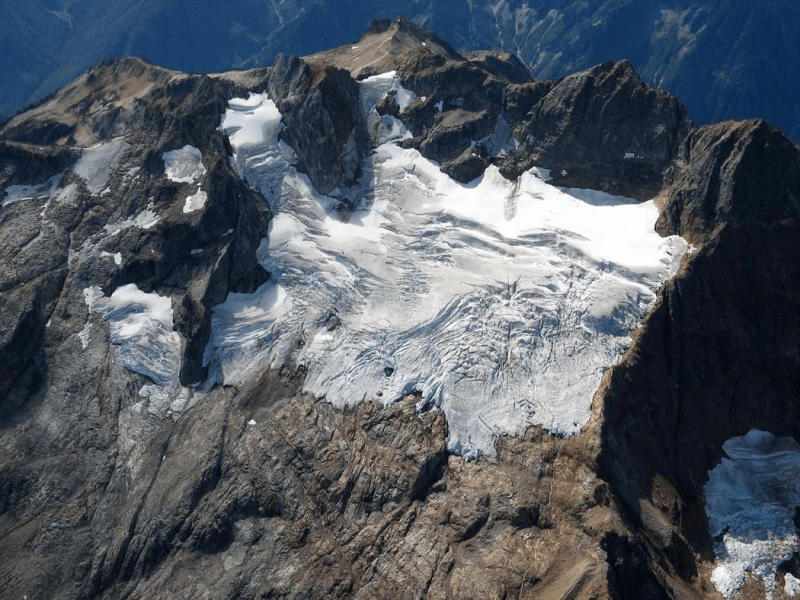
But that afternoon on Mt. Prophet everything changed. The ascent was not so bad. Roped together, we moved cautiously, cutting steps in the ice and the hard snow, not daring to look down. Much of it was hand-over-hand, straight up. At the summit Rogers danced around like he had scored a touchdown in the Super Bowl. “They said it couldn’t be done,” he sang, “couldn’t be done, couldn’t be done. Not from the north, the north, the north.” We all laughed. I, too, was proud of our achievement, but Rogers’ ecstatic fit of glee frightened me a little. How could this mean so much to him?
The descent was of another order. Mark was the lightest so he went first, then Rogers, then me, then Melly. Mark was supposed to use the same footholds we had used coming up, but at one point he got off the track, and when he tried to kick out a new foothold with the toe of his boot, he couldn’t do it. His legs had no heft. Rogers kept a tight grip on the rope and kept encouraging him, but instead of making a dent in the snow, Mark’s boot merely tapped politely at the snow wall. Frozen crumbs fell away. I looked down. Far below I saw a stream winding through a green meadow.
* * *
“Try again,” I said. “I’ve got you.”
“I don’t think he can do it,” I heard Peter say.
He could do it, all right. I gave Mark a reassuring tug on the rope. He looked up at me, grinned bravely, and tried again. Finally, it worked. What a kid! What a trip! He’d never forget it. We inched our way down. A few yards farther on, although I kept reminding them to keep the interval, we became dangerously bunched together—that is, Peter and Melly crowded in on me—and for a moment we all stood huddled there. I was aware of an odor: a sweet syrupy fragrance like a candle burning in a bathroom.
* * *
“My God,” said Rogers, “that’s the smell of fear, as they say.” He chuckled to himself—“I know it well,” he said, also to himself—and looked at me. “Dry, huh? Put some snow in your mouth, Peter,” he said. I did what he said.
* * *
Peter belonged to me now, and so did his son. Terrible thoughts to have, but I had them, and I admit it. In the wilderness, sooner or later, things become clear.
III
Two days later, several miles deeper into the interior, a few yards from yet another summit, I found myself praying for this one to be a first ascent, for Mark’s sake. Since climbing Prophet we had twice been disappointed. Broken-down cairns, without names or notes, but cairns nevertheless, probably built in the thirties, had sat atop both peaks. So this was our last chance. Tomorrow we had to head back to civilization. Mark and Rogers were waiting for Melly and me to catch up. It satisfied Rogers’ sense of decorum that we all reach a summit simultaneously and together touch the topmost rock as though engaged in some sacred ceremony. It seemed silly to me.
* * *
“Go on,” I told Mark.
“Don’t we have to wait for Dad and Mr. Mellichamp?”
“Go on, Mark.”
“But—“
“Go for it.”
* * *
Rogers was grinning, waving me on. So I did it. I felt guilty, but I did it anyway. The summit was covered with these little tiny rocks and lupine and had a bare spot the size of a doormat where I could see goat droppings. No cairn. For a minute I just stood there. I was the first person on earth ever to reach this place. I felt quiet inside, and strong. I was only a high school kid from California, not a real mountain man, but here I was, on top of everything. I looked down at Rogers . He nodded slowly, his face serious. He had been watching me. He’s a great guy. Dad and Mr. Mellichamp were watching me too, so I raised my ice ax over my head and they both cheered. It was great to be here with these three men.
But when Rogers drew beside me, he groaned: “Oh, no.”
“What?”
“Over there.”
Only then did I see what had been right before my eyes the whole time.
* * *
I saw what Mark had not seen. Thirty feet away, across a chasm, looming up as if coming from miles and miles below, was this other peak, level with our own or maybe a foot or two higher. “Double summit,” I said. I knew what it felt like to stand alone on a mountain top, and so I understood why the double summit hadn’t registered with Mark. I took out my map and rechecked. Sure enough, it didn’t show.
“So this isn’t a first,” said Mark.
“Half of a first. We’ll do that one too.”
“How?”
“Down and up,” I said, pointing into the chasm. “No problem.” We would have to crawl out on a granite shelf, work our way down to the saddle between the two summits, and climb up the other side. And that saddle would be difficult.
“Let’s go then,” said Mark.
I laughed. “Can’t we wait for a minute or two?”
* * *
My dad narrowed his eyes and took a bead on the other summit. “The one we’re on is higher,” he said.
“You may be right,” said Rogers.
“Higher or lower, I’m staying right here, gentlemen,” said Mr. Mellichamp. “I’m tired”—he pronounced it “tarred.”
“You’ve got the right idea,” said my dad. “That’s too tough for me.”
“We’ve come this far,” said Rogers. “We’ve got to make the true summit.”
“I thought you thought this was the true one,” said Dad.
“That’s what you thought,” smiled Rogers. “Nope, the other’s higher.” He looked at me. “Mark and I’ll do it. We’ll sign you two in as ‘of the party.’ How’s that?”
“If we’re not there, don’t sign us in,” said Mr. Mellichamp. “Keep it honest. And, honest, this is plenty high enough for me.” He lay back, his head against a rock, his arms open to the sky. “What a day.”
“It really is,” said Dad, sitting down next to him. “Gorgeous. It’s worth the trip. You feel on top of the world. Look.” Dad pointed south, “just look, off there in the distance. Mount Rainier . Amazing.”
* * *
You could see for miles: peak after peak, a world of mountain peaks, blooming alpine meadows, cascading waterfalls glistening in the sunlight. To spend the rest of the day here would be fine with me. Best to stay here. I wasn’t going down in that chasm. The sparkling snowfields, the trees. No sign of anyone anywhere. Not even an airplane. Just us four. I wasn’t going down in that chasm. Neither was Mark. This was far enough. Rogers could go alone.
“All set, Mark?” said Rogers.
“All set.”
“Let’s go, then.”
“No, you don’t,” I said. “Harry, you go on. I don’t want Mark—“
“Mark can make it,” said Rogers. “But I’ll check it out first.” He scrambled down the shale, lowered himself around the granite shelf, and disappeared. I was glad he was gone.
Mark was staring at me, unable to speak. At first I thought he might cry, but he gathered himself and looked away. When he finally looked back at me, his cheeks rosy with anger, his forehead pale with outrage, not a tear in sight, I was almost ready to admit my mistake.
“I’m going, Dad,” he said.
“Nope.”
“I am, too.”
“Nope. I have to draw the line somewhere.”
The sound of falling rocks echoed up from the vee between the two peaks. We heard the rocks clatter, clatter again, and fall into silence.
“There goes Rogers,” said Melly. “Splat. Dog food. A Gaines Burger.”
“Wouldn’t want to lose him,” I said. And I meant it. What would we do?
“Could you lead us out if we did lose him?”
“You know, Mark, I think I could. But I wouldn’t want to try.”
“Your old man has a remarkably good sense of direction, Mark,” said Melly.
“Why don’t we both go?” asked Mark, pointing after Rogers. “You, first.”
“Mark, it’s not worth it to me. We made this summit. That’s enough. Why not sit down and relax and enjoy the view?”
“It’s not enough for Rogers.”
“Rogers is a fanatic.”
“A madman,” added Melly. “But a swell guy.”
Just then Rogers appeared on the other peak, climbing hand-over-hand toward the top, grunting like a monkey. He grinned at us over his shoulder. “Come on, Mark,” he called. “You can make it.”
Mark started after him.
“Hold it, Mark,” I said.
“Why?’
“Because I said so.”
“Mark,” called Rogers, “one spot is a little tricky.”
“I’m going.”
“No, you’re not,” I said.
* * *
Mark paused at the edge of the granite shelf and turned to face Peter, who had stood up and put his hands on his hips. While I had been climbing, they had been talking, and to judge by the strained smiles on both their faces, Peter had stuck to his guns. Stupid man. Now I could hear them clearly.
“Come back here, Mark.”
“No.”
Mark edged out over the shelf and let himself down. He moved fast, almost like climbing down a ladder. God, he was good, sure of himself. He moved right down into the shadow cast by the peak I was standing on.
“He can do it, Peter,” I called across the chasm. But now it was my turn to be stupid. We should have roped up. It was too risky, not that Peter knew it. He was frightened for himself.
“You think so?”
“Sure.” But I wasn’t sure.
“Oh, I know he can,” said Peter. “But the point is I don’t want him to try. He’s already proved himself a hundred times.”
“Then he’ll do it again,” I said. I hoped. When Rod Sears took his fall, it wasn’t much different than this: one of those places where you feel silly if you make a production about roping up. Rod dropped onto a ledge a hundred feet below. He was still alive but half conscious and thrashing around. We yelled to him to stop moving, but he couldn’t help it. He rolled right off the ledge and fell a thousand feet.
Mark was out of sight now. When he reached the saddle, he would see that the base of the second summit was a sheer granite face. The only route up was for him to jump about four feet to his right, from the saddle to the crack in the granite face.
* * *
When I looked down it was too much. I just didn’t think about it.
“See what you have to do, Mark?” called Rogers. Both he and my dad were out of sight.
“I see.”
“Do it.”
I leaped. I should have got set and gone over in my mind just how to jump and where to land, but I didn’t. I just threw myself at the crack and hoped my feet would find a solid place and my hands something to hang on to. But my feet found nothing and my hands grabbed only one side of the crack. I held on like crazy, my legs pressed against the rock, the weight of my body pulling at my fingers, my wrists, my forearms. No one could see me. I felt alone. I might have even cried a little.
I tried to make myself light as a feather so the mountain could hold me. I tried not to move. My shoulder sockets began to throb and my heart was beating in my arms. I tried not to move, but I did move. I slipped maybe two or three inches. Over to my right I heard a trickle of small rocks falling, but it wasn’t Rogers or my dad come to help me. It was just the mountain making noise. That’s what Rogers would say. Suddenly I had this urge to let go. I stared at my fingers. My knuckles were white. All I had to do was open my fingers. It would be just as easy as dropping from a chin-up bar. But then came another urge: get up that mountain right now, get going, go. And that’s what I did. How I did it—whether I clawed my way or what—I don’t know, but I did it.
* * *
A great rattling of falling rocks, a dagger of fear puncturing my heart, and there he was: on the other side, scrambling upwards exactly as Rogers had done a few minutes before. Thank you, Lord. He had been down in that chasm so long.
“You okay, Mark?”
“Yes.”
“Sure?”
“Yes.”
I turned back to Melly. He looked at me and laughed. “Did I ever tell you the one about the midget and the singing giraffe?”
* * *
When Mark reached the second summit, the true summit, I pretended to be busy snapping pictures. I lowered my camera and glanced at him. “A little tricky, right?”
“Where?” he said.
“Down by the saddle.” I was so relieved I wanted to giggle.
“No problem. I came right up.”
“We should have used ropes.” I could hardly believe I had been so reckless. It was partly Peter’s fault. “Don’t tell your dad how bad it was. And don’t ever do that again, even if I tell you to.”
“It was no problem.”
“Yeah, sure,” I said. “Well, maybe you are a goat, like I always said.”
As we built the cairn, I noticed that his hands trembled. When it was time to write the note, I whispered, “Should I enter their names?” We both looked over at the other summit. I half expected to see Peter staring menacingly at us, but he was laughing with Melly and when he saw us looking he waved.
“Sure you should,” he said.
“Really? They don’t deserve it.”
He turned his blue eyes on me. “They came pretty far.”
“Oh, I know, I’ll enter their names.”
“Just put ‘of the party’, like you said before. Because they didn’t go all the way.” Then he added: “We did.”
That made me feel better. I loved this kid.
* * *
When we descended the crack, Rogers went first and he went carefully. At the saddle he leaped back and held out his arm for me to grab. I was glad he did. At the original summit Dad and Mr. Mellichamp teased us about being insane but didn’t say anything else. We grabbed our ice axes, took a few more pictures, and started back down, with me bringing up the rear.
* * *
A thousand feet below I saw our red and blue nylon tents nestled among the lavender heather and the granite hillocks. Our camp seemed shockingly small, far away, and assailable. We should not be in these mountains, I thought.
Mark was right behind me, so after a few minutes I turned around and said, “You had trouble down there, didn’t you?”
“Nope.”
“Sure you did.” Why couldn’t he admit it? Why couldn’t he say, once, that he had learned his lesson? “Don’t lie.”
“I’m not lying.”
Maybe he wasn’t. Maybe my son was different from me. We continued down the mountainside. It was true: I wanted him to be frightened. I wanted him to know his limits. A man should know his limits.
Near the bottom, the slope turned into a loose talus landslide, gradually merging into the heather-covered ridge where we had camped. We began to move faster and faster, sliding and schussing like skiers through the looseness, and we both left Melly far behind. Mark stayed on my heels. He was crowding me. He wanted me to know he was there, I guess, and for a while we were in a race. He stumbled several times and nearly fell, spraying rocks and gravel down upon me, but we kept going. Finally, however, I stopped, abruptly, knowing he would push into me, and he did. I was bowled over to my knees.
“Goddamn it,” I said. “Watch what you’re doing.”
“Sorry,” he said. “I couldn’t stop.” And I knew that. I had wanted him to hit me.
“Don’t you know enough to keep some distance between us?”
* * *
Dad’s face was flushed, his eyes were watery, and he was rubbing the small of his back. “That really hurts,” he said.
“Sorry, Dad. I didn’t mean to.” But I knew he wasn’t hurt. I hadn’t bumped him that hard.
“Please stay next to me the rest of the way.” He spoke slowly, sadly, like I was really dumb. “Do you understand what I am saying?”
“I sure do.” We only had a hundred yards to go. As we walked into camp I could tell Rogers had been watching us. He didn’t look at me, but he had a big smile for my dad. He crossed the space between his tent and ours and shook Dad’s hand.
“Peter, thanks for letting Mark come across up there.” He nodded toward the summits. “It was a good thing to do.”
“You think so, do you?”
* * *
I knew then I had gone too far. Peter had this strange smile on his face. Down here, in camp, away from the dangerous places, he was pretty tough looking. He was ready to hit me. He looked behind me where Mark was standing. I could understand why he might hate me.
* * *
Dad looked at me over Rogers’ shoulder. I raised my hands helplessly. I didn’t want them to fight. I begged Dad with my eyes. Then I winked at him. For the only time in my life—except when I was a little kid, learning how—I winked at my dad. Where it came from I don’t know. Where I got the energy to get up that summit I don’t know either.
* * *
“But you’re right, Harry,” I said. I had frightened him—not much, just enough—and I was sorry for him, but I had to admire him. I had to. He was admirable. A part of Mark would always be his. “I’m glad I let him.” But it was that wink, a small thing, like a beautiful butterfly landing on a green leaf in one’s back yard, which made all the difference. It enabled me to say, “And thanks for all your help, Harry.” I meant it, too.
(Used by permission of author Steve Allaback, originally published in Kansas Quarterly, Winter, 1982.)
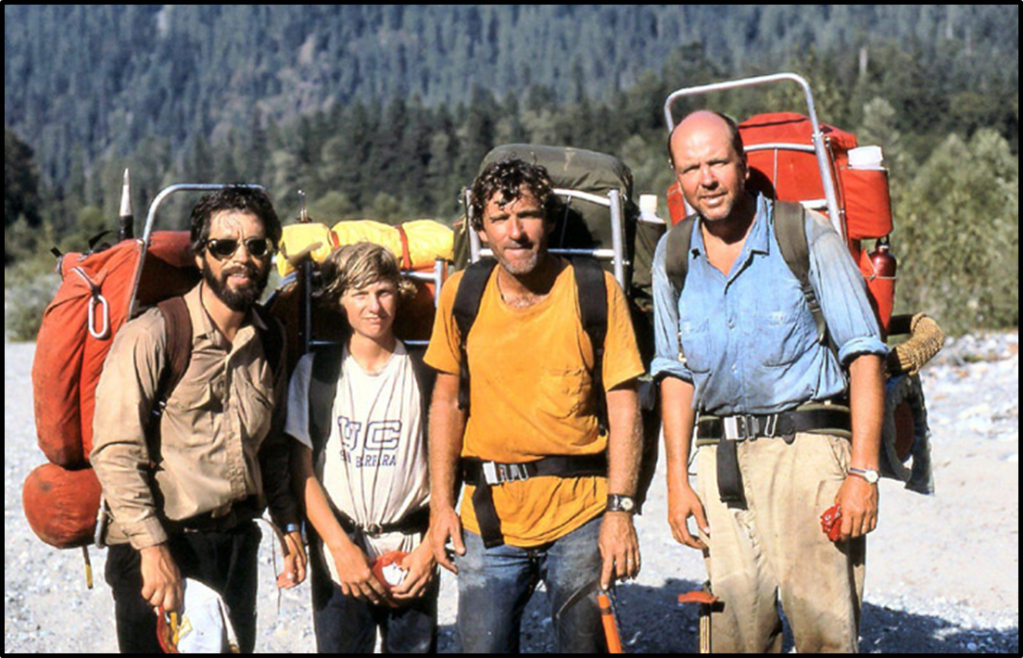
Don Avriett
Climbing With John
1975 to whenever John says, “forget it Don.”
Frisco, Oct 12, 1975:
When you climb with John you have to get used to going places and climbing things you’ve never heard of before. In this “period,” John was into first ascents. Maybe this was one, because I’d never heard of it.
Lesson#1: “If it’s green, it’s good.” Learned swinging our way down a brushy cliffy section to Rainy Lake. Could John have possibly underestimated the steepness of this descent route? Or just that I was taken aback by the terrain John considers “standard.”
Liberty Mountain, May 20, 1977:
“We should average 1000 feet an hour ascending with packs.” This was a thick, steep, miserable several hours squeezing through and mowing over small trees and brush. “The toughest part of Cascade climbing is often below the timberline.” Right John. My first major rappel was 30 to 40 feet off the summit. I think we practiced near railroad tracks in Renton.
Golden Horn, May 22, 1976:
“If in doubt, follow the stream out.” We did this the first weekend after the “North Cross State” highway was plowed. This is, by the way, the proper name of the new highway according to John. (Remember, that according to him then the North Cascades National Park doesn’t even exist.) The snow was so soft on the way out that we were sinking up to our thighs (under beautiful blue skies after a climb on warm gold rock), so we waded out Swamp Creek for the last 2000 feet to the road.
South Twin Sister, Jan 22, 1977 :
Climbed with Ron Aronoff and Dave Stonington.
Trapper’s Peak — First Winter Ascent try Jan 23, 1977:
Started off with the famous Huckleberry pancakes and Newhalem stories told by Virginia. We got to about 50 feet from the summit then realized that, without crampons, it would be unsafe to continue. We got back around 8pm, just as Virginia was reassuring Pam that things were probably fine, even if we were out all night.
Bear (1978) and Tombstone — 4th of July, 1980:
My stomach dropped as the swirling clouds cleared slightly and I could see that the summit ridge and summit dropped off very steeply on one side and had an overhang with a cannonball hole looking straight down on the other. We all got cabin fever waiting for the weather to clear, so John led us off on a route to Tombstone and Spickard with visibility frequently closing down to 30 yards. Between altimeter and topo map, John lead us this way and that, stopping to snack and catching a glimpse of Mox Peaks. We gained a first ascent of Tombstone (John picking an appropriate name to commemorate Dr. Spickard’s death near his namesake) without ever seeing the mountain. I was so impressed with John’s route finding that I went out and bought an altimeter. John showed me how to use it to predict the weather. John discovered one of my mind games of this trip. He pointed out to me “the worse the weather gets, the more red clothes you put on (damn it).”
Mt. Challenger and Mt. Whatcom — July 1979:
My first major peak, defined by me and somebody else having heard of it, my first time into the Pickets, the heaviest pack I’ve ever started out with, and the happiest ending after a doubtful start. After a soggy day carrying this pack up Big Beaver valley, we arrive at the shelter at the pass to head off 90 degrees west and up to the Luna Cirque. We find the following message scratched on the wall of the shelter: Challenger: 1 Us: 0.
We bag this route into the Southern Pickets and swing around to attack Mt. Challenger from the north (John’s idea, of course). This allows time for the weather to break and a spectacular ending with Gary leading 2+ exciting pitches to the summit. From there, all Gary could talk about was the “quart of cold milk: that his wife would have for him at the car. John had something else on his mind.
Silver Star’s Little Comet (down the ridge and probably a first ascent):
A shoulder stand was ordered by Capt. John as the crux move to gain the summit. He was on the bottom.
The Distal Phalanx:
I had to exit before the party reached timberline, but participated in John’s greatest tactical maneuver: a Tyrolean Traverse (over Thunder Creek).
West McMillan Spire – Sept. 1993:
Hiking up Goodell Creek, all of a sudden John stops us and says, “we head up from here.” I could see absolutely nothing indicating this as a route into the Southern Pickets. Halfway up we skirted a cliffy section and ended up above timberline exactly where we needed to be.
I couldn’t believe that the next day we were going to traverse around this enormous cirque, climb a steep snow chute (which John knows I love to do, and let me lead), then free climb the ridgeline to the summit and return. Truly a dream day. Let’s all forget the helicopter.
Mt. Prophet — Jeremiah, Ezekiel, and the Garden of Eden:
Rest stop, 2/3 of the way to timberline up from Big Beaver and Monte looks white as a sheet and says he feels awful. I can’t remember any complaints from him the rest of the trip, but he had quadruple by-pass surgery 3 weeks later.
Our exit march down the ridge from The Garden, the drop off the ridgeline, bushwhack to Big Beaver below, and the hike to our pickup on Ross Lake was orchestrated by John with rest stops timed to the minute. John said the boat would wait 15 minutes, 20 max. We arrived at Ross Lake 10 minutes before the pickup.
Mt. Booker – Sept. 1995:
The original Cascade Pass trail must have a reputation. Anyway, to liven things up, I started this trip off with a double forward roll down an avalanche slope. Somebody at the end of the line thought I was a bear. The 400-foot bushwhack up a brushy cliff from Blackhawk Mine to the cirque below Ripsaw Ridge and Booker with a full pack was a bitch. I felt bad all that evening and realized in the tent with Charlie that I was in atrial fib. I got my first good look at Goode, Logan, and Storm King the next day. I’ll pass on Goode. Maybe the approach. My knee looked like a cantaloupe in the car coming home. Half a meniscus shattered.
Trapper’s Peak with our kids:
To be announced
Don Avriett
Return to Friends’ Stories list
http://www.rhinoclimbs.com/stories/donbeavon.html
Don Beavon
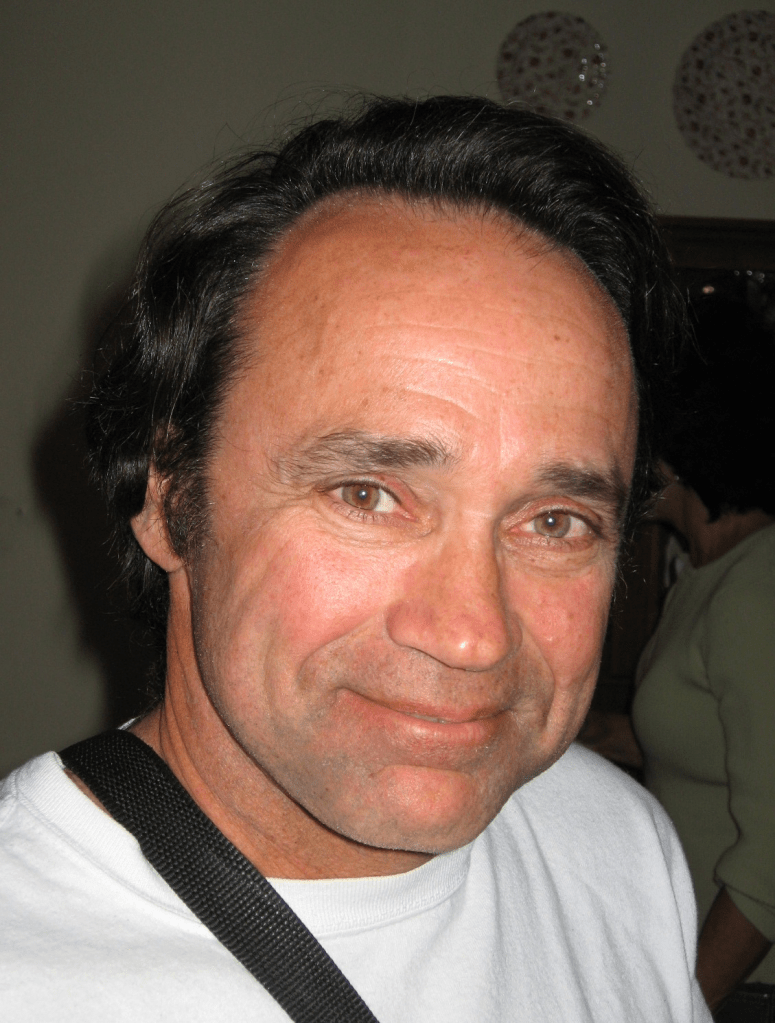
Snowflea and Anvil Island were not enough! I still think we should get together for Nooksack Tower! It would give me something more to remember you by! Now that the top 100 are done I’ll be looking for more challenges which, you’ll be happy to know, include the top 100 by 400 feet of prominence AND Nooksack Tower. I’ll start tuning up for it on the first of the year when I join Mitch at Joshua Tree… Nooksack has been on my list for a long time but I’m not going to do it solo. I just need someone to belay me!
John, are you listening!? I’ll be in touch and Oh yes, What better way to begin your 61st year of life than by climbing Nooksack Tower.
Happy Birthday!!!
Don P. J. Beavon
[PS: Unfortunately I never took Don up on his offer to get me to the top of Nooksack Tower (the last remaining named peak in the North Cascades National Park that I had not done).]
Fred Beavon
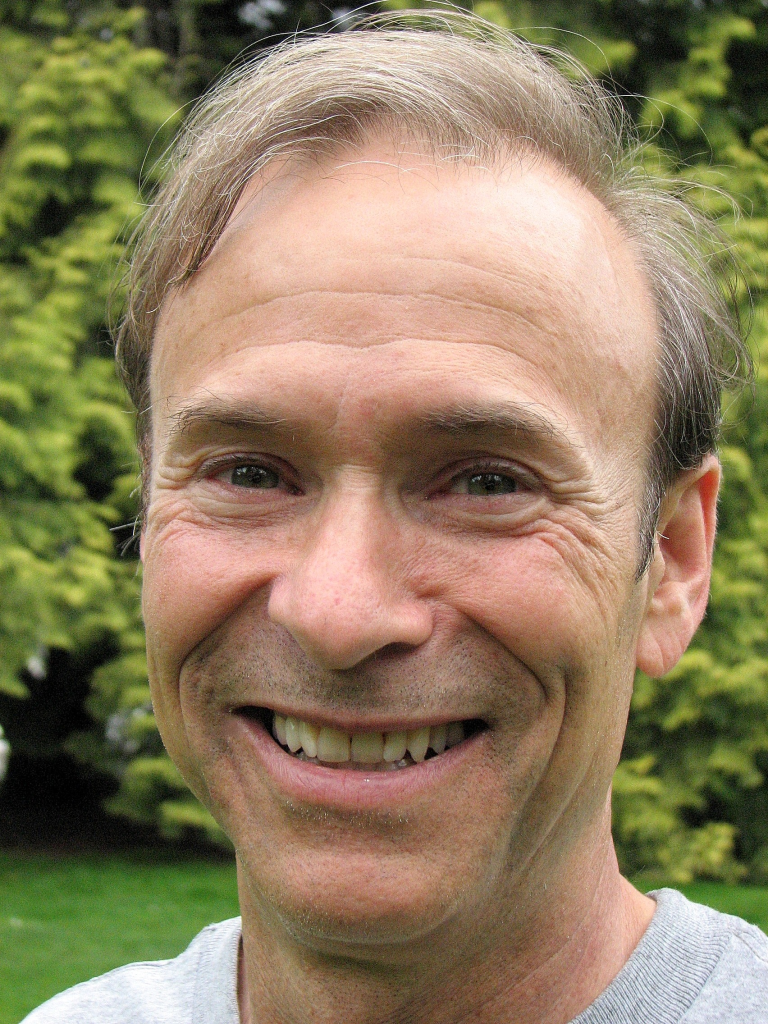
John Roper, a true gentleman, always answers e-mails, even my dumb ones. I’d pay a small fortune for all his trip reports gathered in one place. Yes, they are THAT interesting and fun to read. A meticulous list maker. I’d pay another small fortune for all his lists of peaks. He has a great sense of humor and is forgiving of the dumb stuff I’ve done and said in the past. No one else I know comes close to his peak bagging records. And he knows the climbing history of all the peaks and how their names originated. A good impromptu speaker, witness the tribute to Chris Weber at the latest 100 Highest Party. Anyone know of one who has a more extensive collection of photos of the peaks? I don’t. I wish all his knowledge could be put into a book. An all-around good guy.
Fred Beavon
Mitch Blanton
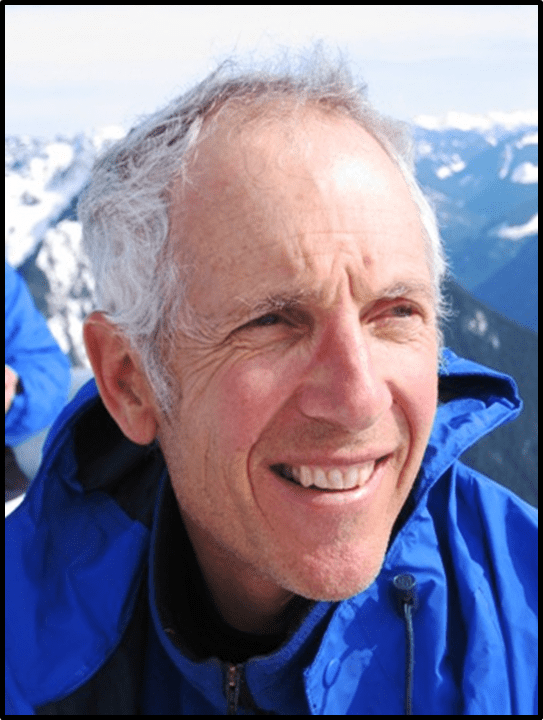
Meeting John Roper has been the high point of my climbing life; it’s as simple as that.
I had conceived of the idea of climbing the highest point in every part of the North Cascades, but it was not until I met John that I understood exactly what that entailed. He pioneered and established the example that all dedicated peak baggers are now following. His approach was truly unique. No one else was “cleaning out” every summit in vast tracts of terrain on each trip. I got to see how this was done on my first overnight foray with John. This trip in the Canadian Skagit was a classic Roper loop, climbing every notable summit. It was a real eye-opener for me, from which I learned so much. I’ve unabashedly copied the format.
The article that John wrote after that trip is an example of the breadth of his talents. He had researched the historical information about the area and wove that into the story. A Roper trip report is guaranteed to convey unusual and interesting anecdotes. He has made history in the North Cascades, and his personal acquaintance with so many of the climbing personalities of his era is an endless source of interest. He’s a great story-teller.
No description of John would be complete without mention of his sense of humor. He manages to find the fun in every situation. Many grueling uphill slogs have been enlivened by his gentle barbs, poked as often at himself as at his hapless companions.
One of my favorite things in life is sharing a mountain summit with John. No one is better able to identify all that can be seen. There’s probably something in view that he was the first person to climb, and certainly there’s a notable unnamed feature which bears a Roper Name that is both clever and descriptive-he’s the master in this arena.
Congratulations, John, on your 60th birthday. I hope we can have shared adventures in the hills for another 20 years.
Mitch
Bob Bolton
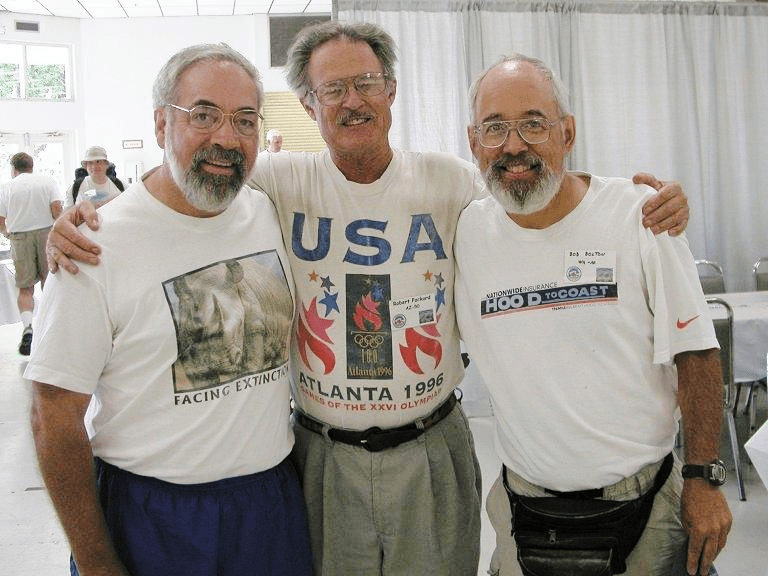
I have very limited experience with John but the one time was memorable. John asked me if I wanted to join Jeff Howbert and him for some prominence bumps near Morton, “Big Bottom Butte” and Cottlers Rock, in December 2001. I told him I’d meet them in Morton, so I went down to REI and rented some showshoes, drove to Morton, and met them at the Chevron food mart. It was a miserable rainy day, but we managed to get the two hills. Later I heard a weather report that claimed it had been the wettest day on record in Olympia with a total of around 3 inches. Given my soaked condition, I definitely wouldn’t doubt it. The nasty cold that followed was witness to why I’ve never preferred winter outings – especially since I’m susceptible to pneumonia! :-(
Happy Birthday John, and MANY happy repeats! Bob
Amy Carlson and Kal Brauner
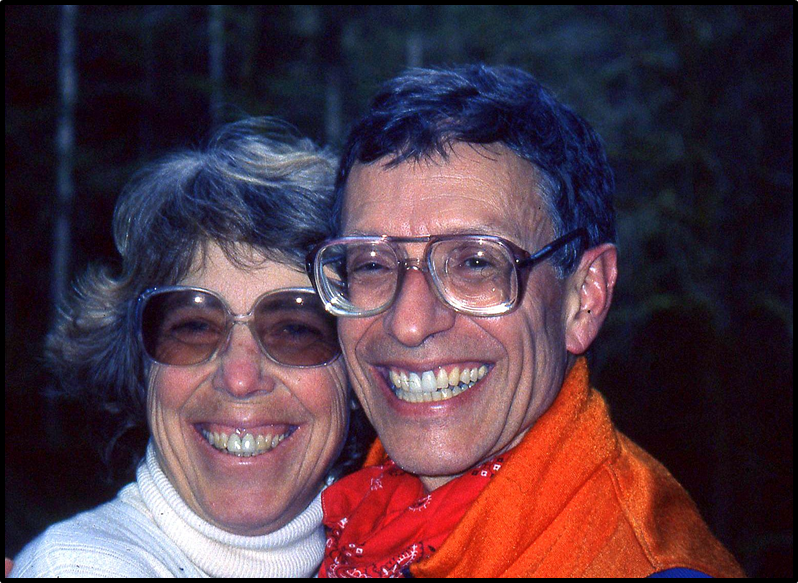
We have not had an opportunity to do many outdoor trips with John. We have, however, had the opportunity to know him through other activities. This past summer though, in August 2003, we did a backpacking trip with John, Karen, and Aaron in the Wind River Mountains of Wyoming. The purpose of the trip was to climb Gannett Peak, Wyoming’s high point. While it did not happen this time, a good time was had by all.
John does not believe in all of these new-fangled gadgets, such as GPS’s and maps that cost real money. John was asked before heading into the back country whether he had a map. Of course he did! However, every time we stopped he asked to look at our map. Finally, my husband, Kal, said, “I thought you had a map.” John did indeed have a map. (See picture below of his map.) It was a composite of printed pages from a free website (www.topozone.com ). We all were amused by his map, but it did the job just fine.
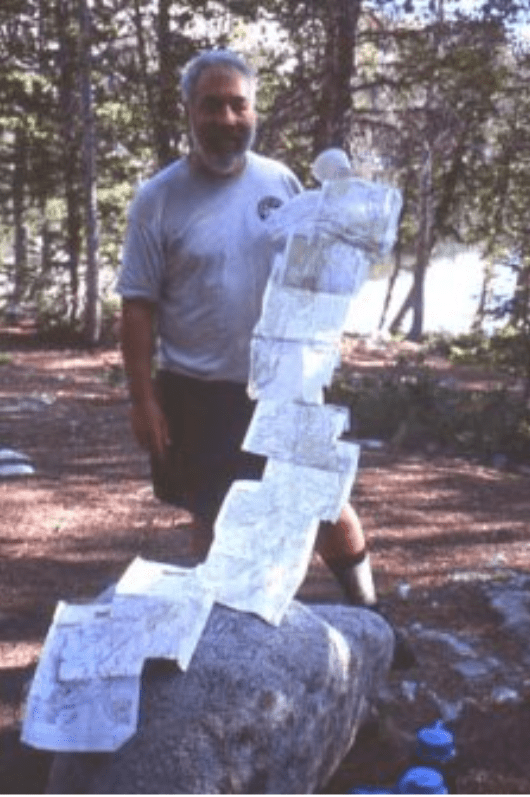
Amy Carlson and Kal Brauner
Brad Bromling
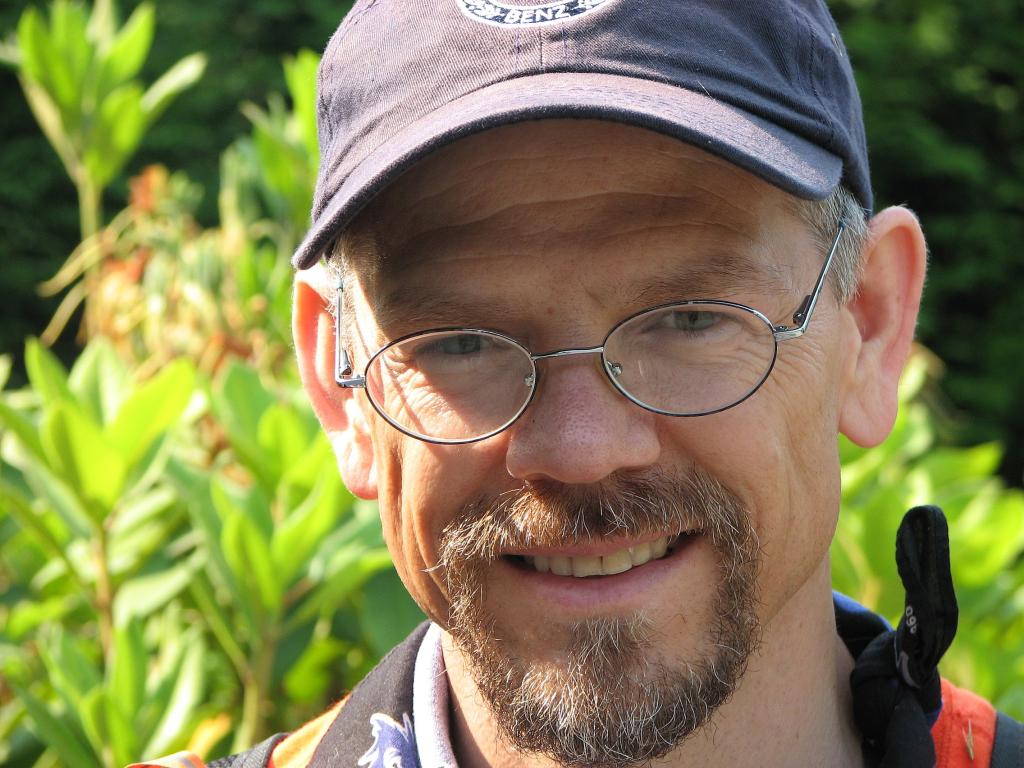
John honored my family with an invitation to join him on his 2,000th summit. It was a great experience. We all enjoyed the hike and the mini-celebration. It wasn’t exactly K2, but it did afford some awesome views of Enumclaw.
I also had the unique opportunity to climb Mt Ararat and Copper Mtn with him. Being new to this whole deal, I sort of cut my own path and got ahead of him at one point on Copper. Unfortunately, I grabbed a few large rocks that I thought were well anchored, only to find that they were set loose top soil. While I was fortunate enough to latch onto some roots and branches to halt my fall, the rocks I disturbed tumbled down the slope at a high rate of speed, bouncing unpredictably, but nonetheless straight for John. I was so stunned at the image of the rocks speeding toward my partner that I was almost speechless. At about the time he discovered the impending danger, I squeaked out “FOUR” (I did not know the official terminology), and then “I’m sorry!” John moved with the speed and agility of a mountain goat to avoid the deadly objects. As always, he reacted with grace and good humor. No harm, no foul. But, then again, that was the last invitation I received to climb with him–his survival instinct is strong, I suppose.
Brad Bromling
Norm (John) Burke
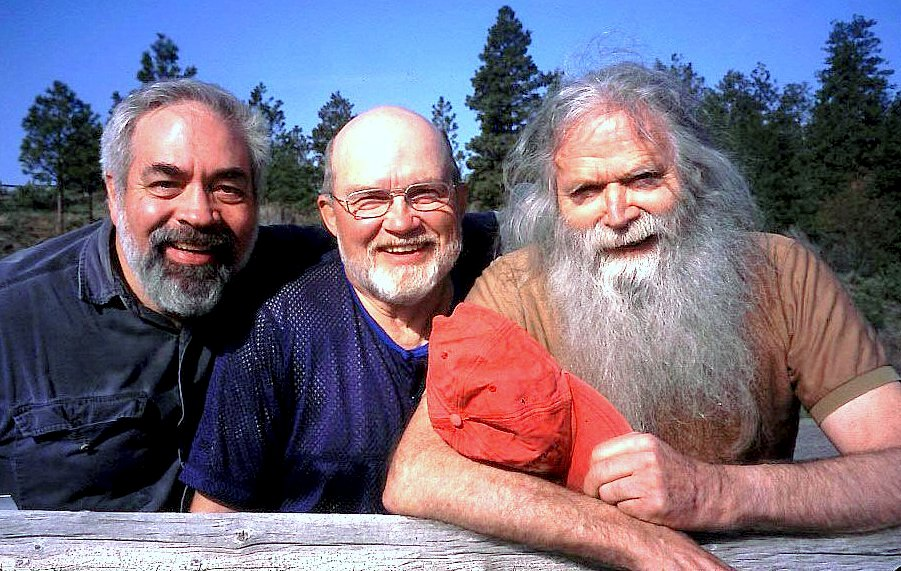
I first met John in 1969 at a Hi Laker fishing club meeting. I had heard of his exploits in the mountains at that time and admired him for all those adventures in the Cascades. I was relatively new to the Cascades then. Over the years his exploits continued to expand and I was only a blip in his memory bank until I moved to Manson. Then in 1991 I received a call from him to go on a trip to Agnes Mtn, the only condition that I had to meet was to pick him and Mark Allaback up at Lucerne then go on to Stehekin. I immediately jumped at the opportunity to finally get out with the now famous John Roper. At Stehekin we caught the shuttle bus up to High Bridge then proceeded to hike the Agnes Creek trail for about 7 miles where we abruptly took a right turn, forded Agnes Creek and gained the ridge crest between Yew Crk and Agnes Crk and from there going over a rocky knob at 6210 elevation, then dropping down about 300 ft and traversing into the Yew Crk basin where we stopped for the night. My first day with John had been completed, my energy level was completely depleted and my thoughts were if tomorrow was like today, then I was in deep trouble.
After serenading John and Mark with some of my best snoring for the night we awoke the next morning and I was ready to go again. I followed John and Mark up the Yew Crk valley where we eventually had to rope up and gain a knife edge crest. We then unroped and literally straddled the crest and shuffled across it with great care since the exposure on both sides was severe enough to make me forget that my crotch was being worn down by the sharp stone. We ultimately got over this hurdle and from there the Summit of Agnes was a piece of cake. We spent a short time on the summit and retraced our steps back over the straddled crest and spent the night at a nice spot looking down into Spruce Crk.
The next morning we went over to Mt Asa and read the original summit register placed there by Asa Post (Austin’s father). From there it was a continuous brushwhack down into the devils club filled valley of Agnes Crk, where we picked up the trail and literally had to run part of the way in order to catch the shuttle bus down to Stehekin.
We got back to Manson in the dark and arriving at my new home, my wife took one look and screamed, because my legs were literally covered with scratches and blood. I had foolishly not put on pants down the slope of the devils club filled valley of Agnes Cr. Thus ended my first trip with John R and it inspired me to never ever refuse a future trip with John. I will always remember John giving me a Mountain Bar of candy when we arrived down into Agnes Crk, that one event made my trip, for then I was an accepted member of his elite group.
Thanks John for your friendship and have a great birthday,
Norm (John) Burke
Maurine Butterworth
“Green is good!”–a most useful adage when pulling yourself up a vertical incline or trying to slow down your decent on a slick, mossy slope. I will ever be grateful for a brother who knew enough about the mountains to take me to places off the beaten path, through the devil’s club, up the cliff, down the creek bed…and even if it seemed like we were lost, I knew I could always count on you to bring us out at the logging road that led to our car.
Of course, there were the times I didn’t keep up with you and had to holler you back because there was no trail to follow, and I didn’t realize that you had made a sharp turn to the west above the ridge on Sourdough when I was still heading south. Or the time I just sat down–too scared to cross a slide area by myself–and waited until you noticed I wasn’t a reasonable distance behind you on our way back down onto Cascade Pass. You always inspired confidence: “Just stand up and don’t lean into the hillside!” There were times you showed me where to put my feet and hands on steep pitches and calmed my shaky knees with your positive assurances. And all those times when we were sopping wet or exhausted, and you’d say, “Isn’t this the most fun you’ve ever had?!”
You were my big brother and always knew best when it came to the mountains. Even though I still can’t keep up, thanks for introducing me to the trails and bushwhacking of the North Cascades (and beyond). Now my love for the mountains and hiking has been passed down to my boys and we are all the richer for it.
Thanks, John. You’re the best brother I’ll ever have! HAPPY BIRTHDAY TO YOU!!!!!!!!!!!!!!!!!!!!!!!!! Love, Reenie
John Childrey
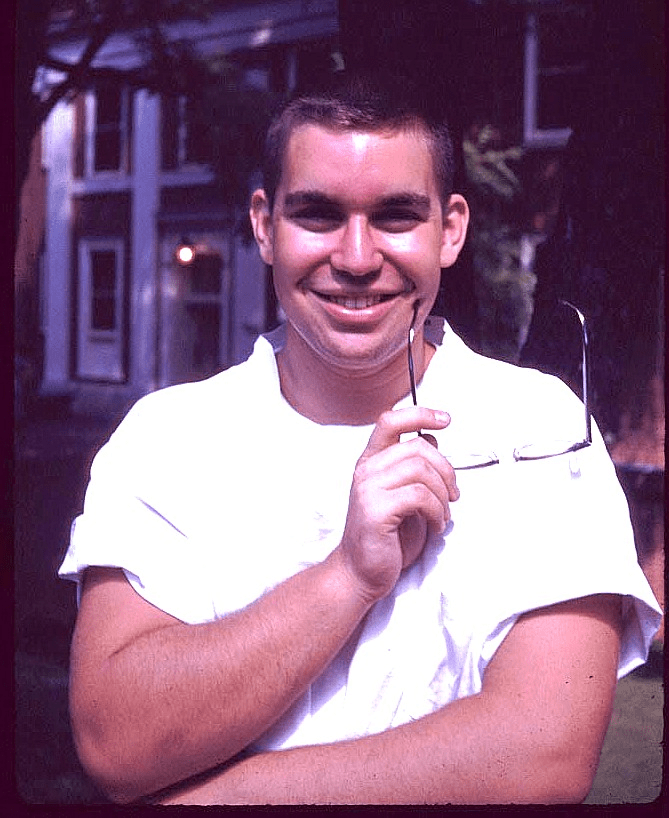
Climbing Mountains with John Roper as experienced by John Childrey
The first mountain I climbed with John was in 1996; this one was an actual mountain following the 35th reunion of Concrete High School’s Class of 1961. I had traveled to Seattle to stay with Karen, Aaron and John. John took me to an early hydroelectric power station east of Seattle and then the mountain. At least he called it a mountain peak, and he awarded me my first Washington peak! I am still dubious since my notion of mountaineering is hanging over a vertical cliff and having the rope sever …. Well, no need to embellish too much on this sport of John’s; he’s made it another year.
Actually, I suspect, the story begins sometime in the summer of 1958. John is hurling from the altitude of a pitcher’s mound. I looked at that fast ball heading, literally heading, toward me with as much fear and trembling as any rope climber sailing downward, seeing the ground approaching at 32 ft/sec/sec. I don’t remember ever hitting one of John’s pitches. Babe Ruth League was a monumental mountain for a newly discovered nearsighted kid from the east. I also thought the mosquitos in New Halem were twice the size of their Concrete cousins and the baseballs were about half the size.
But John and I were generally amiable competitors in other sports as well. There were academic peaks we vied for: who had the better score on this test or that. Those were such important mountains to climb in our teens. The academic scaling made easier by the competition with each other and others, like Tim Roetman, Jim Thomson, Sue Soder – and still others listed in the 1959 Yanica.
John allowed me to tell about his mountaineering experiences in an academic presentation in California a while back, and provided me and my audience with photographs of Jack Karouac’s fire lookout mountain in the Cascades. These are the kind of literary peaks I’ve chosen, and while I admire and wonder at the physical nature of the peaks John’s hiked and climbed, I marvel at the lives he heals, the pain he eases.
Marshall Eaton
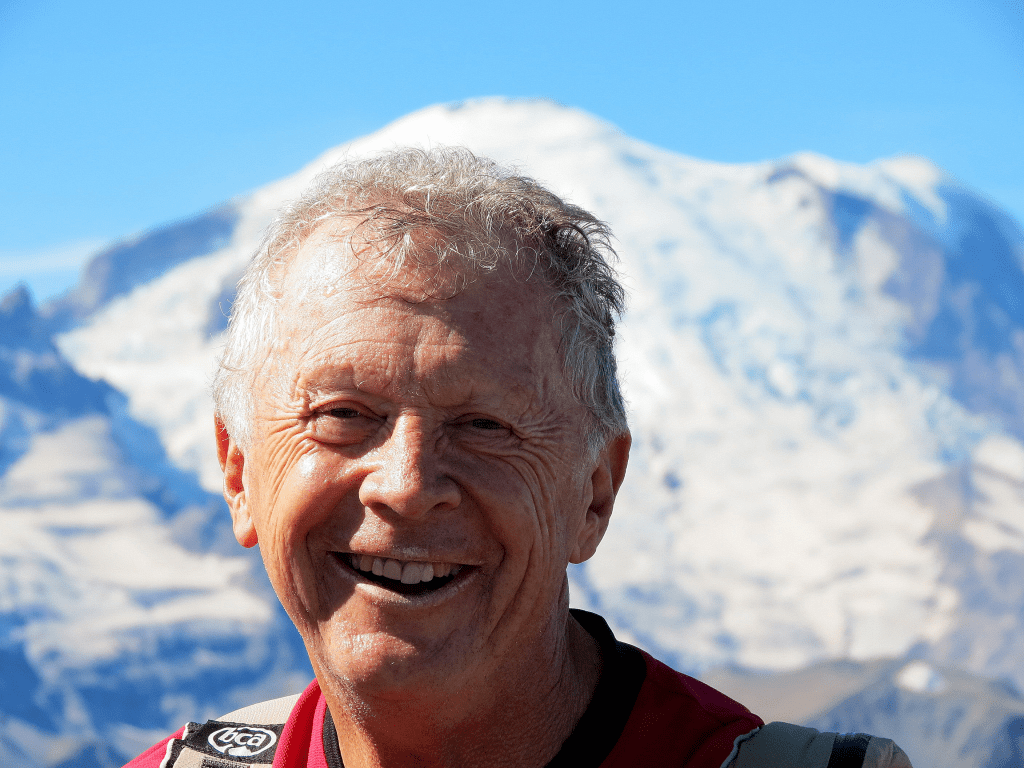
Four Words
As an occasional climber with John, I regard trips with him as journeys into magical geography; not only the dimensional geography of the Pacific Northwest, but also the geography of his imagination, his historic tales, his drive and his genius.
This story borders on the cliché, in that friends, when they read the four words at the end of this story, will figure they knew that all along. The setting was the top of Colonial Mountain on a Cascade summer day. John was perched near Charlie Janeway’s son, Jeffrey, a tag-along knowing neither the local geography nor John. All three of us quietly absorbed the scene, as we breathed deeply in response to oxygen debt from the climb. Stunning cloudless blue skies merged into magnificent mountain peaks in all directions. Every glance delighted our senses with visions of foreground ridges, mid-distance summits and distant massifs linked together by fading colors.
We owl-rotated our heads, awed by the immensity of the panorama before us and occasionally pausing to appreciate views recognized from past adventures. Eventually Jeffrey turned to John and simply blurted: “So, John, I know you climb a lot —- which ones have you done?”
John paused in his style of taking every comment seriously, and looked across the horizon. I glanced at John as he brushed his beard in a light downward stroke.
“Everything you can see.”
He remained still, satisfied to be blunt, and perhaps hid a smile.
The pause was now Jeffrey’s. He blinked as the ramification of John’s simple answer filled his imagination. He moved his lips, as if to repeat the words, but said no more. We settled into silence. If genius is utterly unique and beyond most people’s imagination, then John is a true genius of geography. Marsh
Stefan Feller
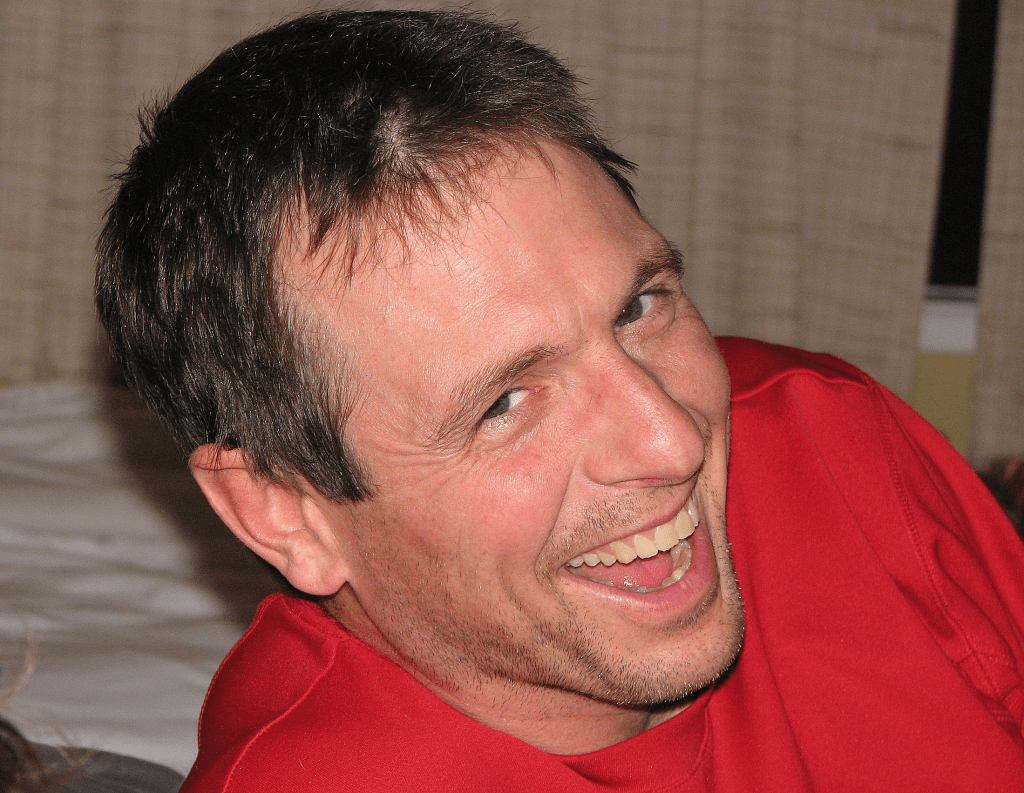
Whenever I do a mountain or a mole hill I think to myself, “When was John Roper up this one, and who was he with?” The mountain could be Mt. Buckner, or it could be point 1120+ on some farm in the Palouse. The only thing that stops John from attaining any summit is a private landowner with a gun–a “No Trespassing” sign is still game.
Everytime I enter the North Cascades I look around and see the time this man has spent in this area. The time spent is probably more than the hours I have spent in school and work combined–for which I am jealous of. He has an incredible wealth of historical knowledge and a keen interest in native American nomenclature which I find interesting and admirable. When the ashes of John Roper are spread among the peaks of the North Cascades the thoughts of future climbing children, grandchildren, and generations will come to the same conclusion I have — “When was John Roper up this one, and who was he with?”
I am priveleged to know John Roper today.
Stefan Feller
Bette Felton
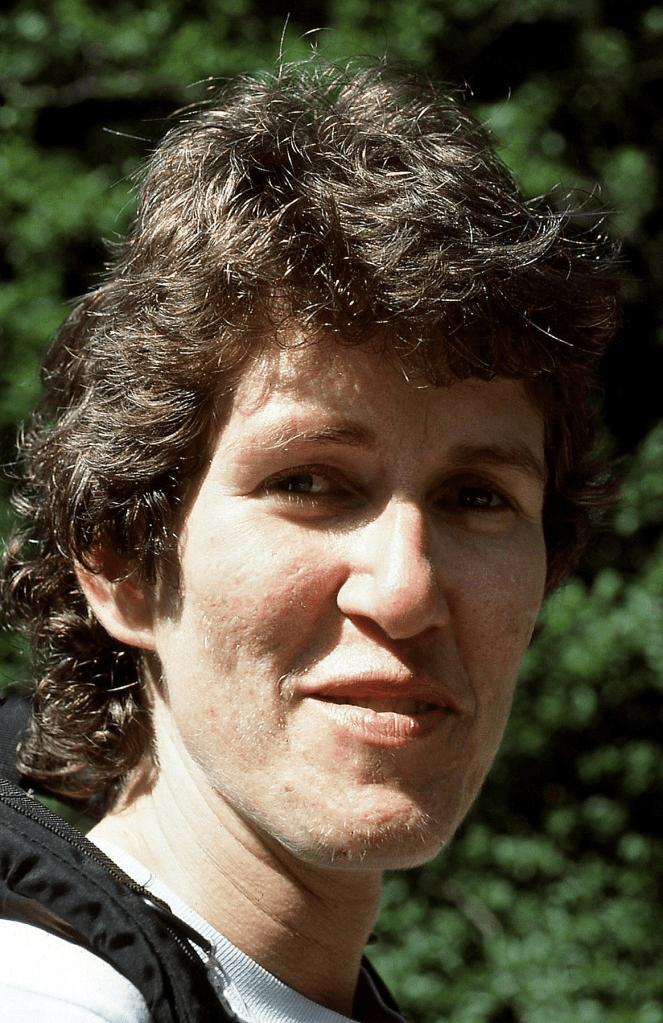
Ball Arts
The Himmelfarhtz Kommandos (John, Russ Kroeker, and Silas Wild) were famous for their promotion of what they referred to as “Ball Arts,” the technique of cramming as much as possible into the smallest pack possible. The net result was a pack about the size of a child’s book pack crammed so full it resembled a bowling ball. Not that they skimped; John at least always managed to include a tent.
The day came when I got to see Ball Arts in action. Desperate to nab Tupshin, I went off with the HFK to climb Tupshin and Devore. Being worried about keeping up, but fond of my large pack with its nice comfortable hip belt, I did my best to minimize the contents, even leaving my 2-pound camera at home.
The first indicator that Ball Arts was not quite as advertised appeared at the trailhead. Out came the adhesive tape, not for feet but for backs. Evidently, carrying the bowling ball packs wasn’t very comfortable and could result in damaged skin.
This was followed by a discussion of who would carry what community gear. This is a fairly common trailhead topic of conversation among most climbers, but I was not prepared for the extensive discussion of what constituted community gear. It seemed like every item in each HFK bowling ball could somehow be justified as community gear, and all three of them were obviously well practiced in creative justification. John’s perennial favorites (among others) are the first aid kit (which I can maybe partly accept if it’s better than mine), and also the camera. Once that was all decided (at least for the moment), we started off.
The discussion continued whenever one of them lagged slightly, which the laggard always attributed to having more than his fair share of community gear. At one point Rus, who had carried the rope over Cascade Pass that morning, began to whine (and whine and whine..) about his unfair burden. Being somewhat naïve, I finally offered to take it from him, which resulted in a torrent of ridicule and abuse directed at Rus from the other two, far up the hill. As I recall, he swallowed his pride and gave me the rope anyway.
In the end, I had to concede the camera as community gear, since John gave me some slides from the trip. And, now that ultra-light packs with almost nothing in them merit coverage in the New York Times, I have to concede that the HFK were ahead of their time and did an amazing job of packing sufficient gear into a small space. However, I still enjoy my hip belt and I’m not the least bit interested in having adhesive tape all over my back.
Steve Fry
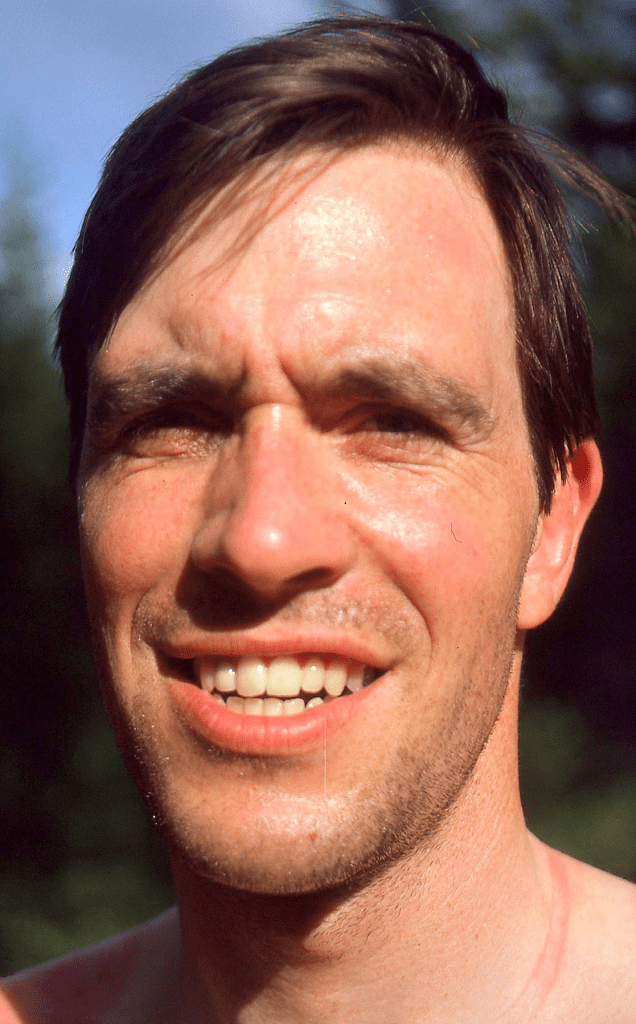
I helped John get Lost [Mountain] in 1987 to complete his Bulger List Top 100.
John and I went over and out “10-4 Mountain” in December about a decade ago, and a twig poked me in the eye, giving me double vision.
We have scampered atop numerous mountains, such as Indian Rock and Lemei Rock, amid summery skies in the vicinity of Mt. Adams in about 1992.
John and I have had holy debates about mountain place names, especially those in the NCNP, and different opinions about ascent history and what elevation to assign to peaks.
John is a relentless climber who has completed a wide variety of mountain lists. He also first stated that once every closed contour had been tallied, then the mountain list-maker’s job would be done.
John and I also climbed Holy Acorn Mountain, and he was later enlightened on nearby “Salvation Peak.”
Take care,
Steve Fry, Edmonds
Don Goodman
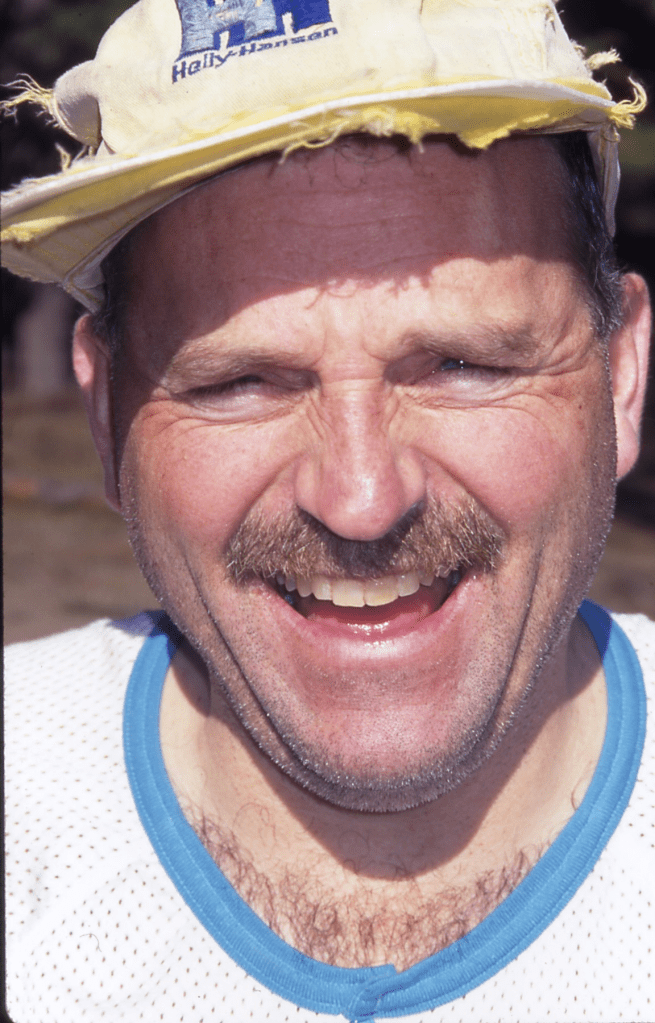
John and I linked up for a spring climb of Finney Peak, Chelan Mtns., in the late 90’s. In addition to John and me, the party included Norm Burke, Dan Sjolseth, Ed Liebert, Natala Goodman and Juan Esteban Lira. John suggested strongly (you know how he can get sometimes) that we bring snowshoes to facilitate getting around in the spring slush. I protested claiming advantage of a “secret weapon”. That secret weapon was Juan’s ability to kick steps in the snow all day long! John bought into it and off we went without snowshoes.
On day two, the actual climb of Finney, we encountered knee deep punching. Time for the secret weapon!!! Juan shot off like a rocket and the rest of us could not keep up with him. Unfortunately Juan had no clue where he was going punching wonderful holes in the wrong direction!!
After about 1/2 hour trying to catch him John turned to me exclaiming “The next time you bring a secret weapon figure out how to aim it!!!!”
Don Goodman
Warren Guntheroth
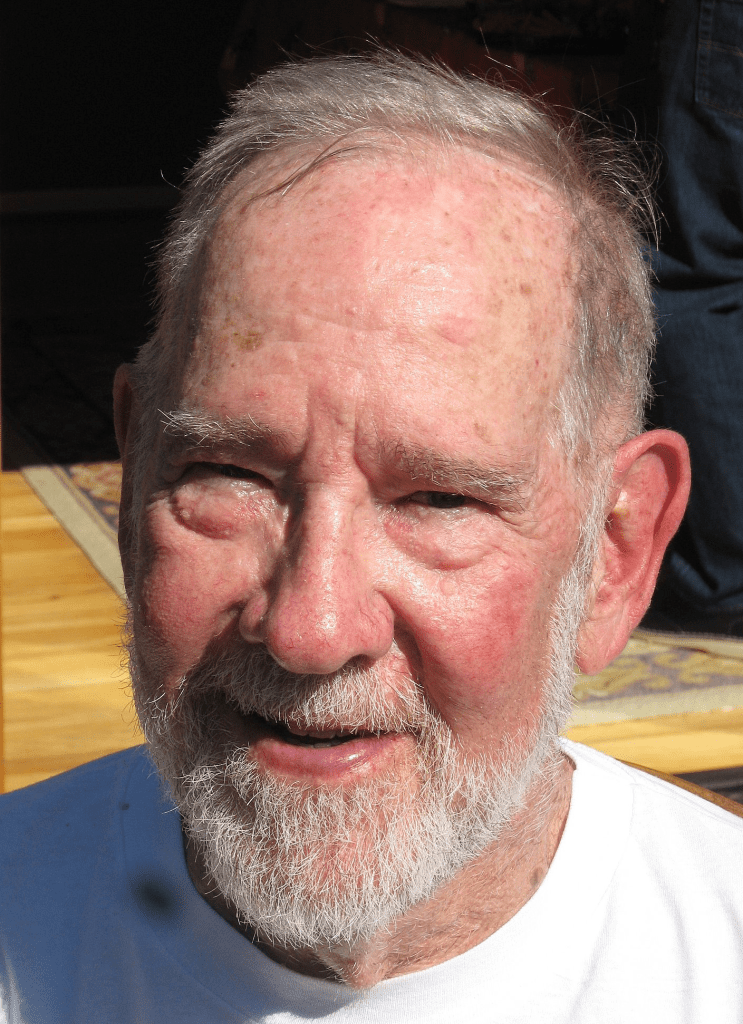
On this Columbus Day, October 13, 2003, I recall a neat climbing trip to Bull’s Tooth, with John and my beloved my Husky dog Sasha. The hike in was warm and a little tough, but we went for it that afternoon. There was more than a little confusion as to just which summit was the actual Bulls Tooth, so we climbed them all! Good rock and good views.
After a quiet night near the lakes, discussing many things, John offered “that a dog provides something hard to come by in this world: unconditional love.” (Karen, he accepted our wives!)
The next foggy morning we climbed a very pleasant mountain just north of the pass. Coming down was a problem of visibility but Sasha unerringly found the correct chute. We named the peak for Sasha.
John wrote it up for Pack and Paddle and included some very nice photos of Sasha.
Thanks, John.
Warren Guntheroth
Ray and Diane Hazen
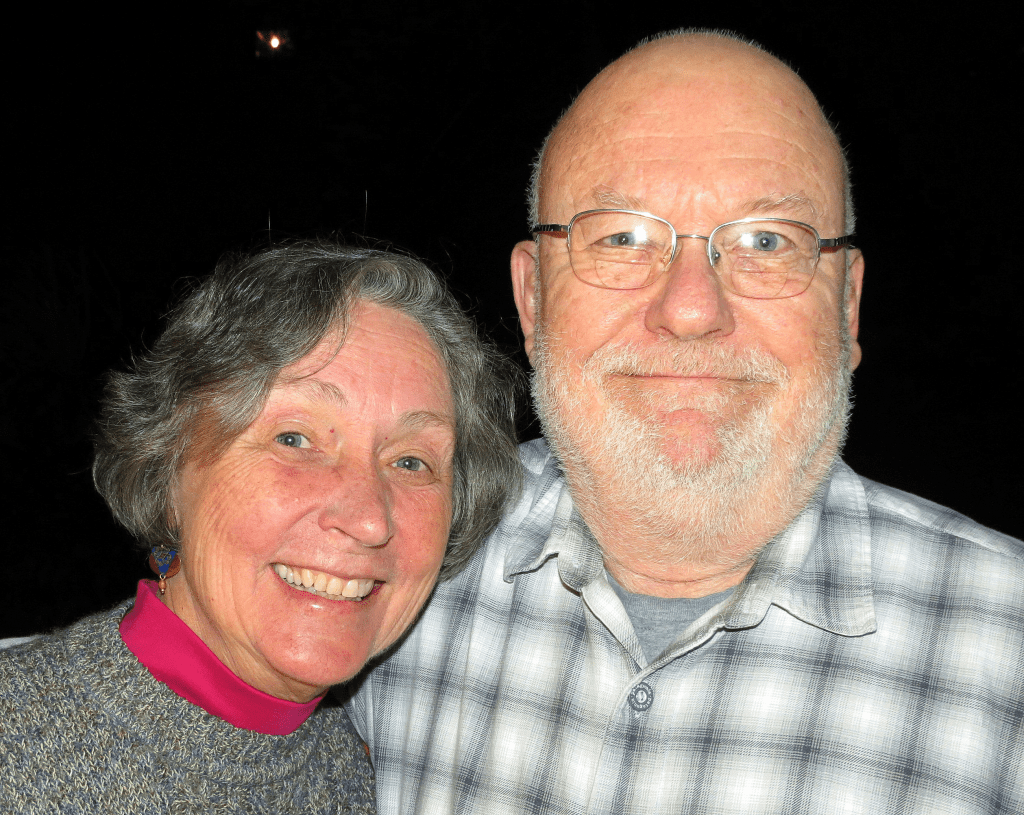
JW took Ray and me on our first venture in the North Cascades in 1972. We followed him up Trappers Peak, of course, and I got to complete the initiation into the “Roper Club” by jumping into the icy Skagit River behind his parents’ home in Newhalem.
Even after we had to move East and resume our role as visitors, John has never flagged in his eagerness to share his love of the mountains with his indoorsy, overweight, somewhat timid friends. Once we went with him to the summit of Sauk Mountain, and when we straggled up that “easy” mountain with our two daughters in tow, he made the entire expedition unique by
a) showing us the highest toilet in the world, and
b) hauling a watermelon out of his backpack as a part of lunch.
We look forward to more adventures with JW when we finally move back to his part of the country, and wish we could be there for the celebration of his 60th birthday.
Love,
Ray and Diane Hazen
Ted Hegg
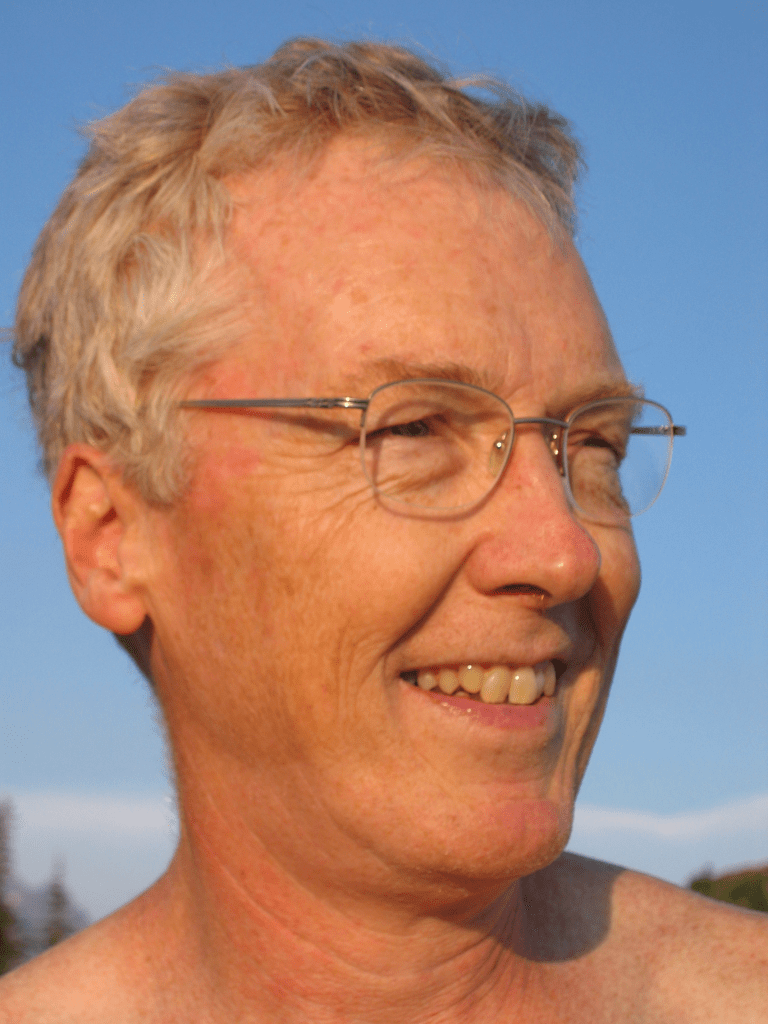
I don’t think I’ll ever forget my first climb with you and GHAS (the Group Health Alpine Society). Remember Memorial weekend of 1981 out to climb Distal Phalanx and Styloid. I enjoyed my first ever Tyrolean traverse as we crossed Thunder Creek. As I recall you crossed a small wet log jammed in the chasm about 12 feet above the roaring creek and we belayed you, though it seemed more like fishing with live bait.
The hike up through the “burn” up and over downed trees with full packs was glorious only in retrospect. At the time I was sure I would die of exhaustion and only wished death would come soon. I recall your giving me some words of wisdom and comfort for my weary body when we finally arrived at our campsite that night. Always the eastern mystic, you asked me to visualize my wife sucking my toes and all would be better.
In all seriousness, exploring the Cascades with you has been one of the great joys of my life. Your fantastic knowledge of the terrain and history together with the humor and camaraderie that we have shared up in the mountains is something that I will never forget. I need to join you again soon for a trip.
Best wishes on your 60th. Hope you lose just a little of your endurance so I can keep up.
Ted Hegg
Jeff Howbert
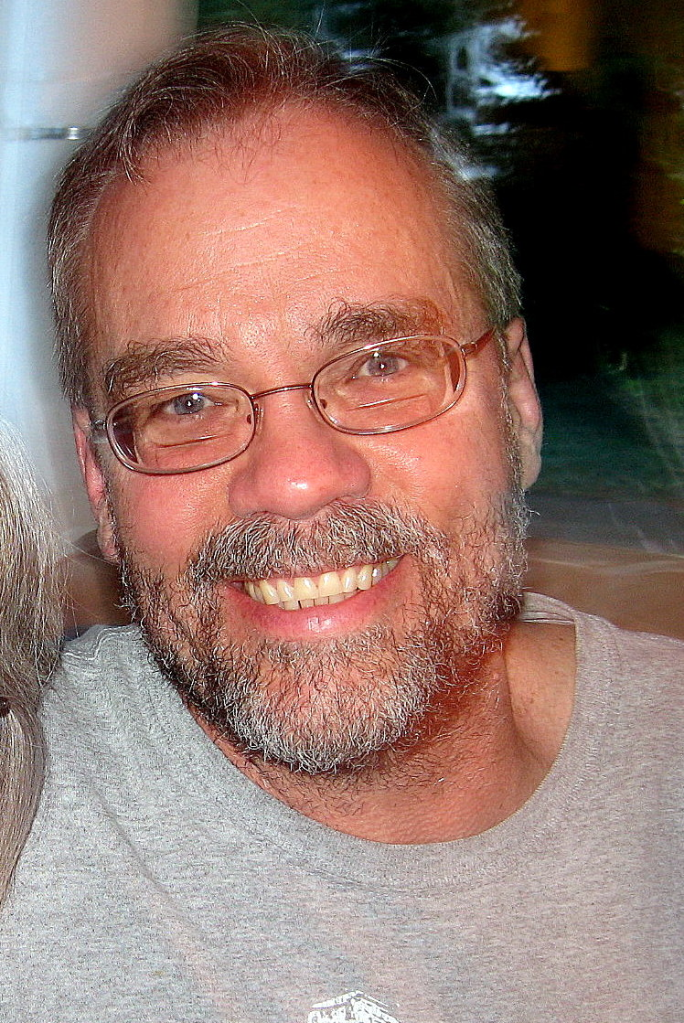
I blame it all on John. I mean that as a compliment. And I am grateful, truly. But it’s still all his fault.
I refer, of course, to the compulsion for mountain list-making that has consumed most of my free time for the past eight years. If I hadn’t met John, I doubt I’d have realized it was so important to compile list after list, covering all manner of mountains in every corner of the Northwest.
The first step on that slippery slope was my own doing, I suppose. After returning to the Northwest in 1993, I began visiting the mountains every weekend. At first it was only hiking, but the thirst for adventure soon led to scrambling, climbing, and winter mountaineering. A lot of the time, it wasn’t easy to find people to go with me. That’s when I noticed a certain John Roper regularly submitted reports to Pack & Paddle, describing trips similar to the ones I was risking on my own. So I phoned him up cold and introduced myself. He was properly hesitant, as the group he went out with was pretty hardcore, but finally I talked him into letting a complete stranger join his next trip.
And so there I was, on January 15, 1995, in the middle of the pack on a brutal, dawn-to-dark, three-summit, early-winter snowshoe bender near Snoqualmie Pass. “Who are these animals?,” I pleaded. “The Bulgers,” John replied. “What the hell’s a Bulger?”, I asked. And so, over the next few trips, John filled me in on the history of the Bulgers, the Big Boy list, and the personalities involved. I was fascinated and inspired. I had stumbled onto a big and living piece of the authentic pioneering climbing history of Washington.
The Bulgers became my role models, but I doubted I had the fortitude to emulate their feats. This was the impetus for my first list, the Home Court – I wanted a list of mountains to pursue that was within my abilities. Right from the start, John egged me on, providing lots of suggestions for improving the list and helping get it published.
It was only some years later, when I knew and appreciated the mountains of Washington much better, and had gotten past John’s habitual modesty, that I understood how John’s contributions to exploring the peaks of the North Cascades well exceeded even those of the original Bulgers.
And somehow, the list-making kept gathering momentum: the Back Court, the Oregon Top 100, an Olympics list, a Pasayten list, each supported with great enthusiasm by John. Finally, John broached the obvious final project, a list of all the summits in the entire state of Washington. I told him he was nuts, that it would take years to finish. But the truth was I had already toyed with the idea. And once he figured that out, there was no turning back.
Today, after staring at maps and computer screens for thousands of hours, I’m still not quite finished – I have about 90% of the state analyzed. But I have no regrets. The Washington Master List has been a project as rewarding as it was monumental. As I’ve published interim versions of it on the internet, I’ve been gratified to learn than quite a few people besides John agree.
All lists and list-making, of course, are just excuses to look at maps and explore vicariously, in preparation for enjoying the real thing. Fortunately, over the years, I’ve been able to share nearly as many days in the mountains with John as I have spent making lists. We’ve had a few desperate, unwise adventures (Three Queens comes to mind), countless exhausting winter slogs to cloud-bound, viewless summits, and even a couple of first ascents (a drop in John’s bucket, but precious to me). In recent years, as John has run out of things he hasn’t climbed, and my knees have run out of tread for more serious climbing, we’ve specialized in multi-summit scavenger hunts, picking off 8 or 10 minor named features in a single day in various out-of-the-way parts of the state.
Through it all, John has been as steady and reliable as any climbing partner I’ve known. When I’ve had a lousy week, I can count on him to be upbeat, gracious, witty, and entertaining. He is truly expert at navigation and map-reading, and furnishes every trip with an astounding store of knowledge on topography, place names, and local history.
Happy 60th birthday, John. Thanks for being a friend. And I forgive you for fostering my addictions.
Jeff Howbert
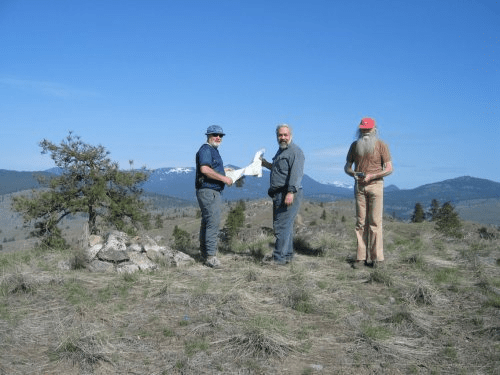
Charlie Janeway

Happy 60th birthday to John. I wish I could give him a present as wonderful as the one he has given me over the years.
Without John’s leadership, I never would have experienced many exhilarating climbs in the mountains as John was the mentor of our Group Health Alpine Society (GHAS).
For many years GHAS had at least a yearly climb of some mountain on or near a peak on John’s “to-do” list, one that he hadn’t previously “bagged” for his life list of first ascents. These were trips of six varied Group Health docs. Our packs were always heavier than John’s as he had less food and clothing than the rest of us. John seemed to survive on berries and nuts on these trips, a diet which undoubtedly accounted for his marked annual weight variation. He would gain 30 pounds in the winter only to lose it all by the end of summer. Despite the weight loss he was always a strong bear-like fellow.
After a few miles down a well-traveled trail John would cut off into the brush almost by scent. This bearded guy would then have us cross a roaring river suspended by a rope, in what I think he called a Tyrolean traverse. Then we would sweat up some steep incline through the brush, sometimes tripping over a “burn” of fallen logs to end on our backs turtled-up looking at the sky. Eventually we would breathlessly reach the summit where we were on top of the world able to see forever. From this vantage point we were ringed by mountain ranges that John knew like the back of his hand. He would name peak after peak scanning the horizon for 360 degrees to my amazement as I confess most of the peaks looked pretty much the same to me. I knew if I was there alone I would be seriously lost. With John, however, I knew we could always get home because he knew exactly where we were. John always seemed to push me to my limit but was sensitive to what that limit was and when to stop. When I got in trouble he was there to take care of me, even reducing my dislocated shoulder (twice).
Those trips were great times for male bonding where men would stink, fart and tell dirty stories, those things we would not do at home or at the workplace. Such sharing, however, made Group Health a better place to work.
Again, John, happy birthday and thanks,
Charlie Janeway
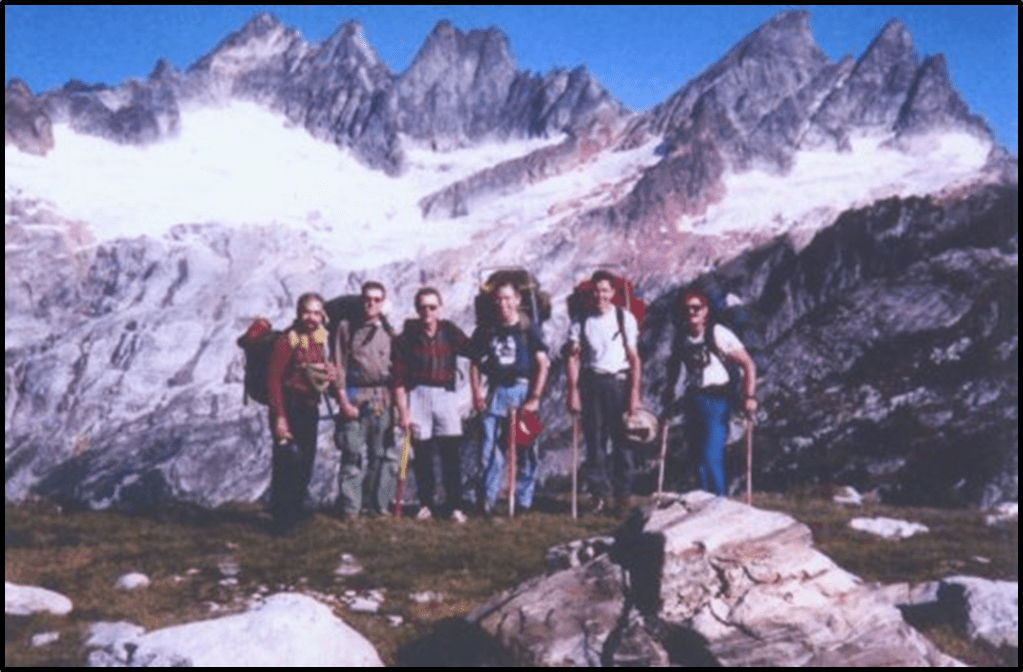
Ken Jones
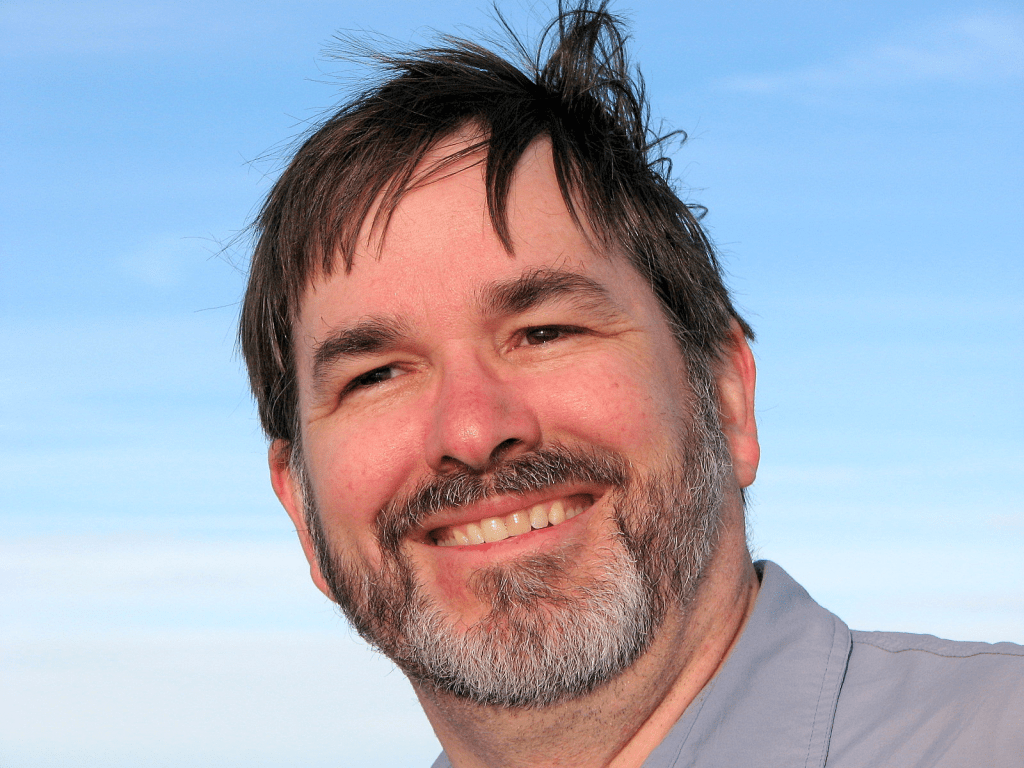
I’ve only hiked with John once, to the best of my recollection. He came on a Mountaineers trip I led to Banshee and Central Cowlitz a few years ago.
The only thing I’d like to pass on is my observation that his county highpointing accomplishments in Washington – though only a tiny piece of what he’s done in the state – are to my mind the second most impressive county highpointing accomplishment by an individual. [It’s hard to compete with Bob Packard’s overall record.]
Ken Jones
Dick Kegel
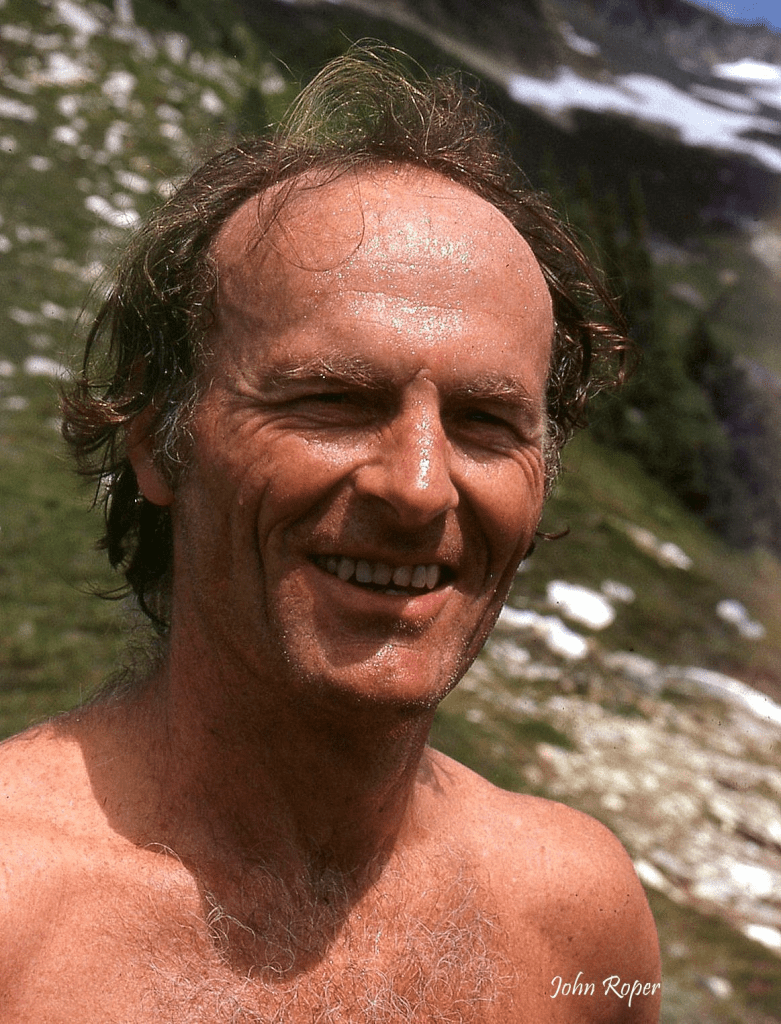
My Adventures with John
John, Bruce Gibbs and I were planning to do a two day ridge run somewhere north of the town of Index with some obscure un-climbed bumps along the way. We left John’s car at the end of the traverse and drove to the starting point. Bruce suddenly realized he might have to compete on a mad dash with a charging Rhino and leaping Kangaroo and decided a peaceful Giraffe would be better off sleeping so he went home.
John and I encountered a few technicalities along the ridge which kept the Rhino in check but the downhill stretches were a brutal competition with the Kangaroo vainly trying to keep the Rhino in sight. We made the summit of the un-climbed bump and dropped down to a brush filled valley, and then to a rock filled stream. I managed to keep up with John until about half way along the stream when my boot caught between two rocks that stopped my foot while I kept going. My foot felt like it had a broken bone so I couldn’t put any weight on it.
John took a professional look at my foot and after deciding I would live, took off for the car which (unknown to me) was about a mile away. I discovered that I could make some progress with an extreme limp but I was comforted in the knowledge that John would come back for me after a day or two of waiting at the car. A couple of hours later I managed to limp to the car where John was patiently waiting. I very much prefer the Bulger rules where you assume everyone can take care of themselves rather than the suffocating Mountaineer rules which are so inhibiting. [Xrays the next day confirmed that Dick had broken a bone in his foot.]
Coming down the ridge from Spire Peak I was racing John down a Heather slope. He realized I was hot on his tail so he proceeded to do a STANDING GLISSADE on the heather. I had never seen anyone do this but I tried it and it worked.
Another time John was leading our party down a ridge from Sharkfin Tower in Boston Basin with me close behind. When the snow ended in thick brush John stopped to put on his leather gloves. This reminded me of the scene in the movie “Bullet” where the bad guy realized Steve McQueen was determined to catch him so he strapped on his seat belt. The race was on. With super human effort I managed to keep the Rhino in sight.
Another time I was following John along a ledge above a snow field. The ledge stopped with nowhere to go except for a 10 foot vertical drop. I was trying to figure out how to climb down when John solved the problem as he leaped down onto the snow.
My trip with John on Lost Peak where he completed his 100th peak of the “Top 100” Bulger List in early July convinced me that it was a worthwhile endeavor. Until then I thought that it was much better to do interesting climbs instead of remote but trivial peaks. I realized that the adventure of exploring remote peaks where you are unlikely to encounter another living sole was very satisfying. At the time I had 41 of the top 100 using my previous philosophy. At the end of the year I had 82. The next year I finished the list. John later led me up Cascade Mountain for my 100th peak on the “Home Court 100” list.
Dick (Kangaroo) Kegel
Dallas Kloke
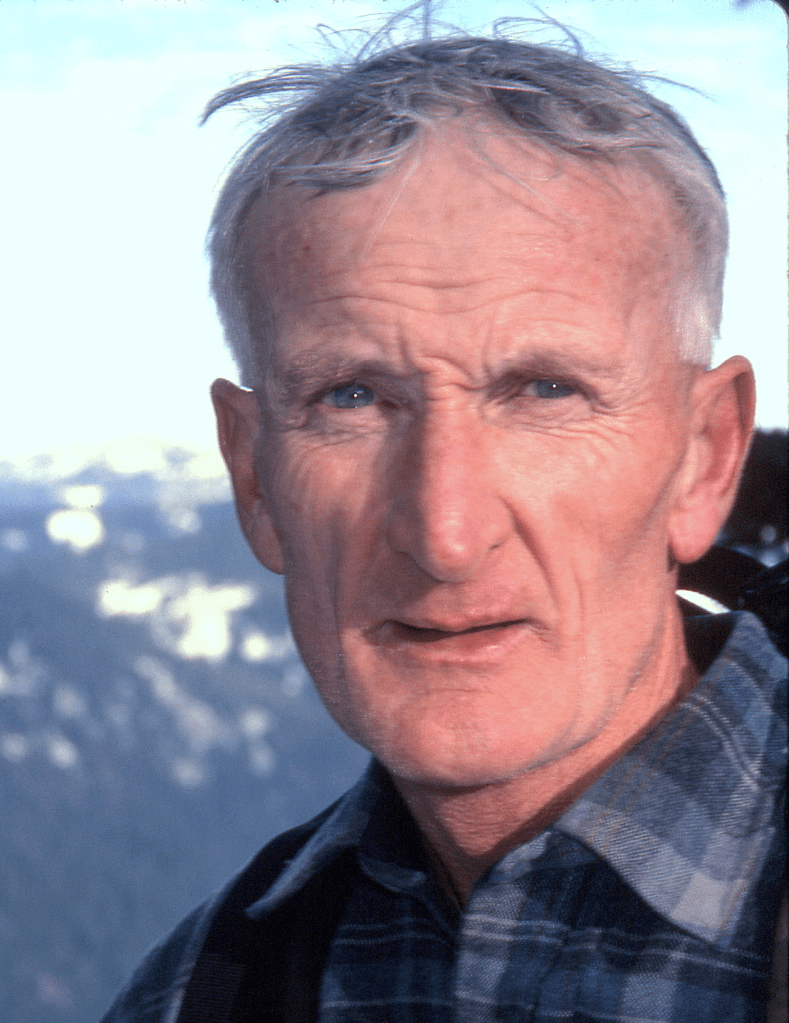
Here are some comments about the first trip I was on with John. Actually, I can only remember two trips; there could have been a couple more. John organized a trip into the Tricouni-Primus Peak area in late May of 1972.
The six of us, John, Scott Masonholder, Reed Tindall, Mike Theobald, Paul Greisman and myself hiked up Thunder Creek trail for 6 miles then took off up forest, some brush and rocky terrain to a campsite at about 5600 feet. It took us 8 hours to reach our camp. The next day we made the first ascent of a new route up the North Ridge of Tricouni Peak via easy snow slopes. It was also the 3rd ascent of the peak. We continued over to Primus Peak climbing it from the SE. I also remember John wanted Reed and me to go into the Southern Pickets with him. When we got to Newhalem it was raining pretty heavily. No way would Reed and I start hiking in there. I believe John and companions hiked in a ways but retreated.
The last time I went out with John was on December 6, 1997, on an attempt to climb Bessemer Mtn. I think we had a group of seven but had to turn back close to the summit because we had no pro for the technical difficulties. However, we did bag the South Peak. John is the ultimate peak bagger! Mr. PACK & PADDLE. There’s no doubt that John has been the number one explorer of summits in the Cascades and surrounding areas over the past 40 years.
HAPPY BIRTHDAY, John. Remember, age is only a number. “Old age” is not a time to coast, but climb.
Dallas Kloke
John Lixvar
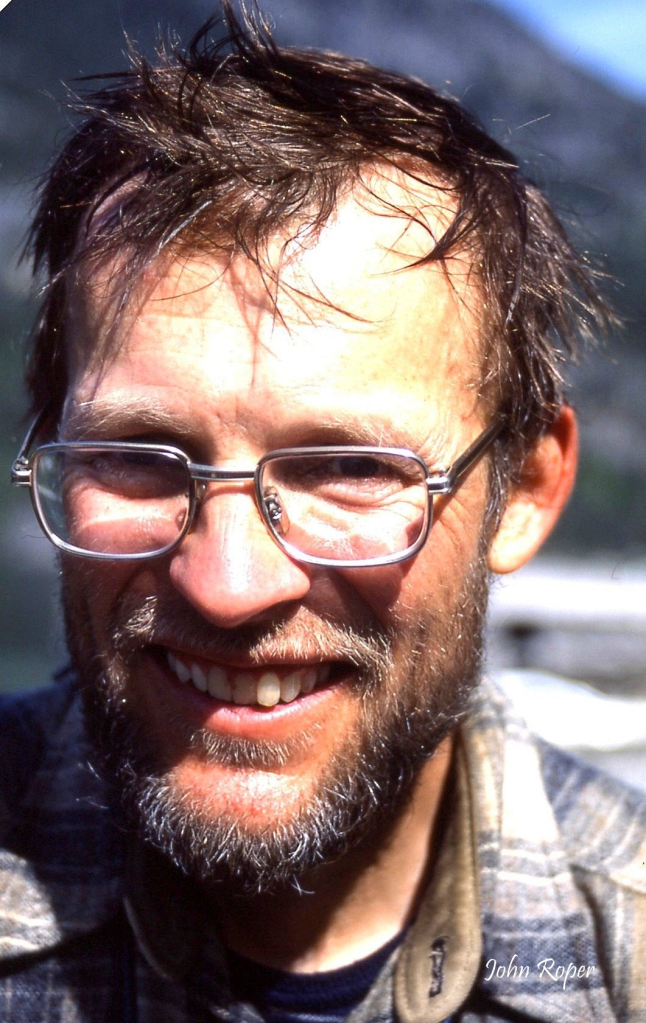
Rhino Reminiscences
A key word search through Lizard’s on-line mountaineering journal reveals only eight “Roper” entries between November 8, 1981 and January 13, 1991; although I suspect there were a few more trips where the Bulgers and the former Himmelfarhtskommando crossed paths. Without a doubt, the most memorable “crossing” occurred along the Chelan Crest in the spring of 1984 when an out of control snowshoeing Rhino cut across the front of Lizard’s skis, breaking the tip off his precious Bushwackers. The terse journal entry hardly does justice to the trauma of the event:
May 26-28, 1984 Chelan Crest Ski Tour, WNF: Get Gray, Tuckaway, and Battle Mtns before exiting via Blue Grouse Basin. Roper breaks my Bushwackers. RIP: March 9, 1974 – May 28, 1984.
To John’s credit, the Lizard did receive nominal payment for his fully depreciated equipment – a small sum that hardly compensated for the emotional loss incurred.
Other entries include joint ascents of Mt Thompson, Loomis Mountain, Mt Margaret, and a failed winter ascent of Prairie Mountain, where only Russ Kroeker went on to the summit. That climb is best remembered for Russ’ rescue by a fleet of snowmobilers sent out to find our lost companion. As I recall, Rus made the trip wearing his business suit!
I believe our last trip together was another “mixed mode” adventure where everyone but John was on mountain bikes. Lizard was leading a winter bike-mountaineering trip to Taylor Mountain for the Boeing Alpine Club. John tagged along on foot, interested in the new route I had recently discovered. Unfortunately the trip went rather poorly for the bikers. Lizard got lost enroute, and the weather turned nasty – freezing rain and wind. Our escape route was via a long road that left our plodding pedestrian [John] at a great disadvantage. Interestingly, not one of the dozen participants of that trip ever went on a repeat ride with the Shockwave Rider.
Doctor John has enjoyed a long and prolific mountaineering career that puts him at the forefront of North Cascade adventurers, along with Fred Beckey and a few others. As a goal-oriented climber, fixated on climbing lists, he is without peer. He also stands out as a fine writer with a knack for witty and sometimes absurd names – but most importantly, John Roper is valued as a good friend. May he and his family enjoy the mountains forever!
With Best Regards on your 60th Birthday,
John Lixvar, Lizard the Shockwave Rider
4 January 2004
Ian Mackay
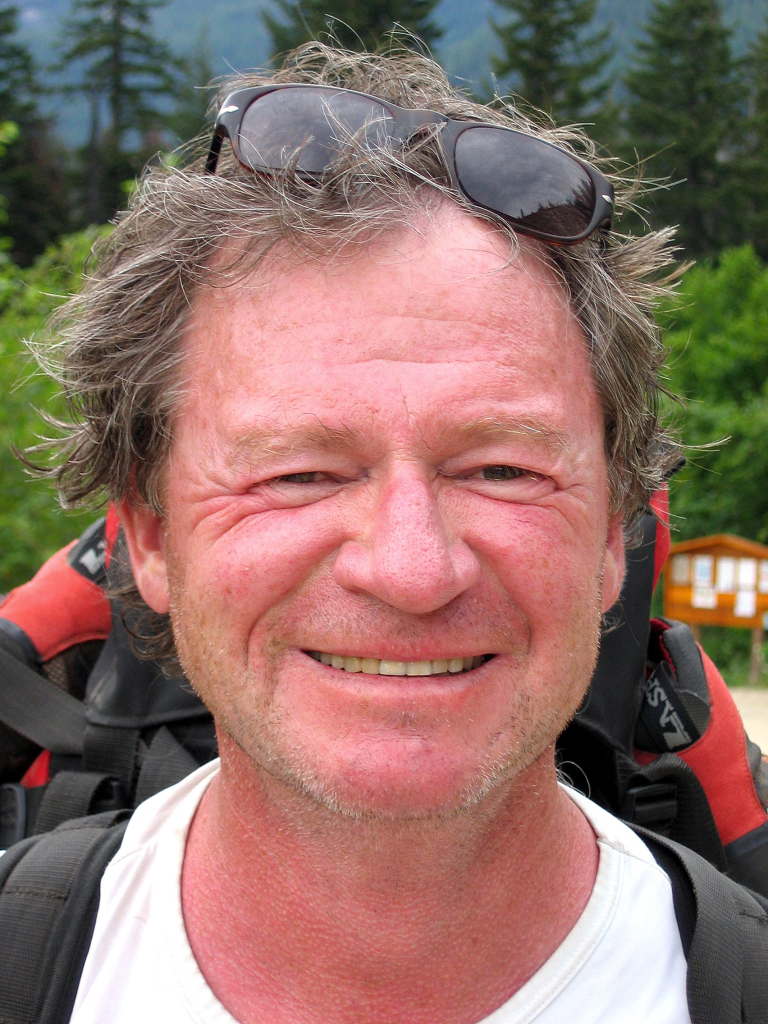
I had heard the name of John Roper and his exploits long before I met him, so I suppose you could say that his legend went before him. Our first outing was with Bruce Gibbs and Bette Felton with a friend of John’s, Howard Putter. The trip was up one of the Fife Peaks on Nov 2, 1997. Conditions slowed us down a bit so the decision to pass on the “bonus peak” and walk back down the trail really upset Bruce. Bruce was set on getting another peak and bashing down through the bushes to the car. I was impressed how John calmly handled the negotiations and heated discussion. I don’t really remember much except John insisting on taking my picture, he said he would save it for my obituary should I die in a climbing accident and he liked to have photos of all of those that he climbed with.
Our relationship did not really develop until we were jammed in the back seat of the car and I began to open my lunch. That day I had prepared a sandwich on a chewy ciabatta bread. The bread was spread with a thin layer of tapenade, a rich puree of Mediterranean olives, anchovies, olive oil and lots of garlic. The next layer was of marinated roasted and blistered red bell peppers. The next layer was cured meats from Salumi’s, veal tongue with cloves and a “killer” salami with fennel. The package was topped with arugula and some fresh basil leaves. Bette who was in the front seat commented on the aroma of garlic and basil that permeated the car. John, who was sitting next to me said that it looked pretty good, and could he have a taste. Little did I know that at that point a relationship, of sorts, was formed.
As years went by I would run into John on occasional trips and would share a snack on the trail. My lunch always looked a little better than his. John usually took leftovers from the dinner table and very old Halloween candy he stole from his son. Our schedules would occasionally line up with midweek days off. The two of us would alternate car-pooling with the 6 cent a mile always ending in debate. John rounds up but likes me to round down. Also John likes to explore endless miles of back roads when he drives, at great expense to me.
On one occasion John and I were going up to do Gee, Gosh and Golly. The road had several water bars. They were quite large and difficult to see over. My old Peugeot was not a good backroad vehicle and John kept joking that “it likes having its tummy scratched.” As fate would have it we ended up in a washout going over one of the water bars. The car was “high and dry.” I thought the day was finished but John had seen something on the History Channel about the Egyptians and the pyramids. He devised a way to jack up the car and pile some rocks underneath, a technique that slowly began to raise the car from the deep hole. After about an hour, with much creaking of the car, moving of the rocks and jack we were out of the hole. We went on to still do 2 out of 3 peaks and descend a “God awful” nose off a “not too bad” ridge. Hanging off cedar and ripping my clothing we arrived at the car soaked and tired. The front end of the Peugeot was never the same.
Upon my return I had a chance to describe the trip to my friend Mike Torok. I mentioned to Mike that “by coincidence” every time it was my turn to car pool John selected trips up some of the worst roads in the Cascade Range and that when John drove we were always on a paved road to a nice parking place. Mike Torok said that I did not know John that well and that this was no coincidence. Things have changed little, but now both of our cars are pretty much trashed.
The summer of 2002 I went on a trip with Mitch Blanton and John up Ross Lake. I didn’t really want to go at first. As usual the peak had no name but was in an area full of peaks on my dream list. As luck would have it John and Mitch had climbed everything in the neighborhood. Knowing these guys made me suspicious. My guess was that they wanted me to come to help pay for the boat taxi up Ross Lake. When the boat dropped us off near Arctic Creek there was nothing, just bushes and a steep hill side. The trip was a classic seldom “if ever” done type. We walked a spectacular ridge. Mitch commented on his love of ridges and the “sky walk” feel. The views of the Pickets in front of us, Jack behind us, south to Mount Prophet and north to Mounts Redoubt and Spickard were spectacular. We camped that night on the summit of the unnamed peak (possible first ascent, no evidence of previous blah blah) We settled on the name Mystic–I always liked that name. John is always good with name suggestions. No, John is the best with names, except for maybe Honeymoon Hump.
The next day we continued on to do The Saint and then John and I hung out while Mitch did The Sinner. We admired the views from Prophet Ridge to the Pickets and John said something that struck me. He said he would not be back this way because now he had climbed all the peaks that we could see. It seemed very cool and very sad at the same time. Once again, as always, we descended the nose of a ridge that was very steep. “I hope it goes” said John, Mitch always the optimist said “so far so good” (what a pair). More bushes and hanging of branches and down to run into a big bear. A nice day in the Cascades with good company and still more good stories. I wish John would not keep showing that slide of me standing naked at the Big Beaver boat dock, I used to look better naked but not today!
There were lots of trips mostly with no names BUT this year John seemed revived and renewed with doubled enthusiasm and much more power than in previous years. The objective was West Anderson. We rode our bicycles up a washed out road and then a nice long hike up to Anderson Pass. The bridge had been newly replaced so we were some of the first back into the area in a while. This gave the trip a special appeal. Up and over Flypaper Pass we went and then a traverse of the Eel Glacier to a nasty ridge and finally over to see West Anderson. This looked impossible and we had little gear.
I remember John saying “if it has snow it will go.” With Gary Mellom putting in a nice lead or two they inched their way up with Torok in a high-pitched voice that “this is ridiculous.”
They scaled the last 300 feet as I watched, or couldn’t watch. It was a long way to come to be a spectator but deep in my soul I knew I could not put a price on mental health. Reminiscent of the steep snow on the North Ridge of Jack, but with little or no protection WOW! John was still performing in style. I guess if you come that far you can’t go back empty handed. John’s attitude is to go until he can’t possibly go another step has got him to many summits. This one had so much “prominence” it was high on the must-do list, plus it had a name.
John continues to comment that he has figured out that if he goes out with me he can skimp on food because I carry enough for two. John is the only one I know that goes lighter than Jim Nelson. He leaves everything he possibly can.
AND then there was the trip to do Mount Thomson. We were the only ones we knew who had not done this peak. John said “Don’t worry, I will bring the tent.” What I did not know is that he only brought a tent. He had decided to leave the rain fly home because of a stellar weather report. After dinner I pulled out some 151-proof rum (to help us sleep). It was so strong it burned as it went down, so we mixed it with Gatorade. I was getting pretty drunk and a little tipsy. Out of nowhere a great rain-squall hit our camp. With no rain fly, John started pulling out plastic garbage bags as a substitute which thrashed in the wind. I said to hell with it and got in my sleeping bag.
John has never forgiven me for not helping him, but these days I take the tent. Except for a few imperfections, you couldn’t find a better outdoor companion and we go at about the same pace.
Ian Mackay
Ann Marshall
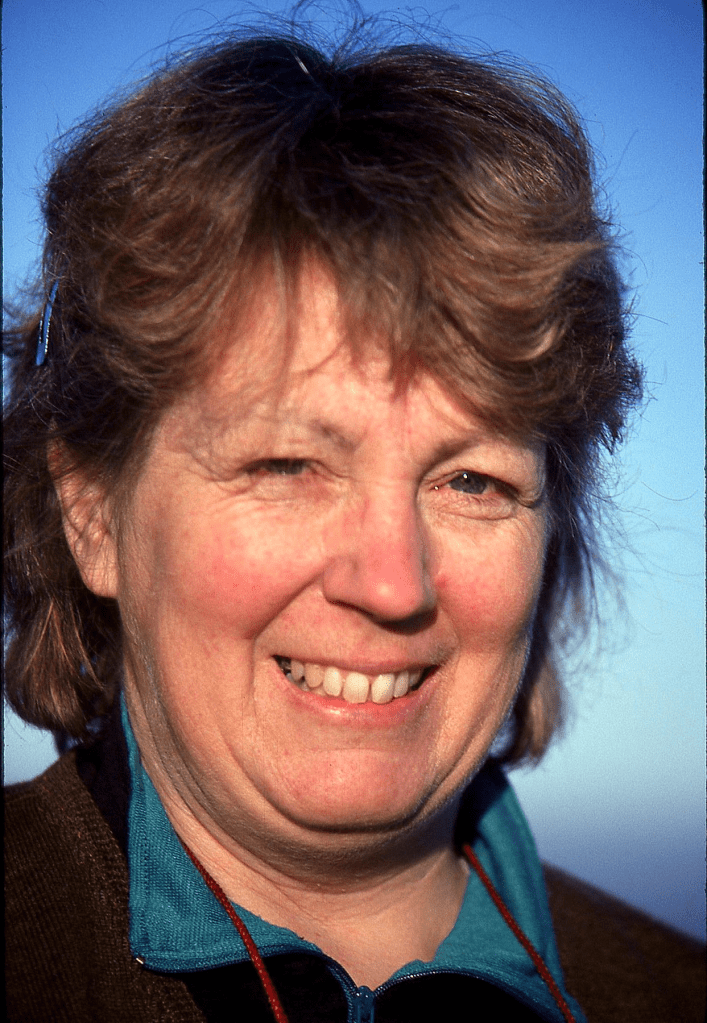
I first met John Roper at a slideshow at The Mountaineers club; we were introduced by Steve Fry. It was about 1989 and I was in the final years of my tenure as editor of The Signpost (now Washington Trails) magazine. I subsequently went to three summits with John: Cedar Butte (1000th summit party), Green Mountain (Kitsap County Hi-Point), and Baldy (2000th summit party). Not big summits, but important ones.
John became a regular and valued contributor to the pages of Signpost beginning sometime in the mid-1980s. The earliest contribution of his I can find is a letter-to-the-editor in the issue of November 1985–actually, two letters, the first railing against the use of flagging on trailless hillsides, and the second (after my editorial comment that flagging can be useful) encouraging the use of map and altimeter so flagging need never be used.
John’s contributions to Signpost continued in the form of impassioned anti-flagging, pro-wilderness letters-to-the-editor for five years.
“Tear this trash off the trees. Fill your pockets with these flags. Make the wilderness wild again. It does the soul good! It does the wilderness good,” he wrote in one inspiring letter encouraging readers to rise up against the hated plastic ribbon (April 1990).
In 1990 his contributions turned toward the descriptive outdoor essays and tales of bushwhacks, routefinding, summits and adventure that earned him a devoted following among readers of Signpost and, beginning in 1991, with readers of my new Pack & Paddle. Besides being an indefatigable explorer of mountains, John is a first-class story-teller with a knack for tweaking words. His quest for the highest summits on a variety of lists always made interesting reading, and when those treks included Karen and Aaron, John was revealed as a mortal after all–a guy with a family who liked taking his kid car-camping and who forgot his snowshoes once in a while.
John’s willingness to write up reports on little-known, unnamed peaks in a style that was not only error-free in spelling, grammar, and punctuation (and was very often funny, too) but also legible put him high on my list of favored contributors.
I hope he has many more years of mountain exploration.
Ann Marshall
Editor (ret)
Port Orchard, Washington
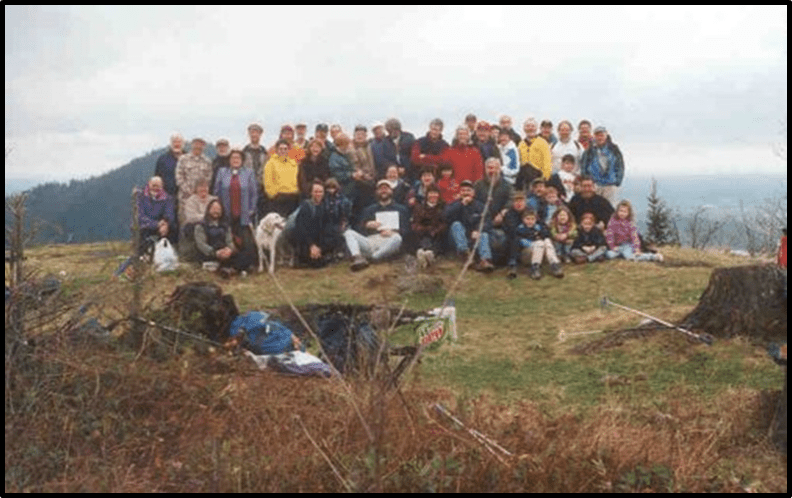
Joe Medlicott
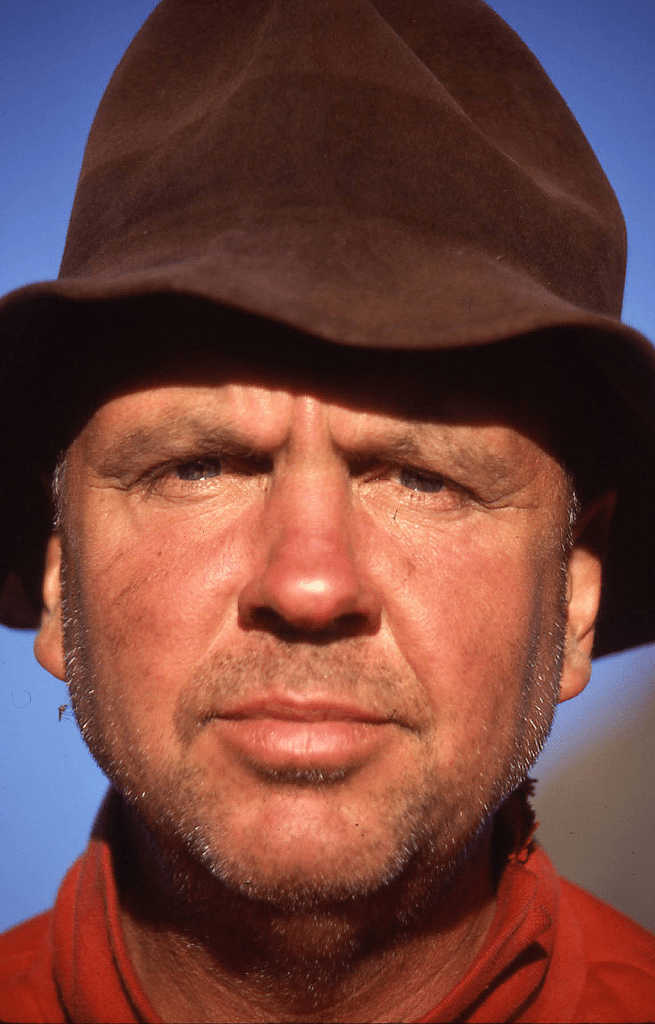
Happy Birthday
When I heard that The Old Man was turning (gasp!) sixty (60), I sat
right down to write an epic poem. But I failed. Instead, I turned to
the sonnet form. That wasn’t any good, either, largely ’cause I got
all balled up in rhyme and meter, especially the Shakespearean sonnet
form (which is the best of the sonnet forms). So I turned a few
titles that had been roiling abut in my alleged mind and came up with
two: “Romping with Roper” or “Mountain Meanderings.” “Romping”
doesn’t capture the exertion, the pain, the agony, and fear, and
sweating, the cuts and bruises of Mountain treks with Roper, any more
than does the word “meandering” bring up all those memories — and
more.
Here’s what mountains and Roper mean to me: first, there’s the
preparations. That made army paratrooper training a breeze. Forty
miles of running every day helped, as did swimming 400 laps before
and after breakfast and 150 right before supper. Then there was the
packing and planning. I soon learned that I couldn’t bring my steamer
trunk or accordion on any trip with Roper. One pair of socks, a
pocket knife, sleeping bag, rain gear, two handfuls of dried nuts and
an orange was all I needed for at least a week. A good attitude
helped considerably as well.
Then the trip itself. At least eighteen (18) hour days was the rule.
An exception to Roper-rules every day was piling into the sleeping
bags while the light still hung in the western sky. Breakfast —
three raisins, a cup of cold Swiss Miss, and a slice of sausage was
an hour or more before dawn.
At the end of every trip, however, Roper allowed a legitimate reward:
hamburgers and milkshakes and greasy fries and a several cans of cold
Rainier (before that memorable company went belly up or got bought
out by some European candy conglomerate).
Now I’m old and creaky and I snap and crackle when I walk first thing
in the morning. But I remain youthful at heart and childlike in
memories because of Old Man John and his Mountain Meanderings, his
Roper-Romps. I’m ever so grateful, pal. Those were the days. I shant
forget them.
Happy Birthday. Keep climbing and romping and meandering. All that
stuff makes you a better person, a stronger character. And God knows
we need all the character we can summon up in our time.
Old Joe Medlicott
One of the Real Guys
Mick Newhouse
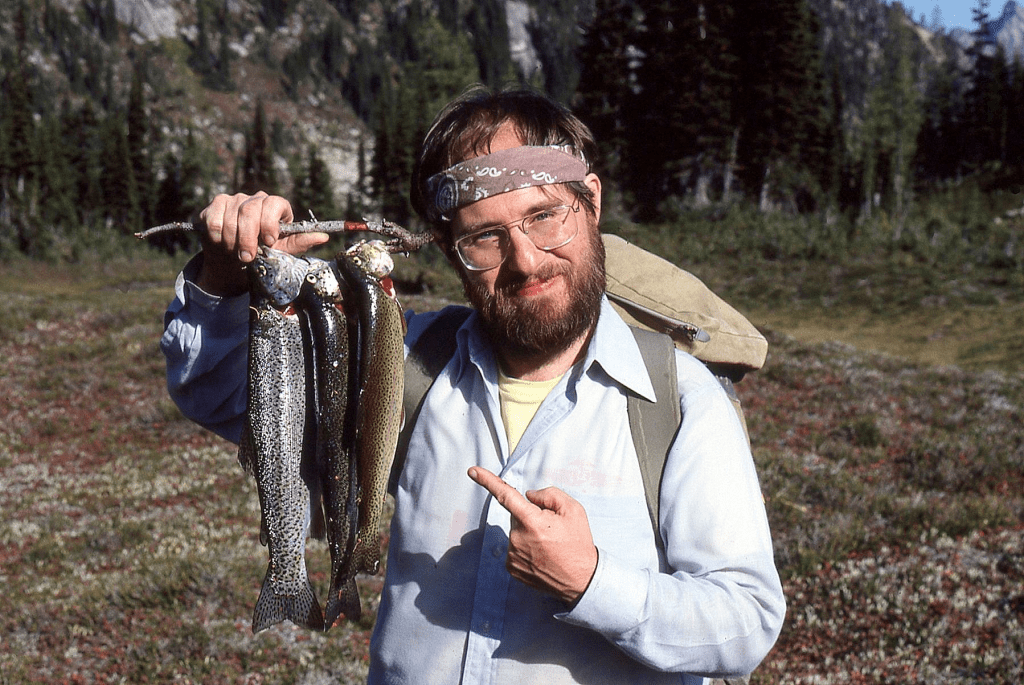
Because John must have left his 11-gram back-country cardiac defibrillator at home (“a good thump on the chest is as good as that glorified electrocution device”), he was forced to let me take a 5 minute rest after I went into ventricular tachycardia on the way up to a first ascent of Pachyderm Peak, my first hike. Copping this little rest was great because it was the first time I really could take in the spectacular beauty of the Panther Creek watershed.
Two months before that crystal clear September day in 1984, John had suggested this climb up into Ragged Ridge in order to rescue me, I suspected, from my post-divorce ennui. (John seemed to know about divorce.) When I first heard him make the offer, I immediately collapsed on my sofa as I had never before ventured out of doors in the daytime. Pathetically, I begged off, but thankfully reconsidered a few weeks later.
This was to be my second major rescue by John in our 34-year friendship. The first rescue took place at our first meeting in Danang Harbor, Vietnam in 1969 when he yanked me off a ladder leading down into the bilges of a decrepit and soon- to- be scrapped Navy support ship, the USS Washburn, or something like that.
I fancied myself a fearless antiwar activist struck side’da face by Richard Nixon for saying I believed in the Bill of Rights, but a less grandiose explanation was probably more like it. Instead of the narrow rope hammock which awaited me under the water line, John offered me a bed in his comparatively luxurious officer’s stateroom for the long trip back to San Diego after he found out I was the “Marine doc the Navy was shitcanning.” It was great for me; the stewards served me hot dogs from sterling silver platters in the officers’ mess and I could record all of John’s LP’s onto my reel-to-real tape deck.
The third rescue (I’ll skip the others) was during a white out on the Tasman Glacier in New Zealand where I learned the value of a good altimeter from watching John and then following him dutifully. My apotheosis from Couch Potato to Mountain Potato was one of the many Great American Stories directed and produced by John. In addition to these adventures, Mount Whitney, Gypsy Peak, the Matukituki, Mount Ruapehu, Langtang and other mountain saunters, my friend the mountain drill instructor taught this acolyte the simple wisdom and profound metaphor in “John’s Rules for Walking in the Mountains”: Every ounce of gear you can leave behind will make the enterprise less uncomfortable; ..walk at a pace, no matter the speed, that you can maintain all the day (because you will);.. if you lose your foothold, gain another; quickly!… don’t even leave footprints. There were others, but you know most of them if you’ve ever been with him.
But the first time I saw him out in the forest was in 1971 when he danced, no, flew, effortlessly through the trees like a pixie on acid, all the while singing: “Green is Good, Green is Good. “
The last time I saw him in the forest, the song was “I love the 900 highest peaks as determined by the ‘200 foot divided by the square root of 7 over the distance in meters from Bellevue’ rule”.
Most of the time I’m thankful he’s my friend. All of the time I love him.
Mick Newhouse
Rose Lochmann
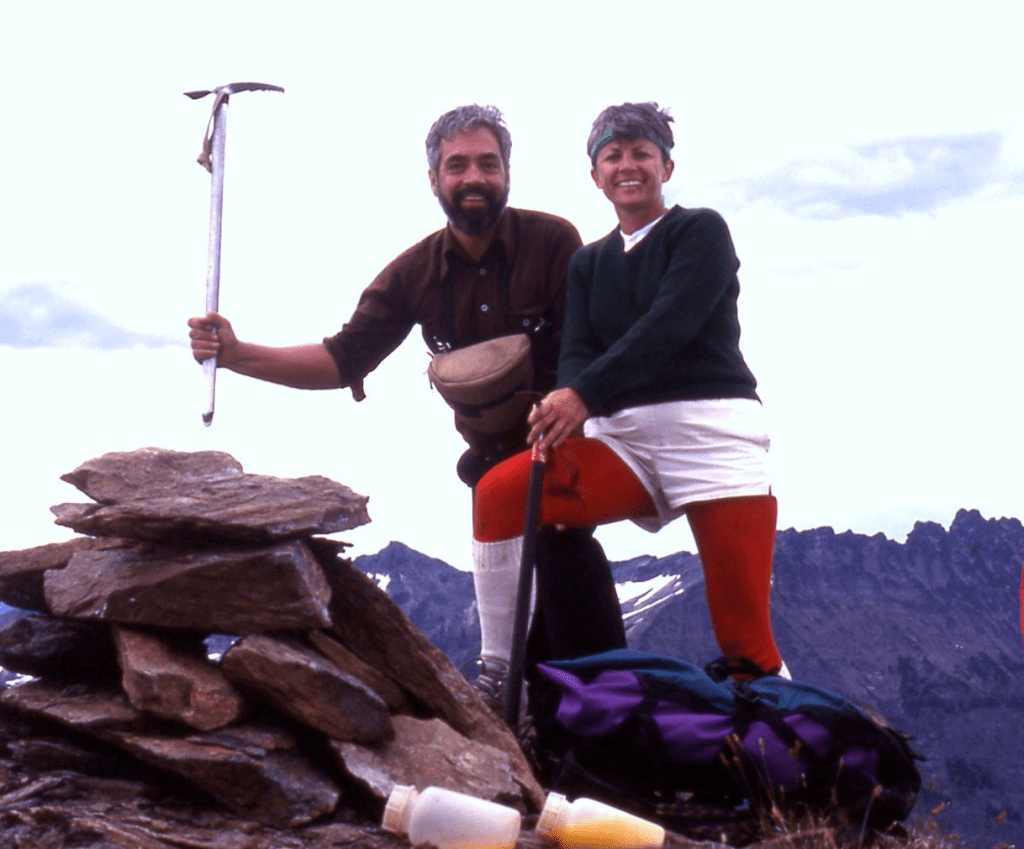
My introduction to John and Karen was in 1987. Mick and I met them on a lonely deserted road somewhere in Washington – late in the afternoon – to car camp. The lasting memory about that meeting was the unbelievable stories they told about their courtship – particularly Karen’s perilous journey over the rushing river on a precarious log. That story got my attention. We four quickly became friends and have had the pleasure of enjoying many vacations and hikes together.
I was privileged to be one of the chosen to do a first ascent with John and I consider that to be one of the highlights of my life. It seems as though I have known John through a fast forward phase of his life. In a relatively short period of time he married, started a family and adopted a different lifestyle. Well sort of. We have never visited John when we have not done some amazing hike or excursion. Aaron was about six-weeks old when we went hiking with him for the first time. John is the expert planner and organizer. No matter how full the car is we always ALL fit in with enough supplies to get to our destination.
I appreciate and love John for all the wonderful experiences he has interjected into my life and the joy of being a small part of his life with Karen and Aaron. John, can’t wait to retire so we can do more vacations and hikes!!!!!
Love, Rose
Mark Owen
I have only been out climbing with John three times but each was very memorable. My one over-riding memory is the great joy he has in the mountains and how that joy pervades the group until we are all having a great time no matter what the weather.
We were on the summit of Arrowhead Mountain in a whiteout with blowing snow in our faces discussing downroutes and before anyone could make up their mind how to go down there was John going down the steepest ridge without a care in the world. I thought, “Crap, I’m not going down that way,” but John seemed so confident you couldn’t help but follow him. He was right on the mark as usual and we safely made it down.
Our trip together up East Garfield was memorable because he knew that Bruce Gibbs would get under my skin concerning my religious beliefs. So he made sure we knew we were about as opposite as they come and then proceeded to forge on ahead as we argued about everything under the sun! Thanks John!
Mt. Price was great because John showed us all how to fall into a creek and still have the upper hand. After getting out on the other side after the wetting he quickly reminded all of us that the same damn thing could happen to us. Do you think he offered us a hand? No way, he just watched as we all crapped our pants getting across hoping all the while we too would fall in.
Thanks for memories John and thanks for all the information and advice over the years! You have been and I’m sure will continue to be a blessing to all of us who call the mountains home.
Happy 60th and many more to come!
Mark Owen
Bob Packard
Wish John Happy Birthday for me and many happy returns. He has been of great help and encouragement to me in my attempt to finish the Washington County High Points. He loaned me several of his maps and in fact he guided me on a memorable climb of Buckner.
I’ll never forget the first time I was at your house and met John. Dick Michelson drove me there. John met me with camera in hand. I had my picture taken even before formalities. Flattering I suppose to have my visit “documented”.
Sincerely,
Bob Packard
Jim Pinter-Lucke
John “Mountain Goat” Roper
Where to start? So many wild and crazy trips with John. Should it be the bushwhack up the ridge to Bouck Lake for an hour’s fishing, the Fourth of July snowstorm and climb of the Blip, the hour to bash through a quarter of a mile of vine maple, the daring ascent of the Devil’s Toothpick, or the more leisurely trip up Mount Hood to prove at age 47 we still weren’t too old?
While I appreciated John’s company on the Mount Hood trip, 30 years after my first climb of the mountain I grew up with, it was not typical of a Roper romp: the weather was perfect and there was no brush to soak us either with rain or our own sweat.
More typical and more memorable was the Fourth of July trip I took with John and Gary Mellom into the Southern Pickets. Naturally we started in threatening weather up a short trail and into the brush. Only John would have known how to reach the basin below the Blip and the Blob, but even he could do nothing about the weather. We were soaked by the time we stopped and could not see much through the clouds, but John assured me that our goal was right over there!
The next morning we rose to snow and spent the day in the tent playing cards and trading lies. That was great for getting to know Gary and hearing about the good old days at Concrete High.
Finally on the third day we could see the Crescent Creek Spires. Of course they were encrusted with snow and not at all inspiring. There were even minor avalanches from the new snow – really just snow sloughs, but impressive to me. As we were running out of time we decided to tackle the Blip. This is a minor summit between the Blob and East Twin Needle, both much bigger. We wandered across the basin and worked our way up the snow to the base of the Blip. Seeing no more snow we stashed our ice axes and climbed up the ridge, only to find a gully leading directly to the summit pinnacle. Of course that gully was full of snow and I was somehow elected to lead up this slippery slope, carefully kicking steps for the team. I then got the privilege of leading up the rime-ice encrusted final tower and to be the first to stand, no sit, on top of this summit.
The rest of the trip has faded from memory, though I have the distinct recollection of swinging down the slope below the Stump from one vine maple clump to another and arriving back at the car soaking wet. But of course the Roper home was only a few miles away where there would be warmth and good food. Another highly successful ramble through the lovely if not welcoming North Cascades! Probably another pair of pants so thoroughly trashed that they would never see the light of day again.
I certainly know that the jeans I wore on my first trip with John to Bouck Lake never recovered and I never did adopt John’s attire of thrift-store polyester pants. He may have been way ahead of his time there: most of my serious outdoor clothing is artificial now!
Jim
Austin Post
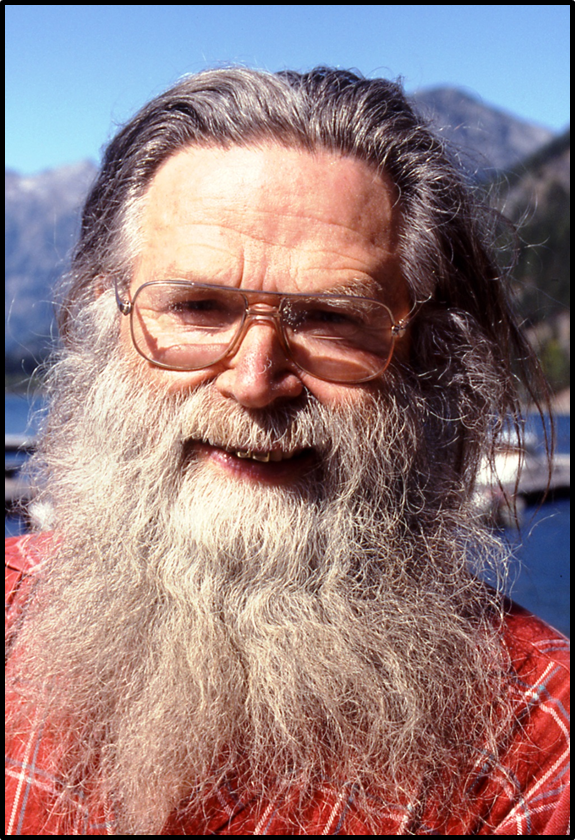
This winter’s (?) snow is rapidly melting at this moment. Proof that the world is still going its way through space and doing its usual thing regardless of all the foolishness humans get involved in. Pretty incredible when one thinks about it. All those billions of years getting here, preparing these hills and mountains for us to climb and the billions of years which will change it all come the future and such inventions as human beings are long forgotten. And we egotistical critters called Homo sapiens feeling all this was prepared just for us personally, and, as far as we are concerned, it was; if we weren’t here, who would be aware of it at all? Pretty incredible!
But the earth is here and so are we, and those hills are to be climbed, including the mighty heights of Vashon Island and over in Douglas County. So, it is a case of what is next. Have any good ones planned, John? Say, next spring about wildflower time in the desert and spending another night at Barker Canyon? That place really appeals to me, sure glad you found it.
Or another trip up Lake Chelan with John Burke’s boat would sure hit the spot. I could poke around the Purple Pass trail and you eager beavers do Rainbow Mtn, something like that. I’m still looking for the right photo of the lake and the weather wasn’t all right last summer.
I understand you are passing the 60’s barrier. If reasonably lucky, another decade of real activity, then definitely slowing down so those Douglas County Alps actually become mountains for you after all! Whatever, it’s been a good life for us all, John, and I’m glad you have made me a part of yours; these outings have been really appreciated.
Sincerely,
AP
Don Potter
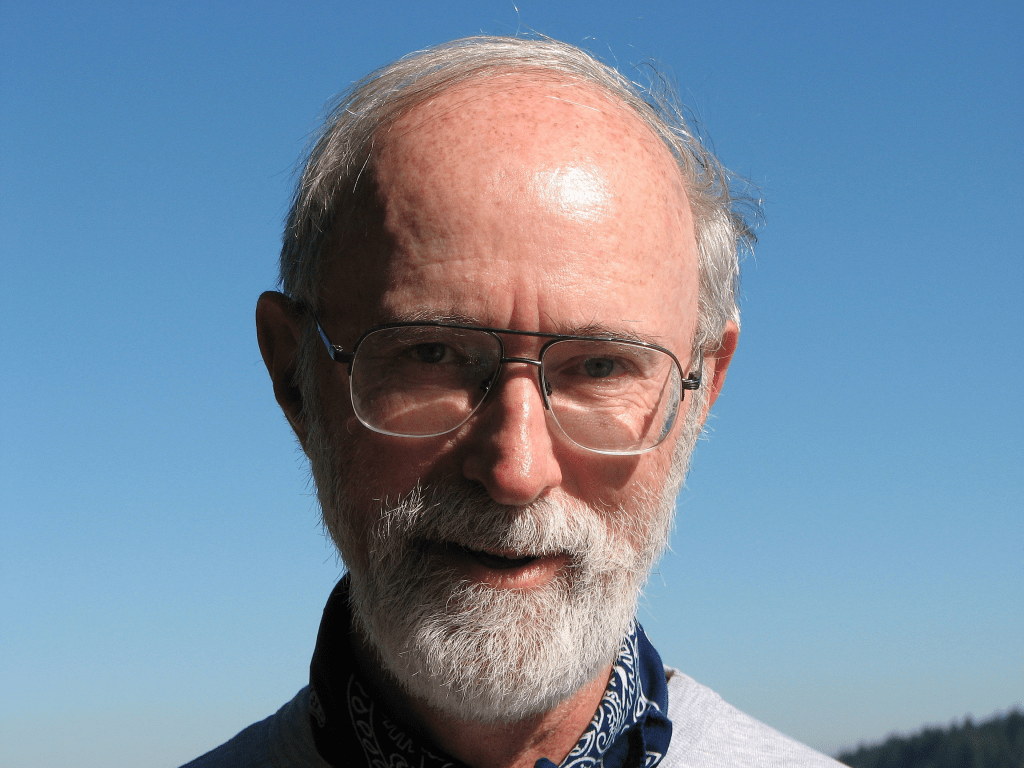
I have hiked a couple of times with John, as most of us have–including that memorable 2,000th peak near Enumclaw a couple of years ago, when many friends and family joined together in celebration. But I have the privilege of knowing John in a combined manner that few others have, both as a hiker but also as a fellow physician at our clinic, the Eastside Primary Care Clinic at Group Health Cooperative. I have the chance to speak with John a couple of times a week, sometimes about medicine, but more often about the mountains.
Often, I just receive inspiration form John, to get out and see the wonderful world above us. I do a lot of “virtual hiking” with his write ups in Pack and Paddle , and other e-mail reports. Often I review the maps and enjoy following the route.
Another interesting sideline of John’s is to contribute his knowledge and suggestions to the Washington State Board of Geographic Names. Only a person with a mind for details can be a witness for an insignificant “knob,” or small stream, or un-named ridge, with such accuracy and knowledge. Can anyone else come up with the list of all the features in the state with the name of Squaw, or Breast, or any other named feature as accurately as John?
So, John, I hope I can crawl to the top of your 5,000th peak with you! You’re an inspiration to us all.
Howard Putter
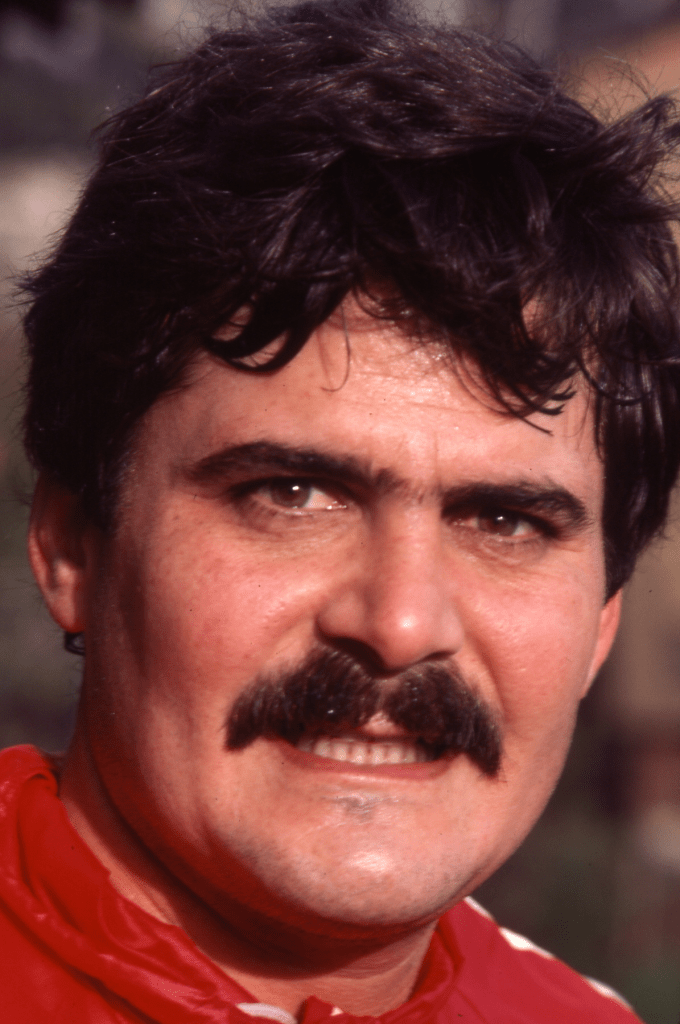
I remember climbing with John many years ago in the Stuart Range. I was hot and tired and in the distance was a shiny, blank, large, pink wall. It looked impenetrable so I turned to John and said, “Why bother to walk all the way to the base when clearly we wouldn’t be able to climb it?”
John looked at me and said, “Can you do the next step?” Then after I agreed the next step was no problem, he said, “Keep going until you can’t do the next step.” We kept going and soon we were on the summit.
This is one of life’s great metaphors. Often we see in the distance an obstacle we think we can’t overcome, so we think why bother and we give up. If we keep going until we can’t do the next step we accomplish a lot more in life and find that many perceived obstacles in the distance aren’t insurmountable.
Happy Birthday John,
Howard Putter
Tom Rainey
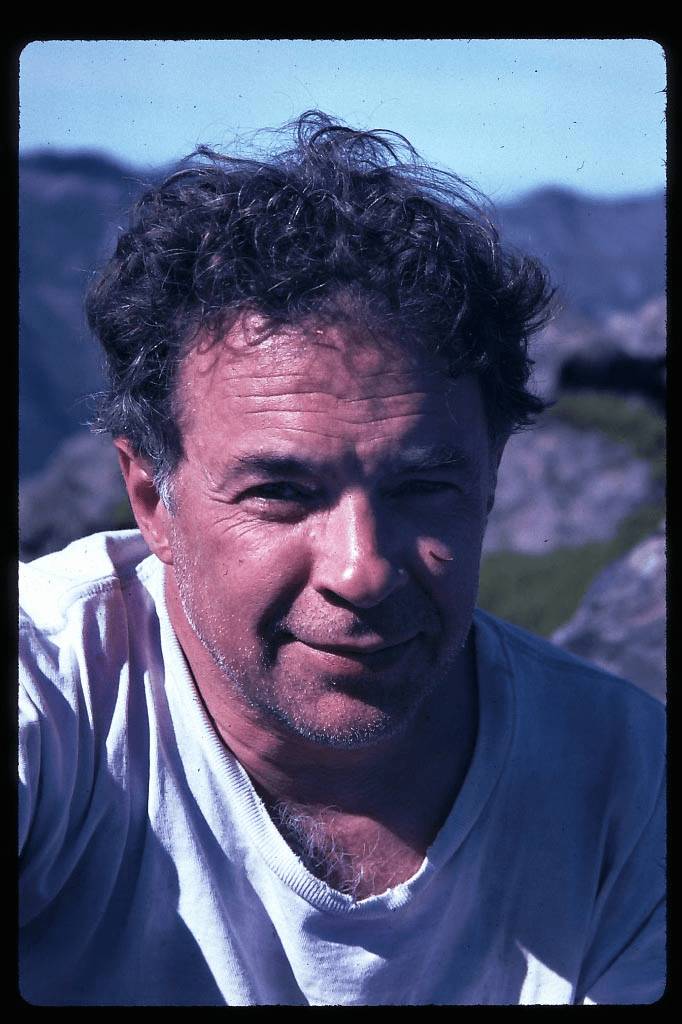
One September in the early 80’s Mitch Blanton and I were heading up Terror Creek for our first foray into the Southern Pickets. We were paused trying to figure out the route out of the valley and into the high country when we heard a thrashing and crashing in the jungle ahead. Soon two characters appeared out of the thicket. It was John and Gary Mellom who were on their way out of the range. They kindly provided us novices with good information about how to gain the high traverse, how to cross the Barrier and also about the “secret” way out they had just negotiated. This info helped make out trip a success and I have always been grateful.
Through the years I have gotten to the top of many mountains and for the most part, John has left his mark before me. At first this was aggravating, then comical and now I have learned to accept it. John has climbed most of the peaks around and certainly all of the good ones!
In the last ten or so years John has become a friend and climbing companion. His humor and energy have brightened many a trip. He continues to provide people with useful and accurate information. I am happy to know him and can’t wait for the book!
Happy Birthday John,
Tom Rainey
Jim Richards
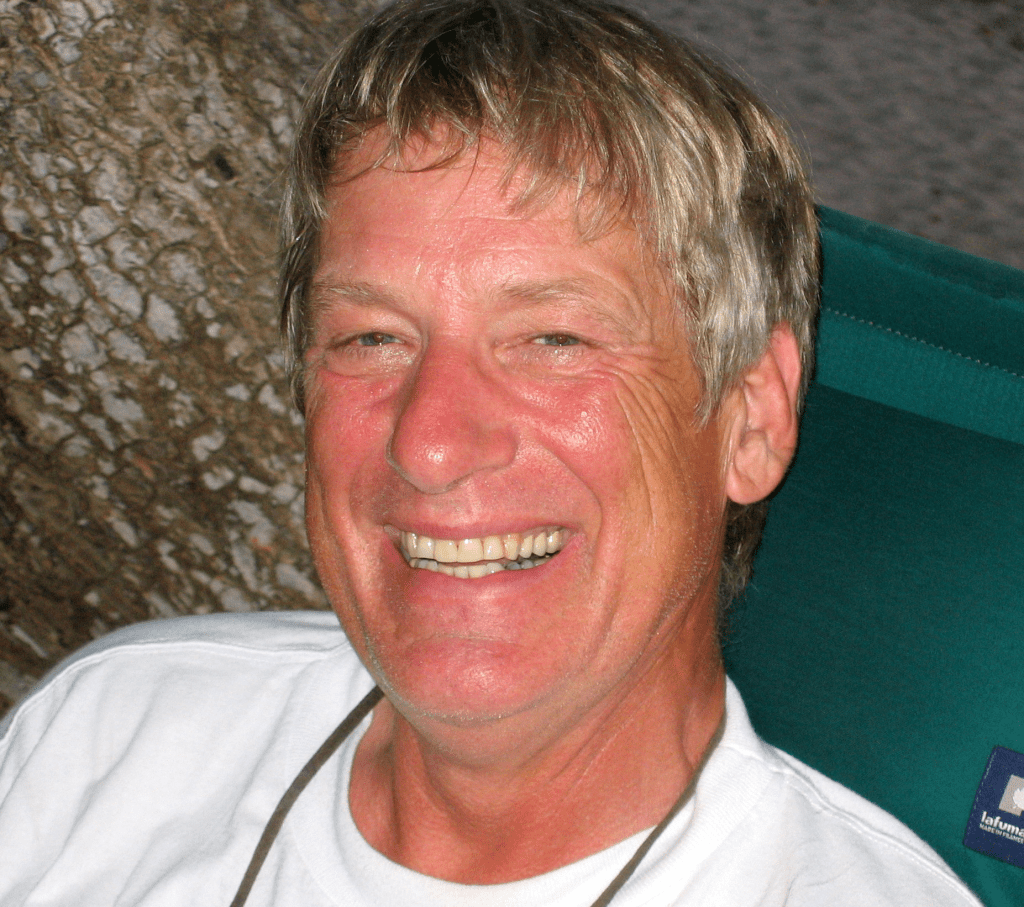
Blacktail Butte
Since the early ’80s John and I have regularly wandered around together, mostly over various Washington peaks, often in the company of other Bulgers and fellow travelers. I learned early in our friendship that John was, and would always be, far more knowledgeable about the terrain we traversed than I. Whenever we arrived at a view point, if asked, John would quietly and confidently name every single peak in sight. His climbing resume was even more astounding: over 2,500 named peaks with The List growing every week or two year ’round. It seemed a very long shadow to huddle in but it also seemed that I was always welcome there.
One of our most recent outings, in the summer of 2003, was a rather mundane undertaking which, nevertheless, was great fun and also exhibited some of John’s more pronounced inclinations. John has already reported on this trip in “Peakbagging in NE Washington,” July, 21-22, 2003. My version of events is slightly different than John’s.
The trip was initially billed as a weekend endeavor involving two peaks near Lake Chelan-their names now escape me. I signed on eagerly. However, as the week wore on (and other invitations were declined) John became increasingly inclined to do half-a-dozen lesser peaks in the northeastern part of the state. He fairly and, as it turned out, accurately described them as unremarkable. Not explicitly stated was that over a single weekend The List could be lengthened by six rather than just two names. Nevertheless, I agreed to the revised destinations.
Conscious of his disdain for new-fangled devices, on the drive east I only very gingerly unlimbered a GPS. John eventually deigned to notice the instrument and inquired, with a distinctly skeptical inflection, whether it had ever “saved” me when lost. I allowed as how it hadn’t but thought to myself that it probably had prevented me from becoming lost—as had old-fangled devices like maps and compasses done the same for us both.
The trip’s first objective was Blacktail Butte, noteworthy (in John’s mind) due to the fact that it has 1986-feet of prominence and John had already climbed all the Washington peaks with greater prominence.
First, though, we needed to obtain car-camping supplies at the giant Wal-Mart in Colville. These, it turned out, consisted of junk food and cheap beer. While there John also acquired a $12 pair of moccasins and two visors which he negotiated down to, as I recall, 50 cents each. (I suspect the salesperson had had limited experience with clientele who treated Wal-Mart like an Indian bazaar.)
Thrift having been given its due we headed to the heights of The Butte. This consisted of bushwhacking up several hundred feet to a rocky knob which John seemed to indicate was the summit. I recall a hand being extended in congratulations. I peeked at the GPS and suggested we had about 300 feet to the SW yet to go. After consulting his electronic altimeter (an apparently permissible newish-fangled device), John graciously agreed to wander in the indicated direction. Soon we were on the true summit.
John responded equally graciously to the teasing I inflicted while consuming several, several of his beers that evening. I suggested to him, and subsequently to a number of our mutual friends, that the incident on Blacktail called into question every previous summit on The List and that the only way to remove this shadow of doubt would be to re-ascend every claimed peak—-with a GPS.
I suspect that this will be the only time my navigating will come close to outdoing John’s and I’m forced to admit that it took $15 billion of DOD satellites to do it.
Jim Richards
Dusty, Toby and Christina Steere
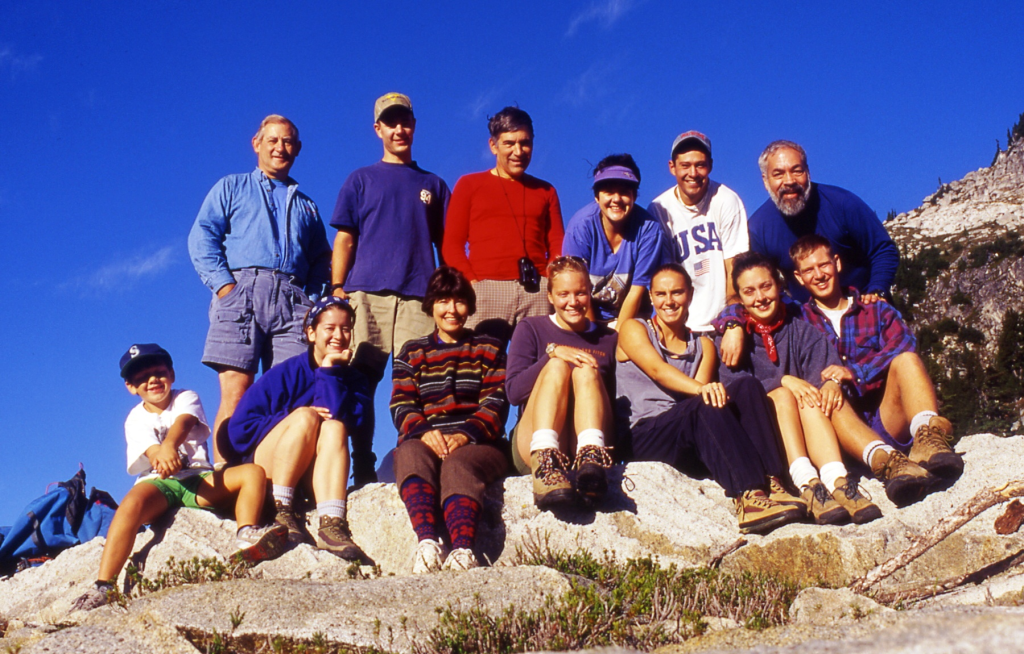
Hidden Lake party includes Gary Mellom, Toby Steere, Monte and Ellen, Dusty and Christina Steere, Sarah Steere, Denise Toal, Aaron, Karen, Ella and Grady Steere, and John.
Growing up in the Steere family, Toby and I were initiated early on into the joys and challenges of backcountry living. However, it wasn’t until we climbed our first nearly 9,000-foot peak with John Roper that the Steere cousins fully understood how to pack for a Roper climb.
Our destination was Black Peak, tall and commanding rising from deep within the North Cascade mountain range. The climbing party consisted of Tex, Toby, Dusty, Monte, Grady and Nigel Steere who followed our fearless leader John Roper. Down at basecamp our packs had been considerably lightened as John paired down our “10 essentials” to what seemed like 3 essentials.
The climbing trip was a fabulously memorable experience as we all summited Black Peak on a sunny summer morning and took in the glorious views. However, as the climbing party began its descent back to the cars, young Dusty felt the call of mother nature and announced his urgent need to vacate his bowels. He quickly emptied his backpack in search of toilet paper but found none. Frantically, he asked John to use some of his.
John smiled, reached down, selected a smooth rock and handed it to Dusty with this advice, “Don’t squeeze the Charmin.”
Grady and Nigel Steere
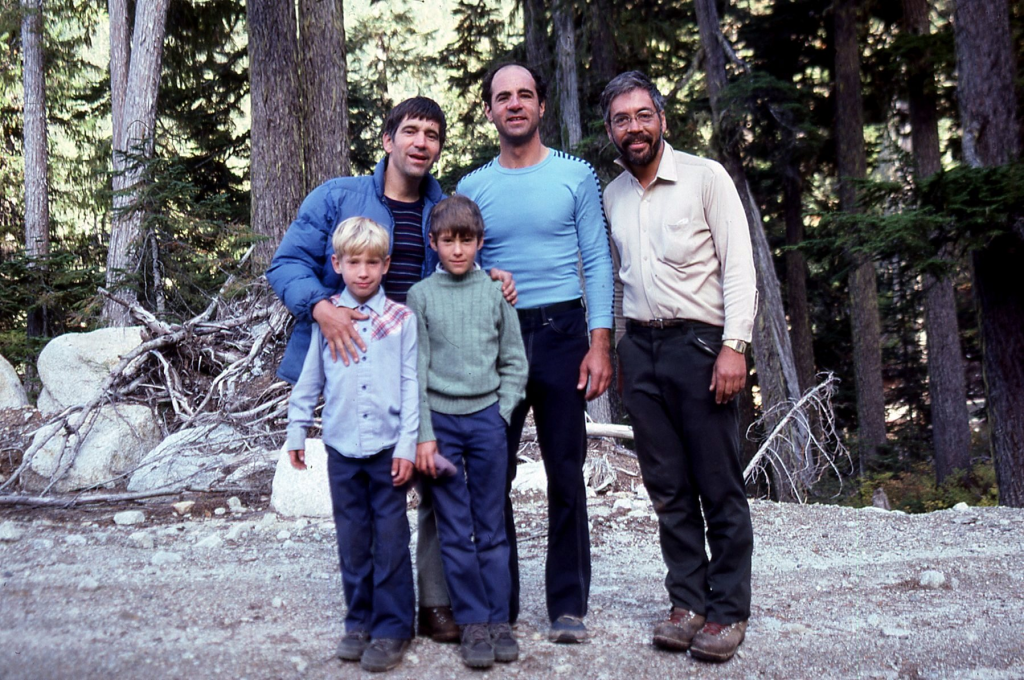
Trip to Tommy Thompson Peak via Granite Lakes September 1985.
Grady and Nigel Steere (FCORs, first cousins once removed) are initiated into the world and nature of true “Roper” climbs, leaving the beaten trail to forge off into wild and adventurous territories.
The adventure began at the end of an old logging road up Boulder Creek, off the Cascade River, outside Marblemount, WA. The party was led by John (of course) and included Monte, Grady, Nigel and I believe Gary Mellom was also with us.
We hiked the old road while John pointed out big Douglas fir, Silver fir, Cedar, and Hemlock with the “droopy top”. Each hike we went on with John was a platform for teachable moments and he always took advantage of them, quizzing us on all the coniferous organisms along the way.
The overgrown road/trail led to lower Granite Lake where we dropped a fishing line to try our luck with the trout. I remember taking some nice fat female cutthroat, thick with bright orange roe.
John, the constant instructor, filled us youngsters in on the delicacies of Russian Sturgeon Caviar and convinced us to indulge in the finer art of Trout Caviar! One little taste was enough. I remember it being quite bitter. The fishing was good and the weather was spectacular, but we had to continue on in pursuit of our true fishing quest, the rare and little known Grayling, a salmonid cousin of the trout.
Up and over a small saddle was Upper Granite Lake, one of only a few lakes in the state which was known to hold this rare fish with a large dorsal fin. We camped at Upper Granite and caught several specimens, admiring their bright spots and oversized dorsal fin much like that of a marlin. In addition to the fun of fishing was the abundance of frogs in and around the lake. Soon Grady and Nigel were armpit deep in the nearby mud pools chasing these “glacier frogs.”
The next morning we woke early, but did not pull out the poles. It was time to climb. The real goal was the rocky summit to our south, Tommy Thompson. In order to get there we would have to ascend the boulders and snowfield above the lake. On the snowfield hiking with John out ahead, we heard the audible “croak” of a flatulent. All of us moaned, but John insisted it was one of the rare snow-dwelling “glacier frogs” which we heard throughout the day “croaking” up ahead (curiously followed by a uniquely unpleasant odor).
I remember being terrified as we crossed a portion of the extremely steep snowfield, and could only imagine our fate as I observed the small “glacier” disappear over a cliff below us. We had no crampons, and John was the only one with an ice axe. John would have had fun explaining to our mother if we fell. The summit was achieved after we ditched our packs and scrambled a steep pitch to the top.
That evening we camped above tree line in a massive granite boulder field surrounded by a natural Cascade Stonehenge. The summit was cool, but these boulders were even cooler. We had a blast coming up with names for each rock, like “Splashdown”, “Almost Impossible” and “Open Book”. We were figuring out routes to the top of these bus- and house-sized rocks until the sun went down.
The Tommy Thompson/Granite Lakes climb was full of good fishing, great “bouldering” and a learning experience that will last a lifetime. As a memento of our “initiation,” John gave each of us our own Ice Axes the following Christmas. Each was custom-engraved with our names in big letters by John himself, using a hammer and a nail to “peen” the aluminum shank. I think we were all proud. Grady and Nigel Steere
Monte and Ellen Steere
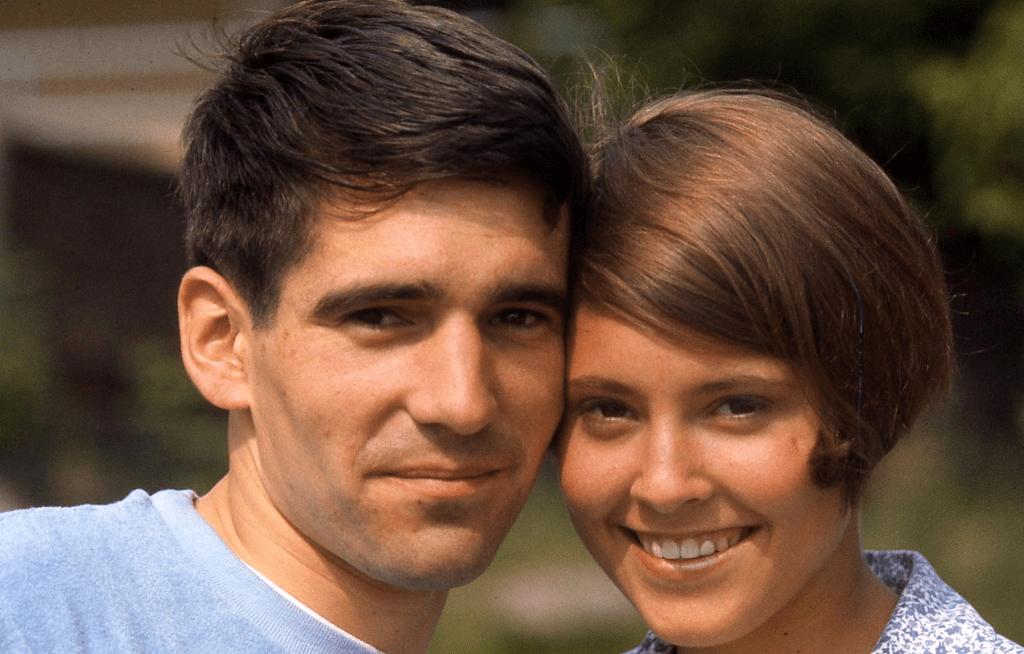
Dear John,
The great memory-makers you gave to Monte’s life include Wilcox Lakes, Popcorn Point, and Tiwicef Lake, among many others.
“It’s just over the next rise” echoes through our minds—a motivator you would use to keep us going toward the goal you had set for us (Ellen especially noticed that). However rigorous the hike might have been, we loved using a permanent marker to add the name of each hike to our red 1970 REI state of the art backpacks. It was fun watching our hiking achievements list grow. We still use those backpacks to haul elk out of the wilderness when Grady is successful in his hunt.
Happy Birthday cousin! You’ve just caught up with me again for another four months at the big six-(oh!…Monte) trip around the sun.
We wish for you many more mountains to climb, stories to tell, and encounters to experience with family and friends! So, happy 60th and looking forward to many more memory-makers,
Love from Monte and Ellen
Tex Steere
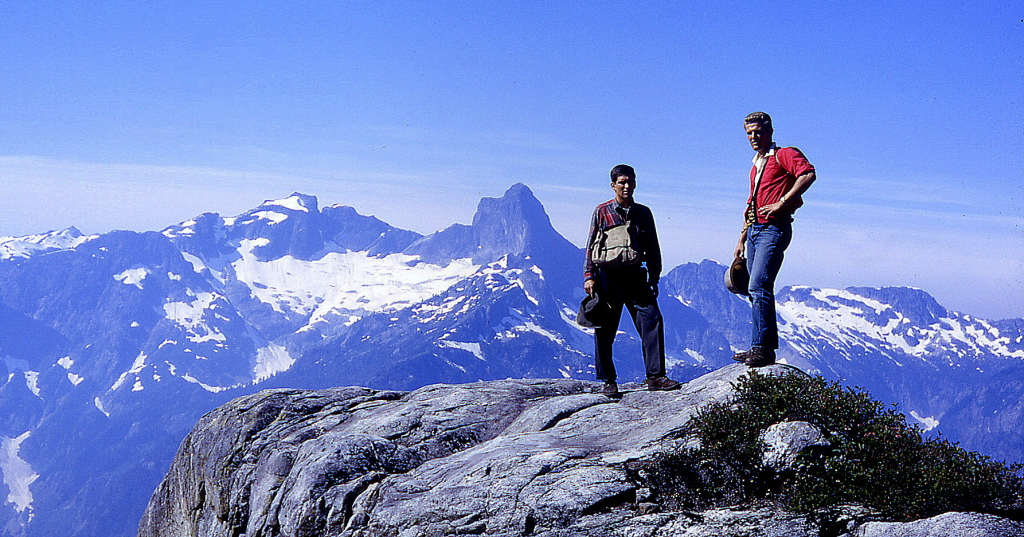
The memories I have of John Roper introducing Tex & Monte Steere to the ways of the “mountains” go way back. I do remember our 1st ascent of Trappers Peak by Newhalem in 1963. A real scramble but totally worth the views back to town. I recall taking some 8mm movies of Uncle Jack Roper flashing a mirror toward us from their house in Newhalem. We also managed to do a full flip off a snow cornice at the summit. John of course made sure that every trip was exciting and challenging.
Another thigh burner was the trip to “Cousins Peak,” above Diablo Lake. Appropriately named as John and his cousins (Tex & Monte Steere), and their kids and their cousins (Toby & Dusty [absent on this climb] Steere, and Grady & Nigel Steere), were on the ascent with John. A total bushwhack up major vertical off the North Cross State Highway, until we reached timberline. Not an easy 1st day, but totally worth the effort. The descent was just as steep, but not quite as physical as the upper.
Too many other climbs to mention. Lots of pictures, but none of the digital variety. I’m not up on scanning photos into the computer, but I do know that John can put his hands on his copies for sure. I’m hopeful I can make the big function in January, but if I can’t John, I can tell you that turning 60 is just another milestone for you. I know you’ve got lots of good years left in those legs of yours. Maybe I’ll make it on another “easier” jaunt with you one of these years, OK? In the meantime, keep up the challenge for the rest of us. There’s no stopping you now, for sure.
Best to you always.
Your cousin…Tex Steere
David Stonington
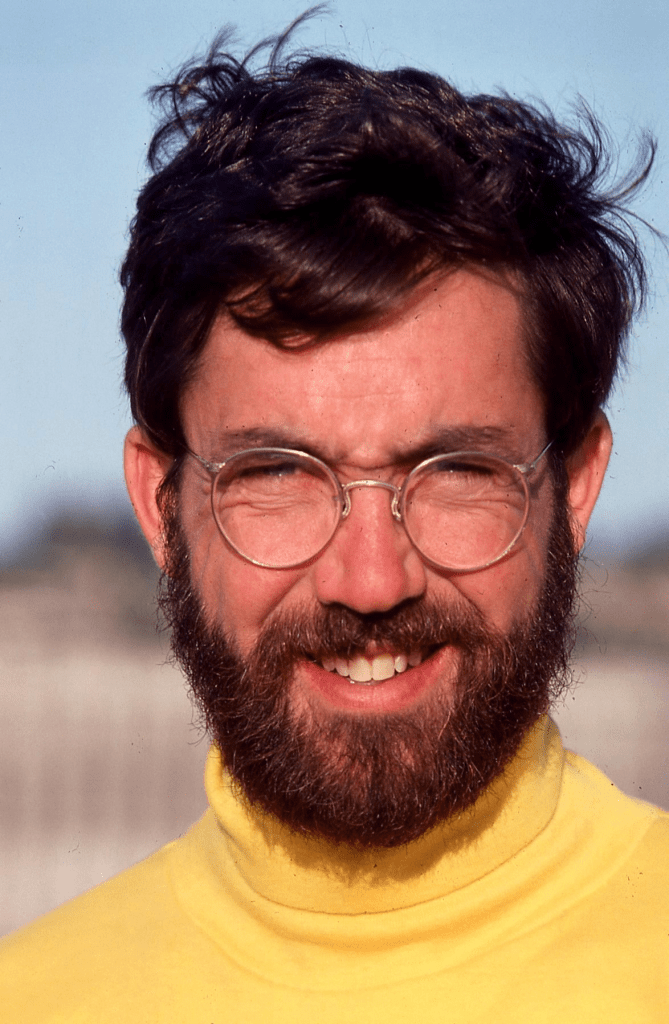
Dear John,
This is not the usual “Dear John” letter. But it is a letter written from the heart. On this your 60th Birthday, I simply want to say thanks for the great memories. I will never forget that first glimpse of the Picket Range from the top of Trappers Peak or the moonrise as we ate dinner at the base of Pyramid. You have been the architect of many days of joy in my life.
There were definitely moments. How about that cartwheel fall you took on the ski down Mount Saint Helens (before it blew)? From then on I knew how tough you were. And being tired goes with the territory. The tiredest was in and out of the Distal Phalanx (the First Ascent and the Tyrolean Traverse made up for it).
There were so many highlights that they defy counting. A bath in warm water in the Garden of Eden certainly comes to mind, with thanks to Monte’s heart for waiting a few weeks before needing a visit to the repair shop. The summit of Elk Lick Mountain can be seen from my office and I often find myself reminiscing by scanning the summit with binoculars.
So Happy Birthday Dear Friend. Thanks for everything. Best wishes for many birthdays to come.
Dave Stonington
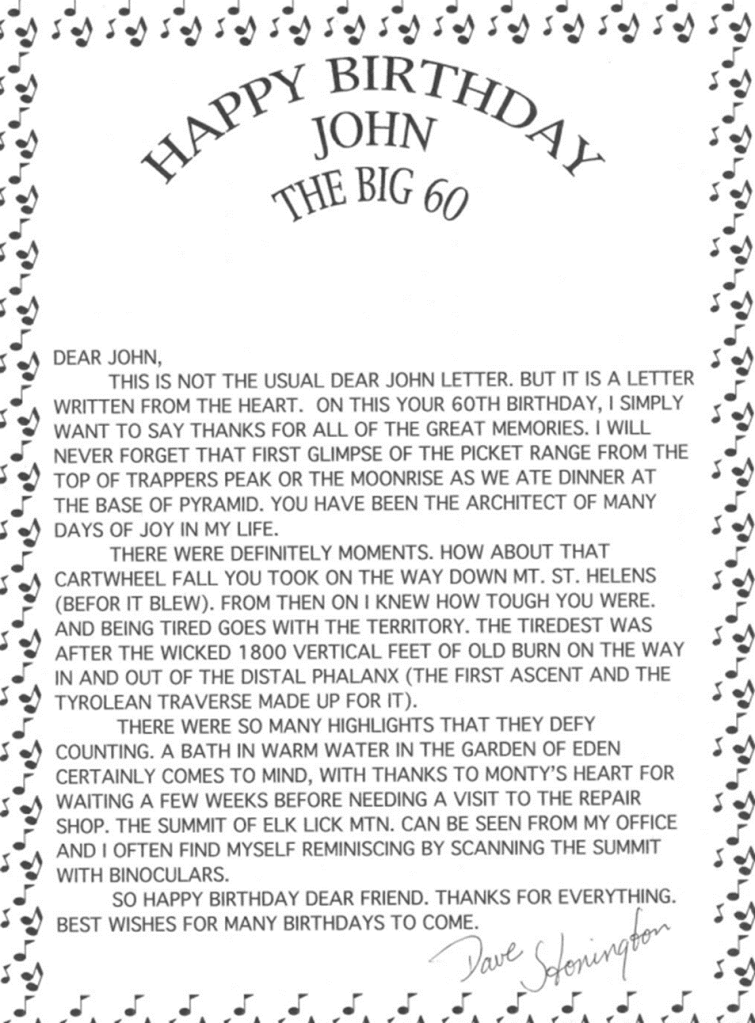
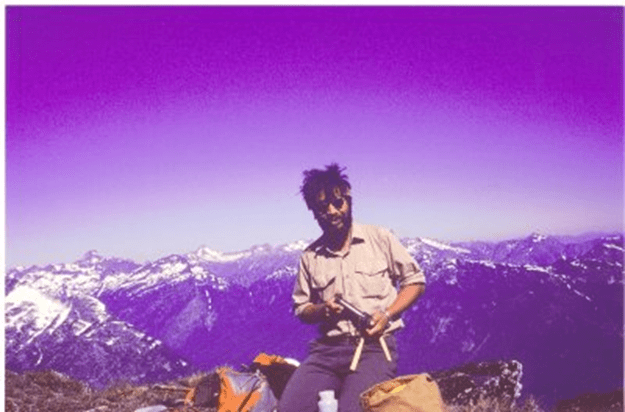
Jani Stonington
I am sure my stories of climbs with John are nothing unusual. (That is, of course, to anyone who’s climbed with him or John himself.) “Others” looking on might not agree. Most people stick to trails, generally not John. Most people take the simple route down, not John. Most people avoid the black clouds of flies, not John. Most people stick close to their comrades going downhill, not John. (But, then most people don’t glide downhill quite like John.) Oh yeah, most people will climb something twice, not likely John. So, I know all this. One might ask, “Why do you climb with John?”
For one thing, I can beat him to the top. That is really satisfying. Without a doubt, he had taken me to great places. I have noticed he designs my climbs just tough enough to challenge me. There are only a few PVC’S per climb. (That is, heart flip flops.) There is just the right amount of sore quads and enough calorie expenditure to earn a real meal and an ice cream cone. Bottom line, my summers are not complete, they are lacking, they are empty, and they are pallid without a climb with John.
So, John, thank you for including me in your adventurous, loving exploration of Washington and her mountains. May you have many great years of more of that. And, believe it or not, all teasing aside, I hope to have many more adventures with you in those coming years…
Jani Stonington
Mike Torok
I met John about 10 years ago and have been on 27 outings with him, some multiple day but most have been one day. Our first was a Mountaineers outing to Crosby Mtn (4/10/94) led by Kal, and the last was Mt Anderson-West peak last Fourth-of-July 2003.
I learned the hard way with John in selecting a destination. If one joins his outing, accept the fact that John picks the trip destination 99% of the time. I have also learned John does not repeat destinations. So to find an interesting summit get together these days is almost impossible (he’s done everything). I would say John has loosened up a bit in the last few years in sharing his “secrets” on route descriptions, and that’s been really appreciated. His numerous descriptions in Red/Green Fred have been of great help too.
One outing that was memorable with John and Jeff Howbert is Twin Peaks up the NF Snoqualmie River on 3/17/96. We started near first light. After walking a road for a short distance, we headed off-trail upslope and soon were greeted with lightly snow-covered jack-strawed trees from a Weyerhaeuser thinning. This seemed to go on many hours for just 800 feet of gain. Then we reached an old logging road that led us to a drivable road.
Where did this come from and why didn’t we use this for the approach? Shortly we were at Loch Katrine Lake. We had hoped the lake would be snow-covered so getting to the other side would be easy. John led us, thrashing through heavy brush (he is not slowed by brush) for an hour, to get to the far side of the lake. Next it was up thin snow-covered very steep brush forest. More slow going. We eventually reached good snow and the summit very late.
I should mention, the rule is that the turn-around is the Summit. But in this case going back the same route would have us in the dark thrashing through bush in the dark. John suggested a direct descent to Sunday Creek to pick up the trail to follow a known route out. The direct descend to Sunday Creek went well. However we reached the creek around dark and the trail was no longer maintained. This was not quite what was planned. We eventually found good trail and were able to follow it with headlamps.
One challenge remained, crossing Sunday ‘river’. After that wet experience, a couple hours later we were back to the car safely. This is the kind of trip I wish to avoid. John chocked up two more fine summits on his list.
Happy Birthday John. Wishing you many more Birthdays and many more wonderful outings.
Mike Torok
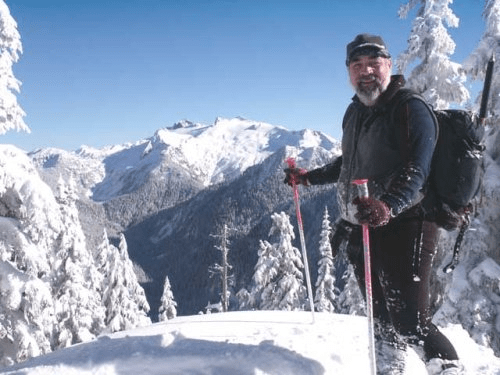
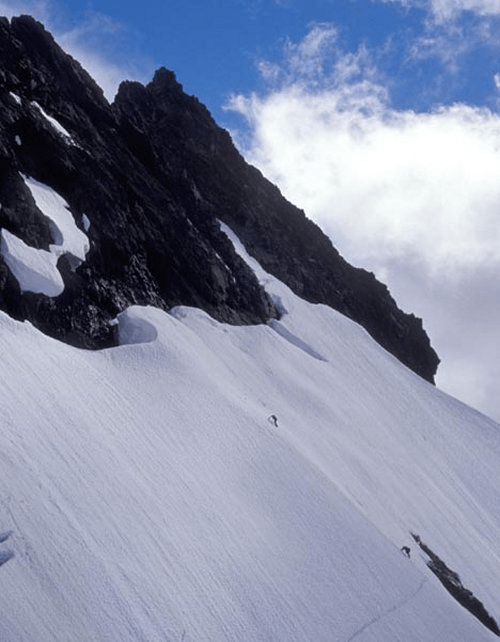
Diane Zehnder
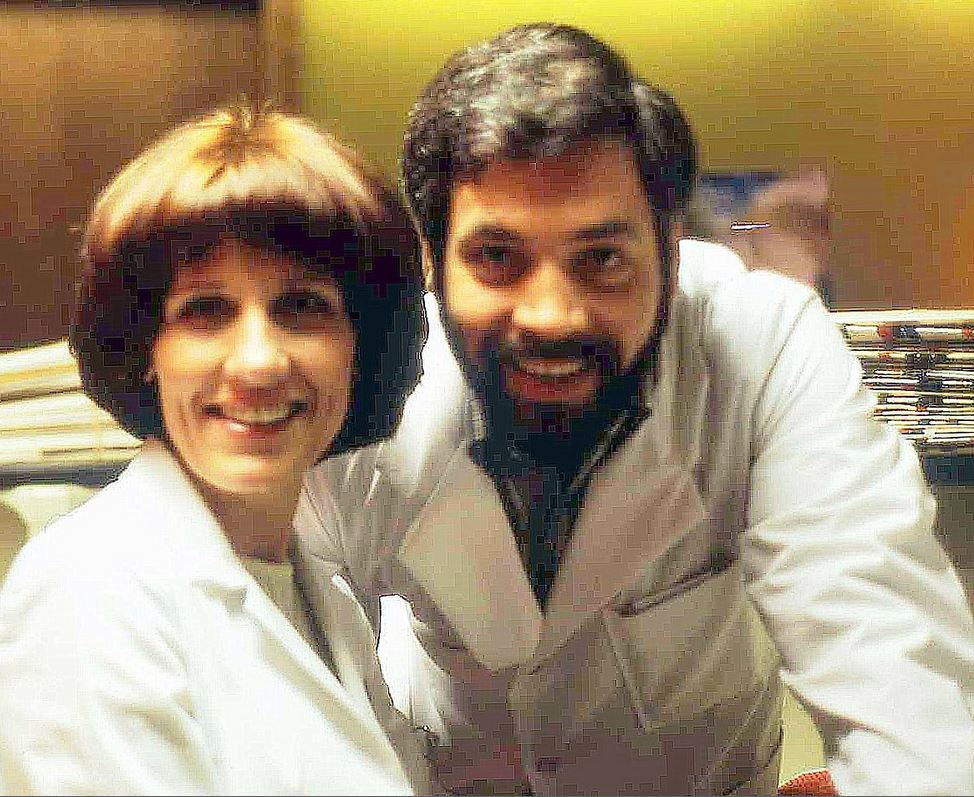
My dear John,
Wishing you a most happy and wonderful birthday. There are so many fun memories of the past 23 years and all of them are so good. Let me simply say I have always held you in high esteem. You are the best diagnostician in the whole world and a splendid physician and all of those dang little 4X6 blue cards were proof! You have a memory like a steel trap and your wonderful wit and sense of humor can get you through anything and endears you to all of us. I can always count on you being the “real deal.” You have accomplished so much in your life and hopefully can look back with contentment and look forward to many more years of everything you love.
You make the best darn Baklava in the whole world and have started many of my years out with a “whistle” -thank you for both.
I am sooo glad you are finally catching up to me! (I don’t have birthdays anymore.)
I truly wish you the best of everything in the many years ahead. You are a wonderful friend and I gratefully cherish that.
Fondly, DZ (John’s registered nurse at Redmond Group Health)
Sue Zook
Happy Birthday John!
Just a reminder of how far you’ve come since this party…I think we are about 4 years old in this picture in 1948. Who would have known what a wonderful life we’d live on the Skagit and that 56 years later our Skagit family would still be so close and special. We are a rather unique group! There are too many memories to start listing, so will just say “60” is a great time in my life (I celebrated with a little “tattooing”!) and now that you, the baby of our group has finally joined the rest of us, I hope you do something a little wild and crazy too! Most of all enjoy your day!
Love and Hugs!
Sue Soder Zook

